
What is Carried Through Elder’s Hands by Lauren Facey (she/her)
DOI: https://doi.org/10.5281/zenodo.21402883
Published July 19, 2026.
Keywords: memory, diaspora, identity, food ecologies, intergenerational knowledge;
What is Carried Through Elder’s Hands
Grandad, (Powder-tail) - age 85
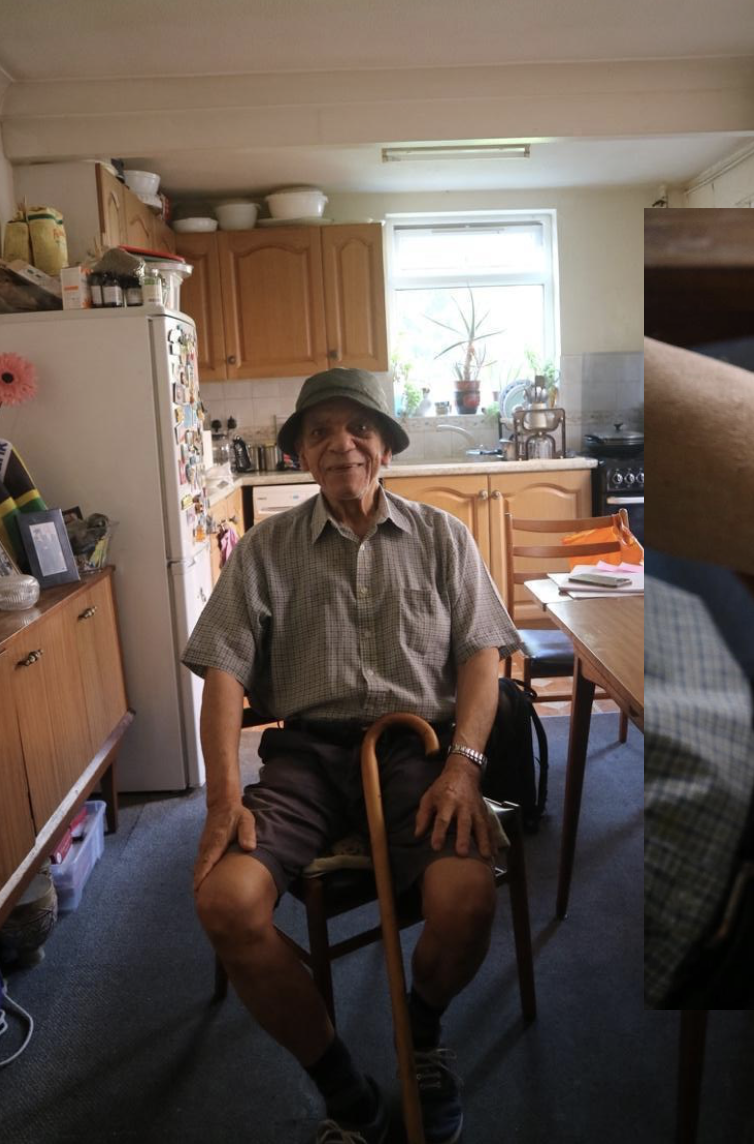
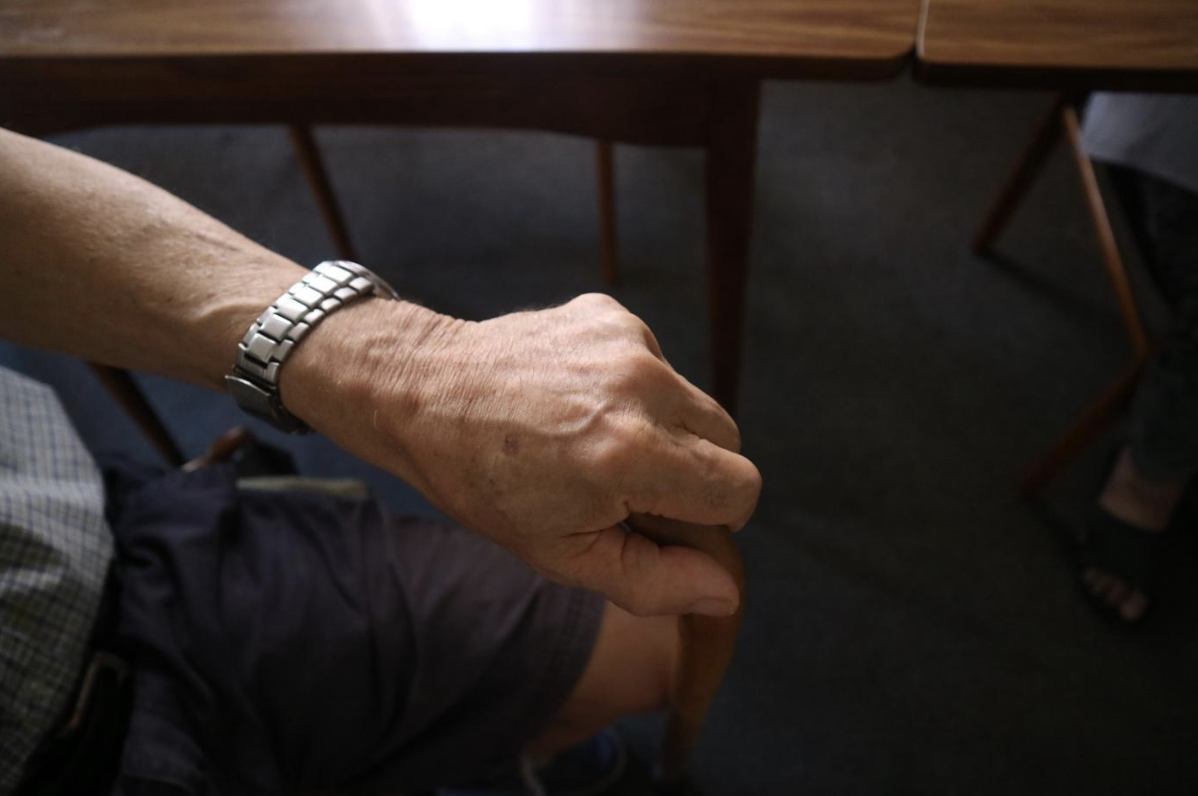
This is my maternal grandfather, who has been a stable presence in my life since before I can remember. He shares memories and stories with me of growing up in an agricultural, community-orientated part of Jamaica. About assimilating to life in the UK in his early twenties and creating a life in London over the past sixty years. To me he is one of my main points of reference to Jamaica and is one of the reasons I understand and respect Caribbean culture so highly. When I bought him back three pears⁴ from Jamaica, he took the time to wrap each one in a tea towel⁵ and told me how this was the nicest pear he'd had since he was a boy. His hands, now broad and pale, sit firmly on top of his walking stick inherited from his aunt. He is a man familiar with the runnings⁶ of the London Underground, and who later took up a career as a local barber. His stories speak to the labour, memory and care of a generation who migrated abroad from the West Indies to create a better future for themselves and their families.
Drinking Porridge
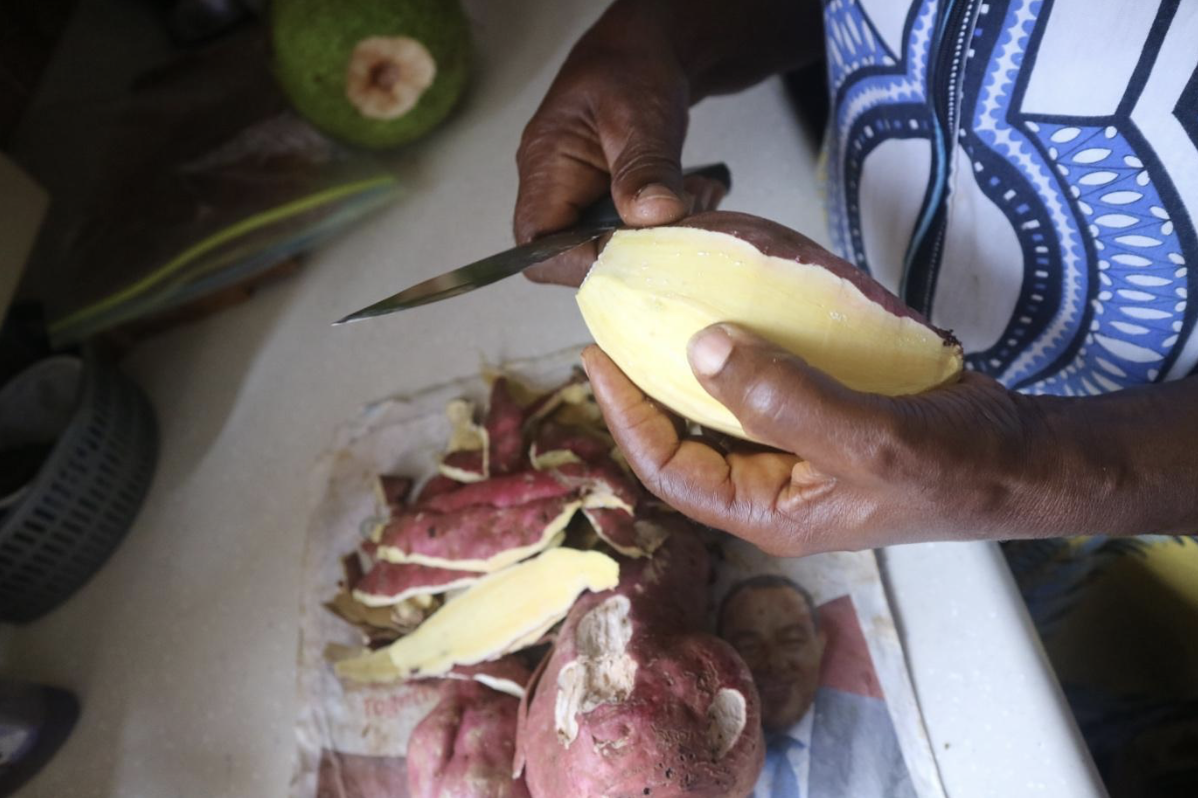
Why “drinking porridge?”, you ask. “Surely porridge is something you eat”… I agree entirely. To this question, I quite honestly have no answer. For some reason within this diasporic context, which involves anyone who is a seasoned Jamaican porridge-drinker, one should be able to relate to the fact that the verb is ‘to drink porridge’, not to eat it. This could be a textural thing, however there is a vast array of porridges that are cooked and appreciated in a Jamaican household (in the 6 weeks I was in Jamaica this included: cornmeal, arrowroot, coconut, oats, peanut and green banana). By textural, I mean that there are many different varieties of porridge, all with different thicknesses, textures, and flavours. The porridge I prepared for my grandparents one Sunday morning, the last time I would see them for a while, was oats porridge.⁷ This is the same porridge my Grandma would have cooked me when I was growing up. It also happens to be the exact same kitchen, on the same stove, same pots and the same table that I would have eaten at the entirety of my childhood. This is to say that something about this practice of porridge making felt extremely full circle. I could relate to the anticipation of waiting for the bowl to get to the table and watching the nutmeg-scented steam warm your face as you wait for a spoon to be handed to you. The three of us sat together once I had plated our breakfast; starting from the edges where the porridge is cooler. Then the slurping ensued. My grandparents, both over eighty-five years of age, strictly slurp their porridge; I believe this is where the ‘drinking’ aspect of eating porridge takes hold. After twenty-eight years, I still refuse to slurp my porridge.⁸ But at least in that moment I knew they were content – the louder the slurp, the more one is enjoying their meal.
How to read this text:
Dear reader,
I do not want this to be an easy, simple, digestible read. It is meant to be messy. I’d like you not to read it linearly. Look at the pictures, then go back and look at them again. Get lost in the images of people’s faces; look at the wrinkles near their eyes, look at the scars on their hands. All these details are part of the story I intend to share with you. These stories are about the real, complex lives that I want to pay homage to.
The collection of words and photos that you’re about to engage with stem from an eight-week project I carried out in St Elizabeth, Jamaica and London, UK in the summer of 2025. It centres ‘careful’ research as my guiding principle; research that prioritises relation and care for both participant and recipient of the process. The aim was to explore how Jamaican food and land practices transmit knowledge and care across generation and migration.
I approach this research as a second-generation Black-British Jamaican, whose relationship to the island is shaped by memory, inheritance, and longing.¹ To me this feels like an inner tethering to Caribbean culture. These aspects relate to my positionality as a diasporic researcher whose presence shapes what knowledge becomes visible, shared, or withheld. My presence in the field was therefore never neutral. What was clear was that I was not (and will likely never be) perceived as a ‘true Jamaican’. I was often positioned as “the granddaughter”, “the foreigner”, or “the hinglish gyal”², and these kinds of identities shape how people spoke to me, and the kinds of knowledge they shared with me. Simultaneously, it is undoubtable that I was inherently Jamaican. The sheer glee of being able to eat fresh Escovitch fish and dumplings at the beach, the feeling of the sun on my skin, the familiarity of reaching for a Red Stripe beer whilst humming along to Beres Hammond – all quintessentially Jamaican-specific experiences. And yet, there were things that would not qualify me as anything more than a British Jamaican. The way I walk, the way I talk, and the way I present myself. Thus, my positionality shaped how my research participants viewed me. At the same time, my diasporic distance enables certain insights. Moments where practices taken for granted locally appeared to me as deeply meaningful, fragile, or in transition. Acknowledging this positionality is central to my approach to this work. It clarifies (at least to me) that this research is neither objective nor detached; it is rooted in relation, responsibility and the ethics of return and care. Returning to Jamaica, after twelve years, as both researcher and family member placed me in a position of proximity and distance. Both at home, yet not entirely.
My true wish is that the underlying sensation of this read sits with you long after you have finished the last page – maybe something about it may disturb you slightly or leave you with a tingling sense of dissatisfaction. This topic applies to each and every one of us in different ways. I implore you to remember this.
As I think stories are stronger when they’re multimodal - text, image, sound and emotions intertwined - I have paired eight songs that I recommend you listen to whilst sifting through the words on the pages. These songs are all related to specific moments and memories from throughout the course of this research.
In the referred sections please listen to:
Dear Reader: Alton Ellis’ I’m Still in Love
Granddad: Bill Wither’s Lean On Me
Drinking Porridge: Beres Hammond’s I feel good
Ms. Denton: Chronixx’s Smile Jamaica
Going Back Home: Eva Cassidy’s Songbird
Lauren: Bob Marley and the Wailers’ Waiting in Vain
***
To learn again you really have to listen.
— Robin Wall Kimmerer ³
¹ My positionality is formed through what Avtar Brah (1997) describes as diaspora space – a site where multiple histories, attachments, and identities coexist, rather than simply one or the other.
² Jamaican patois for “English girl”.
³ Braiding Sweetgrass: indigenous wisdom, scientific knowledge and the teachings of plants by R. W. Kimmerer, 2006.
⁴ Pear is another word for avocado in the Jamaican vernacular. Coming from the term ‘avocado pear’.
⁵ This continues the ripening process.
⁶ Runnings literally means the way that things are run, or an understanding of things.
⁷ Ingredients included oats, milk, coconut sugar, nutmeg, bay leaves - a recipe that has slowly diffused through generations of my family, I’ve picked it up from my grandmother.
⁸ For me slurping really qualifies you into elderly status of being a porridge drinker.
⁹ a colloquial expression for Jamaica used by my grandparents, but has been theorised by Avtar Brah a figurative source of origin or home.
¹⁰ Following Gilroy’s (2003) insistence that diaspora moves through routes rather than roots, andGlissant’s (2009) refusal of origin as a singular point of belonging, I approach return here not as a conclusive act but as a (em)bodily negotiation: a series of encounters through which belonging is rehearsed, questioned, and sometimes briefly felt.
¹¹ A common experience for diasporic communities.
¹² In diasporic communities where cultural practices are altered in a different country, often the practices are adapted or erased between generations.
¹³ “Refusal is a heavily theorised time that is understood by some as the rejection of a particular colonial-modern understanding of human (Wynter, 2003), and is understood by others as the deconstruction of the social imaginary of the Caribbean narrative, usually tied to capitalist and colonial relations to land (Kempadoo, 2016).
¹⁴ There is a whole host of literature that has labelled the everyday practices of rural minoritised communities as ‘backward’ (see Asad, 1975; Wolf, 1982) or ‘nostalgic’ (see Clifford, 1994; Brah, 1997).
¹⁵ Glissant’s (2009) term opacity here stems from his argument that cultures and individuals have a right not to be shared or translated in their totality.
¹⁶ See Mintz (1986), Trouillot (2002), and Kincaid (2000’) to elaborate on these themes.
Ms Denton (Ms D.) - age 83
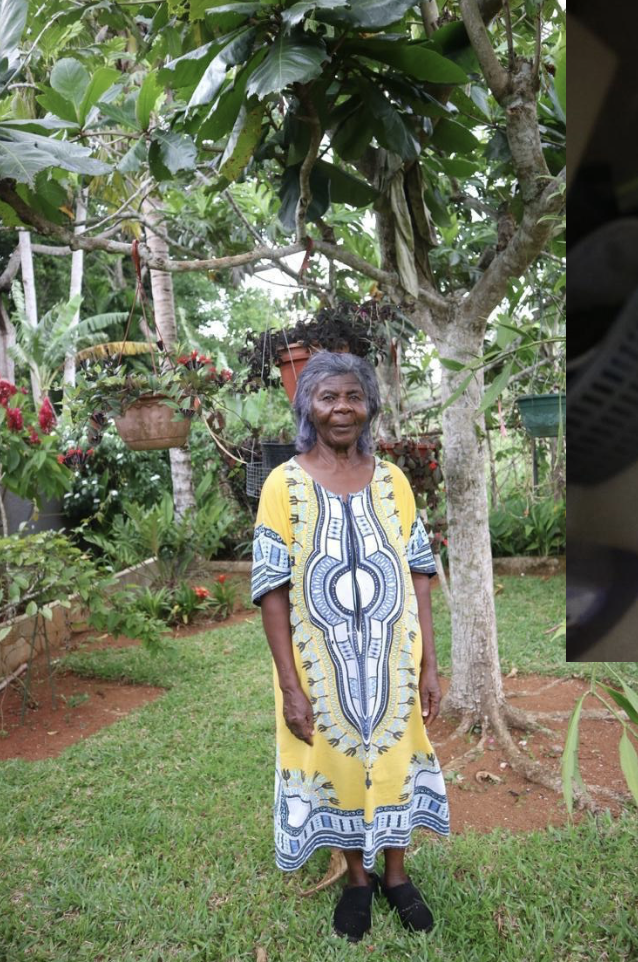
Ms Gurzelle Denton (introduced to me as Ms D. or Ms G.) is a neighbour of Cleo and Pinto's (the aunty and uncle I stayed with the entirety of my trip). I can't exactly recall what the reason was behind our first introduction, but it was the start of a chance for us to share and cherish each other’s company. Ms D.'s garden and general awareness of all things plant-related is a core part of her as a person. Instead of sitting in the living room, we did a casual tour of her garden whilst she caught us up on how she was doing and what her latest garden interactions were. Quite honestly, I felt quickly that she could have been one of my grandma's friends. Not least because of her British accent, but because although she was born near St. Thomas, Jamaica, she had spent the majority of her life in London where she had raised her kids and fulfilled her working career. I remember being deeply tickled by the brown "Southwark Council" bin, that resided behind Ms D.'s gate. She had shipped this over with the rest of her belongings from the UK when she came to Jamaica to retire with her husband. I watched her maneuvering through her yard, stroking leaves and checking the moisture of the soil, picking avocados. Her hands harnessed the knowledge of an encyclopedia.
Going ‘back home’⁹
The Jamaican diasporic experiences that I embody shape the questions at the core of my research. By placing rural Jamaica in relation to Black-British Caribbean life, the project examined not just the movement, but the politics of transmission (i.e. how practices endure, adapt or fade) within a transnational landscape shaped by colonial history, economic precarity, and the intimate labour of cultural reproduction.
For those of us shaped in-between — e.g. a British Jamaican, raised in London but tethered by memory, taste, and family to elsewhere — return cannot be understood purely in geographical terms.¹⁰ To begin with I have always felt Jamaican (to some extent). The reality that I was born into was shaped by Jamaican understandings, and so this is my frame of reference (although I have only ever been to Jamaica twice in my lifetime). I have an affinity and connections with the country; returning is inevitable. The degree to which I return is what I am exploring.
When going “back home” a variety of hesitations erupt. Navigating Jamaica safely and in a functionable fashion could take a lot of work; I would be subscribing to a new environment, where the people I would be surrounded by would, at least to some degree, see me as an outsider or “a foreigner”.¹¹ I would, always, be someone with access to commodities and environments that they may not have access to. However, this does not mean that I am not interested in working with or on issues related to building or supporting Jamaica and its communities. Nor does it mean that I would not consider moving there at some point in my life. These reflections bring up the tensions and obstacles to knowledge transmission across geographies. Namely that through processes of migration, cultural continuity (as in one set of knowledges), becomes disrupted. Or put differently, the lived realities of a British Jamaican twenty-eight year old, and Jamaican twenty eight year old are worlds apart. For example my craving for fresh mangos that grew off the tree during my field work, was something the locals took for granted. The inability to bridge this gap is a result of colonial histories and the impact of displacement. An example of how memories and relation become warped across geographies and over time.
However, I would like to stress that I will always identify with Jamaica and will spend the rest of my life in relation with its people and cultures. This conclusion demonstrates that returning is both a method and a metaphor: it reveals what endures, what has shifted, and what is still possible for future generations. I have posited that diasporic knowledge is an uneven and relational process and I have presented some of the obstacles to its reproduction.
This text was never solely about plants or food, but about knowledge, care, survival, relation and belonging in the aftermath of colonial and capitalist pressures. I am committed to Caribbean ways of knowing, some of which is hosted with older generations and perhaps not always passed down (at least in the diasporic context).¹² Simultaneously my work links to the idea of refusal.¹³ The refusal to accept the dismissal or erasure of diasporic knowledges as something that belongs in the past.¹⁴ Although intimate, my work does not strive to explain or romanticise Jamaican cultural life. Instead, I have attempted to share how much of Caribbean understandings are derived through relations that simply cannot be explained through words – i.e from the soil, an expression, or silence. These relations do not require full transparency; opacity¹⁵ here is a key ingredient for the survival of diasporic knowledges. The moments I have spotlighted are linked to legacies of struggle, resilience, and adaptation.¹⁶ More importantly, they deserve to be protected. Through the framing of embodied knowing - that is my approach to treat gardening, storytelling, and cooking as affective knowledges - I have focused on how people reproduce knowledge. This research speaks to the survival of minoritised knowledges in the wake of colonial disruption. I position this work as restorative, reciprocal and relational. Foregrounding the importance of nourishing and careful research, conducted by and amongst people in diasporic communities, it’s practicing knowing when not to extract.

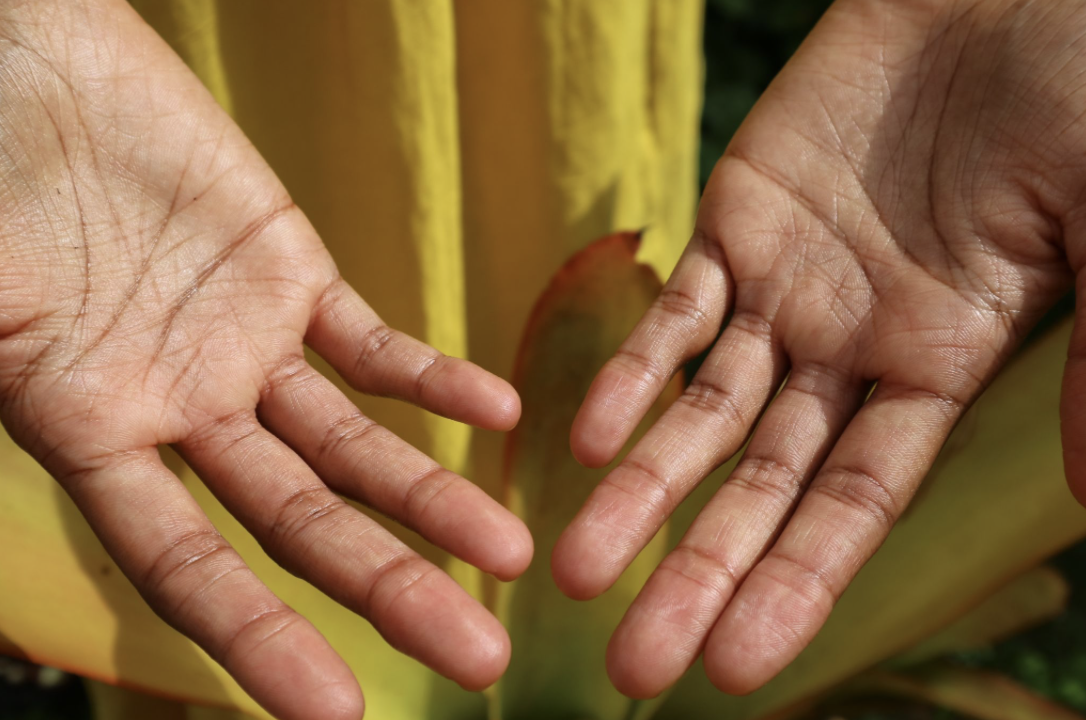
Lauren (Me) - age 28
I can only hope that this paper in some way nurtures the hearts of those who read it - academics, farmers, policymakers, and elders alike. As someone raised within this Caribbean orientation, I care deeply about the practices I have started to unpack in this text. Small details that are intrinsically intergenerational remain the nexus of what I have tried to foreground in this work. Why? Well because, this is how you keep these cultural legacies alive. These stories are derived from real-life histories and epistemologies that deserved to be cherished.
I want my carefull research to be equally restorative for me, my participants and potentially my readers. I hope that some part of this remains with you, long after you have taken in the last word. Thank you for listening.
SOURCES CITED
Published Sources:
Asad, T. (ed.) (1975) Anthropology & the colonial encounter. Reprint. London: Ithaca Press.
Brah, A. (1997) Cartographies of diaspora: contesting identities. London: Routledge. Available at: https://www.vlebooks.com/vleweb/product/openreader?id=Goldsmiths&isbn=978020 3974919.
Clifford, J. (1994) Diasporas. Cultural anthropology, 9(3), pp.302-338.
Glissant, É. (2009) Poetics of relation. Nachdr. Ann Arbor: University of Michigan Press.
Kempadoo, R. (2016) Creole in the archive: imagery, presence and the location of the Caribbean figure. London New York: Rowman & Littlefield International Ltd (Critical perspectives on theory, culture and politics).
Kimmerer, R.W. (2013) Braiding sweetgrass: indigenous wisdom, scientific knowledge and the teachings of plants. New York: Milkweed Editions.
Kincaid, J., 2000. A small place. Farrar, Straus and Giroux.
Mintz, S.W. (1986) Sweetness and power: the place of sugar in modern history. New York: Penguin Books.
Trouillot, M.-R. (2002) ‘Culture on the edges: caribbean creolization in historical context’, in Axel, B. K., From the Margins. Duke University Press, pp. 189–210. Available at: https://doi.org/10.1215/9780822383345-007.
Wolf, E. (1982) Europe and the People without History, University of California Press.
Wynter, S. (2003) Unsettling the coloniality of being/power/truth/freedom: Towards the human, after man, its overrepresentation—An argument. CR: The new centennial review, 3(3), pp.257-337.
Co-authored Knowledge:
Ingredients included oats, milk, coconut sugar, nutmeg, bay leaves - a recipe that has slowly diffused through generations of my family, I’ve picked it up from my grandmother.
Common Knowledge:
Collective knowledge within the Jamaican community and patois speaking people. Multiple sources over time. St Elizabeth, Jamaica. London, UK.
Pear| Another word for avocado in the Jamaican vernacular. Coming from the term ‘avocado pear’.
A common experience for diasporic communities.
For me slurping really qualifies you into elderly status of being a porridge drinker.
In diasporic communities where cultural practices are altered in a different country, often the practices are adapted or erased between generations.