
The Sea is History by Rosa Prosser(she/her)
DOI: https://doi.org/10.5281/zenodo.21207643
Published July 19, 2026.
Keywords: memory, time, history, fluidity, cyclicality, global interconnectedness;
The Sea is History
In the beginning
there was rhythm
and rhythm gave birth to waves
and waves gave birth to shore
shore
our floor
our door to more
cockles, winkles, mussels, clams
crunch of shells in the sand
crunch of shells beneath our feet
crunch of shells rock smashed to eat
The sky breathes birds
the sea breeds curves
kittiwake curlew plover knot
great auk razorbill guillemot
Watch a wave lift
heavy with fish
salmon sea trout pollock bass
mackerel herring sand eel wrasse
Watch a wave lift
bring fish to the shore
feel the sand sucked
as the waves draw
I: THE SEA IS HISTORY 1781
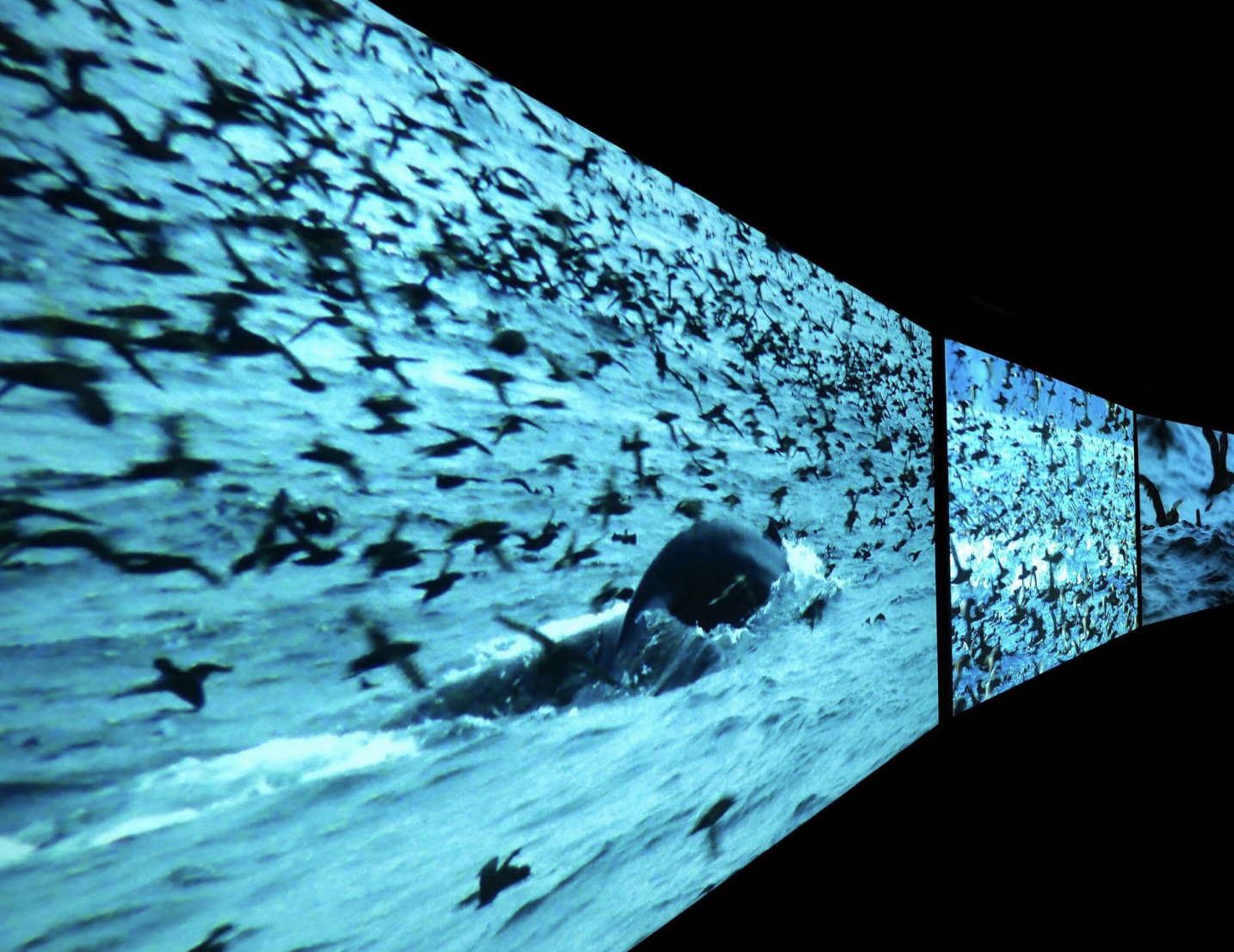
How are we to write the history(ies) of the ocean in relation to humanity? The history(ies) of humanity in relation to the sea? How are we to write a history of a body of water (human or aquatic) that allows for the dynamism of a fluid in motion? A history of the fluid-body that does not fix, frame, contain? Dancing at the edge of these questions, we have John Akomfrah’s Vertigo Sea – a three-channel, 7.1 surround-sound video installation, first shown in 2015 at the Venice Biennale – an ‘epic mediation on the ocean and its role in human history’²; ‘oblique tales on the aquatic sublime’³.
Rather than give us a history of the ocean, Akomfrah’s work posits a more interesting question: is the shape of history the sea? To read ‘The sea is History’ in the symbolic, is to understand history akin to Stuart Hall’s ‘Moments,’ the clustering or coming together of disparate elements (stories, events, habits, rhythms) into (albeit brief, precarious) distinct discursive formation:
II: VERTIGO; ‘WHIRLING’ ‘TURN’
If history is the sea, how do we move through it? In his essay, Anticipation of a Remembrance: The Politics of Continuity in Indigenous Found-Footage and Archival Cinema, Mike Metzger proposes ‘wayfinding footage’ – rather than ‘finding’ footage, you find a way through⁶. Similarly, Akomfrah uses montage as his navigation; through fast editing we are carried with him – never quite landing, churned up in the swell. This is somewhat of a disorientation. Our bodies cannot comprehend the scale of the ocean⁷, and the three channels work to destabilize us further: our position is rocked as our eyes strain to catch the cycle of images across multiple screens.
We have two eyes, so three panels are always beyond us.
However, a question: does this form allow us to thus look (turn) away?
Upon first reading, a ‘vertigo sea’ might suggest a vertiginous effect in the human-body-viewer. However, alongside Povinelli’s ‘turning’ of the earth, we can (re)consider: is it in fact the sea that has vertigo? Is it the sea (in addition to ourselves) that is turning away?
If history is the sea, on what ground are we standing? Through his selection of images – birds and clouds and aurora borealis and bats – Akomfrah penetrates both ocean and atmosphere. In holding the viewer in suspension above the ocean, we are invited to entertain a certain ‘deterrestrialization of thought’¹⁰ as we are confronted by the insurmountability of both history and sea.
To model history as the sea is to suggest that the ‘ground’ of history is unstable: there is of course no solid ground to stand on. Instead, we are particles in suspension-motion. This ‘ground’ may resist an idea that the backdrop of human history is the stable, unchanging earth upon which Man makes his stage. Rather, to move over-through-under it, we must learn to swim.
IV: THE SEA IS HISTORY 2025
Fish
Shore
Fish
Shore
Fish
Shore
Tonight we eat fish,
tomorrow we leave
The Last Supper, Dave Prosser (2025)¹
‘There is of course […] no ‘empty, homogenous (Western or global) time.’ There are only ‘the condensations and ellipses,’ the endless discrepancies and displacements, the syncretisms, mimicries, resistances and translations.’⁴
Replace ‘time’ for ‘water’ and you have a description of the ocean.
Taking fragments of oceanic histories as well as his own reconstructions, Akomfrah leaks a history of the ocean outside of its archival container. By treating all images equally, a suspension is created — an act of ‘insisting on trying to narrate these different times and places together: not as ‘the same’ – for they are not the same – but as connected; connected, not despite, but through their differences’⁵. Images flash up – I count shipwrecks and whales and Sulphur and photographs – crashing into the next; giving motion to mixture. Sound (rhythm) – a requiem of and to the deep – extends this history beyond the representable: sound bleeds into our bodies and we are implicated.
Vertigo Sea (2015)
Vertigo (n) Pathology. A disordered condition in which the person affected has a sensation of whirling, either of external objects or of himself or herself, and tends to lose equilibrium and consciousness; swimming in the head; giddiness, dizziness.
From Latin vertīgo a turning or whirling round, vertěre to turn.⁸
In Geontologies: A Requiem to Late Liberalism, the anthropologist Elizabeth Povinelli states: ‘Things are neither born nor die, though they can turn away from each other and change states. In turning away from each other, entities withdraw care for each other. Thus the earth is not dying. But the earth may be turning away from certain forms of existence’.⁹
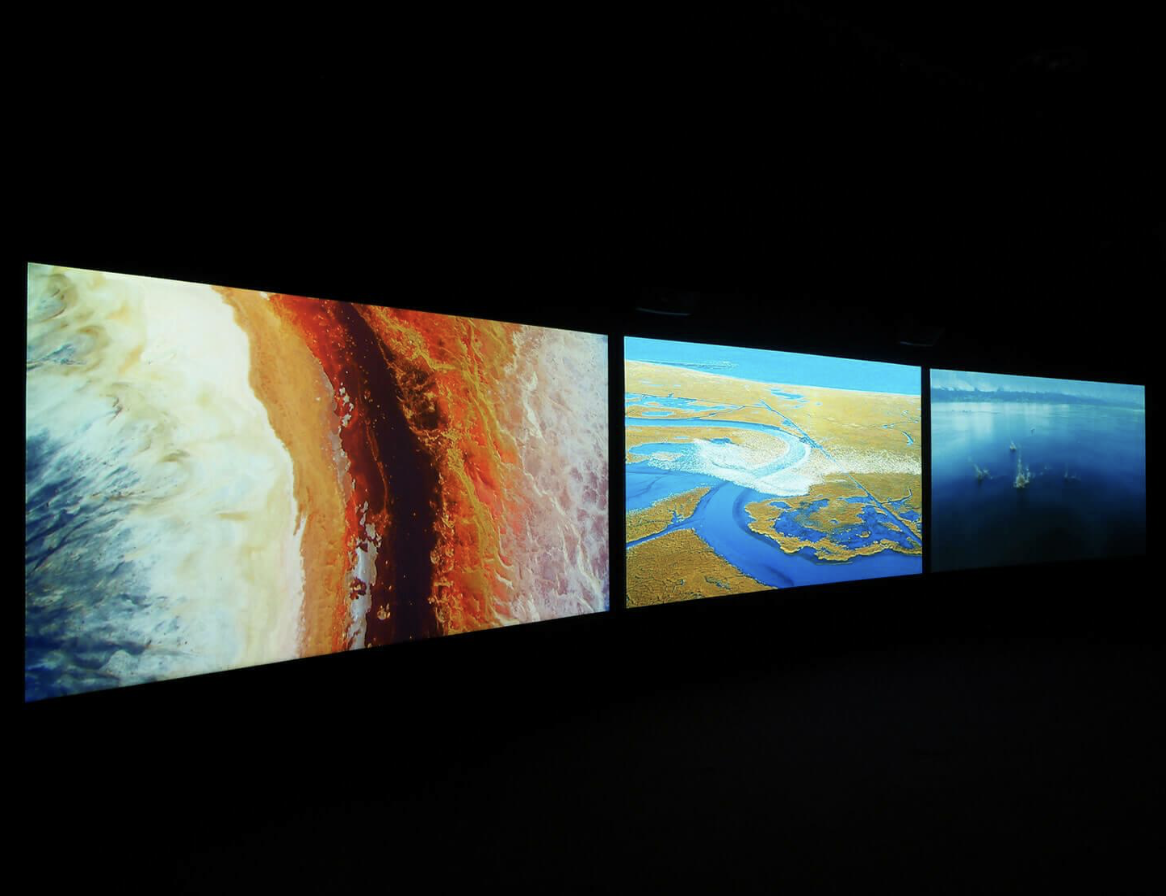
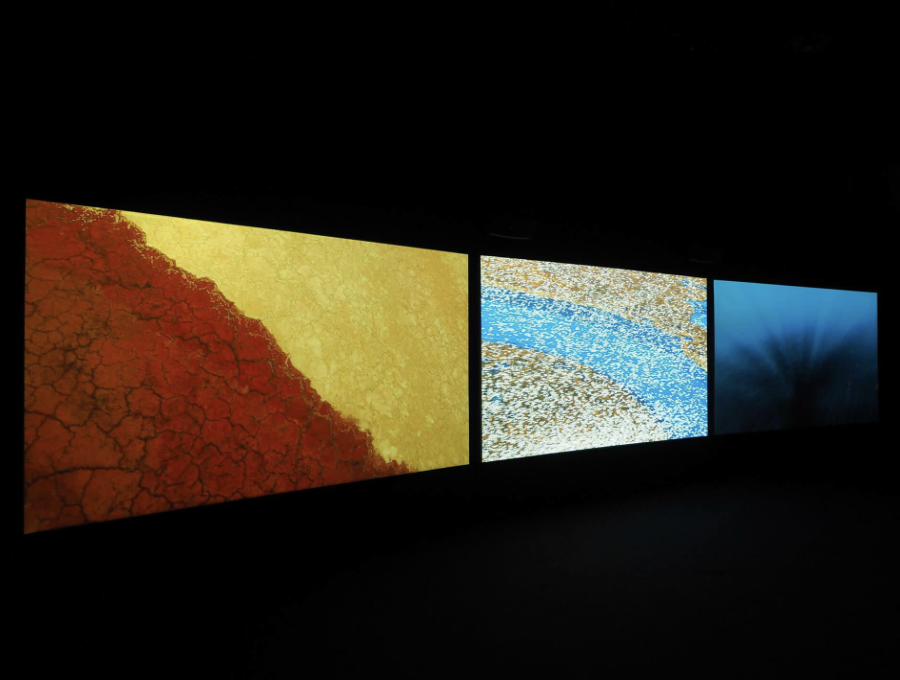
Suspension (n) A mixture in which particles are dispersed throughout the bulk of a fluid.
Suspend (v) Sub- ‘from below,’ pendere ‘hang’¹¹
III: THE SEA IS NOT MADE OF WATER
It is a simple observation, but John Akomfrah’s Vertigo Sea shows us that the sea is so much more than water. The image we are given is a constellation of the bodies and objects and weather patterns and stories that constitute the ocean – ‘ocean’ being more of a gathering than an object in and of itself. Within this space, Akomfrah nudges us to its edges (a welcomed slice of land whilst we develop our sea legs?) and I count butterflies and forests and mountains and decay: the sea is not made of water.
If the Ocean is a Gathering, how do we responsibly
enter, listen, and engage?
If the sea is history, and history is an ocean, to penetrate the surface is to penetrate time itself. But what does this mean for a notion of extended temporality – is it found in depth? Deep time. Opacity?
As light penetrates the surface of the ocean, depth is linked with transparency/visibility.
Any temporality is necessarily tidal, but with rhythm there is still change. This is apparent in the images of decay (I make note of a timelapse of a rotting fish in a forest full of butterflies; on another screen there is an image of a slaughtered whale), suggesting not only a cycle but the darker creep of slow violence. The repeated motif of the ticking clock declares time is evaporating. The traction of the tides is slowing the rotation of the earth; this means that days are lengthening and over epochs, there will be fewer days in a year - in this sense, the sea makes history.
If the sea is history, what about tomorrow?
When we say, ‘the rest is history’ we mean ‘the events succeeding those related are so familiar, well-known, or predictable as to need no repetition; no more need be said’¹². To read ‘the sea is history’ as ‘the rest is history’ is to suggest that we already know what comes next, that the future is drawn out before us in the currents of the deep:
Tonight we eat fish, tomorrow we leave
(but let us not turn our backs on the ocean, on history).

SOURCES CITED
Published Sources:
Akomfrah, J. (2015). Vertigo Sea. LISSON GALLERY, London. Available at: https://www.lissongallery.com/news/arnolfini-to-host-uk-premier-of-john-akomfrah-s-vertigo-sea (Accessed: 11 May 2026)
Chakrabarty, D. (2009). The Climate of History: Four Theses. Critical Inquiry 35(2): 197-222. https://doi.org/10.1086/596640
Hall, S. (2024). Modernity and Its Others: Three ‘Moments’ in the Post-War History of the Black Diaspora Arts [2006], in Selected Writings on Visual Arts and Culture, edited by G. Tawadros. Duke University Press.
Howe, C. (2015). LIFE ABOVE EARTH: An Introduction. Cultural Anthropology 30 (2): 203-9. https://doi.org/10.14506/ca30.2.03
Metzger, M. (2024) Anticipation of a Remembrance: The Politics of Continuity in Indigenous Found-Footage and Archival Cinema, in Temporal Territories: An Anthology on Indigenous Experimental Cinema, edited by SKY HOPINKA et al., COUSIN Collective.
MFA Boston. (2025). Deep Waters: Four Artists and the Sea.
Oxford English Dictionary. (n.d.). Suspend (v.), Etymology. In Oxford English Dictionary. Retrieved June 2026, from https://doi.org/10.1093/OED/1188833654.
Oxford English Dictionary. (n.d.). Suspension (n). In Oxford English Dictionary. Retrieved March 2026, from https://doi.org/10.1093/OED/5526042745.
Oxford University Press. (n.d.). The rest is history, in History, n., P.1.c. In Oxford English Dictionary. Retrieved May 11, 2026, from https://doi.org/10.1093/OED/8345072803.
Oxford University Press. (n.d.). Vertigo, n. In Oxford English Dictionary. Retrieved May 11, 2026, from https://doi.org/10.1093/OED/6381372192.
Povinelli, E. A. (2016) Geontologies: A Requiem to Late Liberalism. Durham: Duke University Press.