
SHIVERS by Ella Frost (they/them)
DOI: https://doi.org/10.5281/zenodo.21402968
Published July 19, 2026.
Keywords: speculative fiction, identity, the black vampire, sharks, monstrosity;
SHIVERS
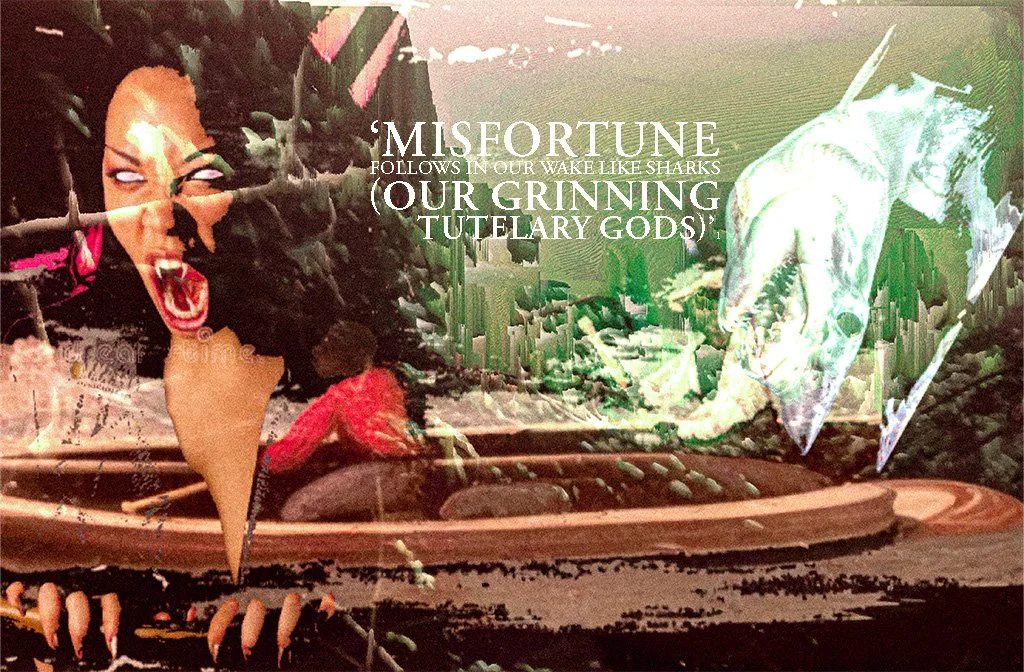
INTRO: DEEP BLUE SEA AND OUR GRINNING TUTELARY GODS
WHY VAMPIRES AND WHY ME
CONCLUDING THOUGHTS
Every now and again someone discovers that sharks’ migratory movements were changed by the Trans Atlantic Slave Trade and they share it on social media. People in my community send it to me repeatedly because of my deep admiration of sharks, and maybe also because I research vampires within a racialised context, and sometimes I am not sure what people remember about my practice apart from it summoning images of blood, teeth, bites, skin and the macabre. To me, sharks and vampires sit together in a bloody messy pulp at the bottom of my heart. I like to think about the unknowable, and beings that are connected to an instinct that overrides social norms, disrupting performativity and bringing the undertow of viciousness into the centre of the conversation so no one can skirt around it. A group of sharks is called a shiver – and just when you think they could not be more perfect, you discover something like that. I think about all the times vampires give humans the creeps by using their preternatural speed to ‘appear’. The shiver is a collective noun, a bodily response to pleasure, fear, cold, dread. It can signal that something is not right – or that something is perfectly placed.
To be honest, I feel absolutely furious about the treatment of sharks, and the red faced masochism that compels grown men to drag Great Hammerheads onto the beach in Florida at night so they can take a picture while getting sloshed on beer.² The sharks rarely survive and the picture lasts forever. I am curious about my righteous anger. I troll the accounts of men that take part, questioning them on their manlihood and then stalking the girlfriends they tag. I am strangely jealous of their connection to the sea, which feels like a way of life even if disfigured in my lefty lofty eyes. It feels an unlikely grouping, sharks and vampires and the transatlantic slave trade legacies, so I appreciate your patience and openness while I try again to put them in conversation with each other.
This essay is, indeed, not my first rodeo. I must admit, I have attempted to put sharks and vampires together before in an experimental film called What I Love Too Much Too Lose.³ The film interweaved young global majority activists fighting for sharks’ rights alongside images of queer joy, 00’s shark films, as well as clips of Buffy the Vampire Slayer (1997-2003) and Princess of the Damned (2002). I hoped it was funny, as me and my friends are funny people. I tried to interlink all these topics to think about how I relate to ecological grief. Narrowing it to sharks, even though I live in an urban metropolis and mostly look at them through my phone screen, it helped me reflect on the question posed by Robin W. Kimmerer⁴ on what aspect of nature we love too much to lose to greed, capitalism and the exploitation of natural resources. In the making of the film I felt like they naturally fit – I was able to use visual techniques that worked the vampire explicitly as a vessel to project and show the rage attached to the cruel way sharks are treated in the fishing industry. This time, I want to know how sharks, vampires, and the transatlantic slave trade crash and meet, see if I can go a level lower, see if they can be reconciled and if so, to what end? What can be extracted, refigured, salted… soothed?
A good place to start is perhaps by thinking about my favourite shark film – maybe you can also think of yours. Deep Blue Sea (1999) is a science-fiction horror which follows a group of scientists in an underwater research facility station. The marine scientists are experimenting on Mako sharks to find a cure for Alzheimer's. One of them, Susan, who is played by Saffron Burrows, goes rogue and secretly genetically enhances the sharks’ brain to extract more quantities of a protein complex, which unintentionally makes them incredibly smart. My favourite part of my favourite shark film is when this becomes clear; an engineer goes to check on the sharks and points a gun at them. They quickly swim backwards out of range. The engineer and the crew, who are watching the encounter via cameras, experience the uncanny and uncomfortable sensation of their place within the anthropocene shifting under their feet. “You’ve taken God’s oldest killing machine and given it will and desire. You’ve knocked us to the bottom of the goddamn food chain”.⁵
This fear is important because a significant change has happened: the imagined stability of a food chain, which I – and I think many others – imagine more like a pyramid, is loped off. It’s the pain of being stripped and ripped, and it’s the tense panic of whiteness biting its nails when thinking of what the Black consciousness⁶ could contain, and what cerebral onslaught they will have to weather next. In the slipping and sliding of irregular plates reconfiguring themselves, I align with the shark. This meaning, I also align with the monstrous.
The smart shark is important in a few ways: in its most symbolic and simplistic, it shatters a comfortable inertia that humans can have with animals, and acts as reflective space for an order that I recognise also does not serve me. The intelligence of these sharks produces possibilities of perspective and knowledge that I am unable to fathom, and that’s the only thing I know. But the smart shark also excites me with its tactical rage and violence. bell hooks talks about how the inheritance of slavery contributed to monstrous attributes being placed on Black people, specifically Black men: “Racist sexist iconography in Western culture during the eighteenth and nineteenth centuries depicted black males as uncivilized brutes without the capacity to feel complex emotions or the ability to experience either fear or remorse”.⁷ Within this iconography, the monster is manufactured. It blots the fabric of society, leading to the common belief held by contemporary doctors that Black People don’t feel as much pain,⁸ have thicker skin, and blood that coagulates quicker than their white counterparts.⁹
A Burial Free From Sharks, by the industrious Black thinker and poet Xandria Phillips, rounds up what I am trying to say in a few short lines:
‘how in the hull we worked we wormed at earth’s lack in we lives and in those deaths / and I say we / not collective not tongued the same and not kin and not in love / but in all of we pressed up against we heat and doings similar and reduced to sameness’.¹⁰
This reduction to sameness is exactly it: I think Blackness, sharks, and vampires are demoted to a menace, a mass, and in their monstrosity they are worked for the masses, in various dextrous ways that spin around the question of fear and its legitimacy.
Back in Deep Blue Sea, Susan is understandably disliked amongst her crew (‘you stupid bitch’, they call her) as she is seen as the instigator of all this chaos. The sharks proceed to flood the station and herd the humans towards wherever they want them. Usually, the protagonists for these types of films are thin, muscular, white, blonde women with frantic legs who have done nothing to deserve their fate.¹¹ Here, I enter the complicated fantasy of being allowed permission to sit back and enjoy the gruesomeness of white femininity embodied being eaten alive by a shark, and there is something not so complicated about it – it is something that, even if I was a white woman, I could probably also enjoy.
It’s too simple to flip that sensation of thrill to disgust when thinking about the enslaved people who were thrown overboard, either sick or already dead, to be fed to sharks. It’s too real and it’s too close. When I start researching anything to do with the Transatlantic Slave Trade it’s a tap I can’t turn off, the disbelief and disgust sits underneath my skin and I read until I collect all the drips. I feel like I have to know and I owe to know and I must know and I must imagine and breathe and feel sick and know I couldn’t stand it because I cut my finger on a serrated empty tin of tomatoes and I knew I was cutting myself but for some reason while I tried to stop I dragged it even more across the edges, I kept going until I thought the tin was more in my finger than out of it and it hurt so much and it bled and bled and everyone took the piss out of me because of how much I connected to the pain and how much it made me shiver but perhaps I would have connected with my breath and laid on my back and felt relief as the cold salt went in all my wounds at once knowing that I was off that ship and that was all that mattered and maybe there was no time to know a choice was made and its astonishing that someone I am connected to went through that and survived it and then had a child that had a child that had a child that had a child that had a child that had a child that had a child that had a child that flew to London during the Windrush and met my mum in Soho.
Sharks had multiple entanglements with the slave ships:
‘Once the vessel was sailing in deep oceanic waters, it attracted, as a big floating object, a ‘‘moving reef’’ of sorts, fish of many kinds and sizes, which would congregate under it and travel with it, especially since ships sailed at a moderate speed. For its fellow travelers below, the ship provided shade, which was important in the tropics, but more importantly it provided food, and this in a place, the open ocean, where resources are more limited than on the coast. The fish and sharks beneath the ship in turn represented a constant food source for the slavers, as they could be caught almost all the way across the Atlantic.’¹²
In Marcus Rediker's book The Slave Ship: A Human History, the author goes on to talk about the most common sharks stalking the ships being the tiger shark, the bull shark, and the great white, along with smaller variations of sharks and also other types of fish. The fish and sharks fed the sailors and the captives, who then in turn fed the sharks and fish when the bodies of the captives who were ill, deceased and dying were thrown overboard. In a grotesque and almost cannibalistic fashion, human, fish, and shark participate in a symbiotic and grizzly entanglement. The enslaved people who were consumed by shivers of sharks and shoals of fish then enter into another (arguably more dignified) chain of events: the short food chain which negotiates a temporary contract with a definitive end. In fact, if sharks are present, the contract is reduced to mere minutes. ‘Stealing oneself away was a refusal of objectification, an unmooring of the relentless, necromantic machinations of a global order that demanded human beings be transformed into saleable commodities’.¹⁴ The locking chain of enslavement and production that demands that life give and give over and over again, claiming the present and the future(s). Sharks are, then, the technology of respite through vicious and monstrous means - they signify having an exit point from the limbo of doom in the middle passage.
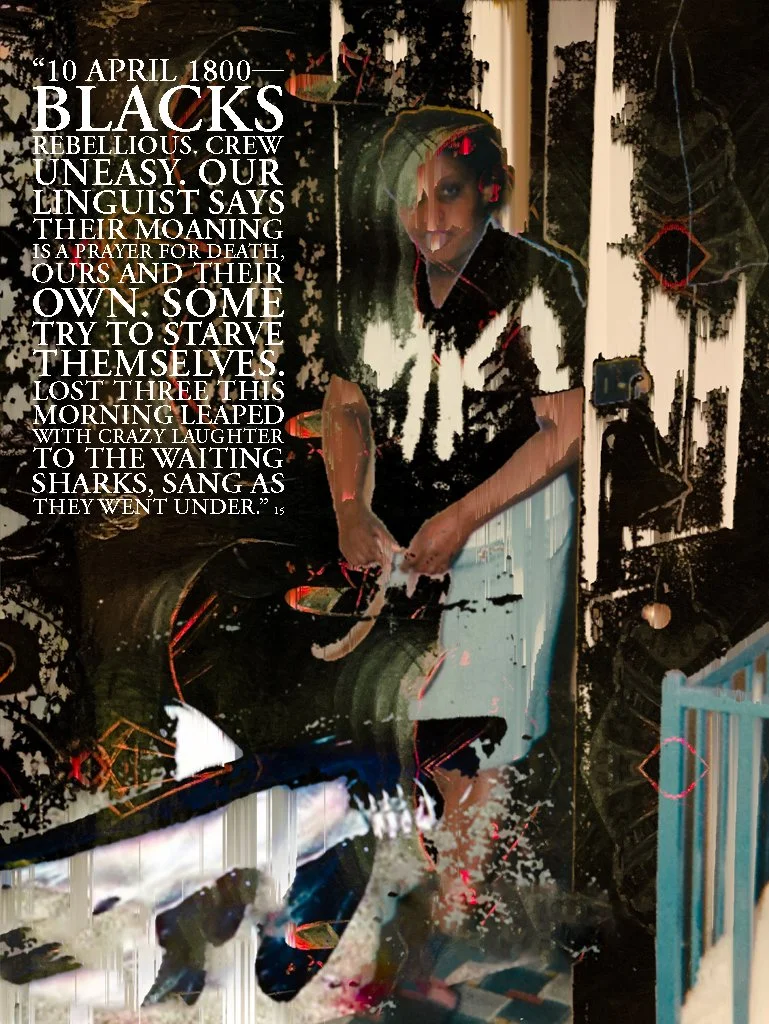
My special subject is the Black Vampire. I take it seriously: I believe that vampires, the gothic, and speculative horror more generally, are fertile ground for exploring notions of extraction, capitalism and immortality. The vampire allows me a creative license to conceptually strain my experience through, including navigating memory, loss, elation and grief related to my connection to the trans atlantic slave trade. It supports my articulation and understanding of themes that span huge amounts of time and are made up of compounded moments. I also like how complex they are as creatures, able to contain and question racial theories, being able to articulate complex ideologies through specific symbolisms and traits, using blood as sustenance, aversion to the sun, agility, speed, eroticness, closeness to animism, and, of course, immortality. And what is more immortal than the legacy of slavery? How it persists and extracts from the present day through either pervasive and persistent means or subtle and infallible ones, ranging from micro aggressions to housing, gentrification, emotional absence, core morbidities, and the list goes on.
These themes affect me and I don’t always know what to do with what I feel. The Black Vampire allows me to indulge in feelings of melancholia as a framework to expand the erotic, as an aesthetic pallette, and as a supporting hand I can pick up and put down at will. I like the impossible power they have. The Black Vampire is an operative for revenge or redemption, acting on behalf of the pain, claustrophobia, and suffocation felt on those ships in another form, also made from the greed and savagery of the slavers. I imagine a creature unknowingly brought onto the hold of the ship at night, an old woman not of much use, the first soucouyant,¹⁶ summoned in the blazing fire of people's rage.
Academic Katie Bray, who has written her PhD dissertation on ‘haunted hemispheres’, states, ‘The hemispheric gothic uncovers and asserts the value of recognizing events that the dominant culture has disavowed and denied’.¹⁷ Vampires are a significant part of the architecture of the gothic, born from fears of the colonial expansion and the miscegenation that came from the product of sexual assault. The violence of sharp teeth and penetration borrows from the animal kingdom – and yet there still remains a limited amount of investigation into how or what the Black Vampire has to offer, how it can engage with the players that enacted the atrocities of slavery as creatures outside of “normal” moral coding. White vampires are the dominant culture within the gothic discourse and my hunger to think and read and discover has not been satiated.
Alexis Pauline Gumb, the author of Black Feminist Lessons from Marine Mammals, talks about gathering everyone:
‘Alexis: There’s a particular passage - and each passage represents one day of me sitting there, I never append them or anything like that - and there’s a particular passage in Ethno or Socio Poetics, which I referenced earlier where Sylvia Wynter talks about the possibility of a ‘we’ that needs no ‘other’. She says, "but who are ‘we’?" So that day I was working with, but who are we? And I wrote from there and the passage, it says, "if you gather them, they would be everyone. Gather them." And it starts to go through this process of I have to gather all the ancestors, including the enslaving ancestors, including the abusive men who are my ancestors, all of the ancestors who I disidentify with in this lifetime. And then there is this moment where it’s like, "gather them more, gather them still." So, there’s this depth that happens and I start to realise that some of these ancestors are… "if you gather them, they would not fit on this island, they would spill back into the ocean whence they came. When you gather them, they will have fins and claws and names you do not know. Gather them anyway. Some will look you in the eye. Some are too microscopic to see. If you don’t gather them all, you will never be free.’ ¹⁸
I love this, and I feel like for me this also includes gathering all the speculative creatures up too. It makes me reflect on the way myth and folklore were used as mirrors for the deepest societal fears and projections for the future. I know what I am missing from my ancestors are the stories to keep me safe, to keep me kind, and keep me connected.
ENTANGLED PLAYERS
There is something I have been hoping to reconcile about sharks, vampires, and the legacy of the transatlantic slave trade that still feels slippery. I can see it so clearly and yet I am probably failing to get it across to you. Let me try again, let me try to bring you home. A key defining characteristic of vampires is their immortality, and the longest living vertebrate is the Greenland shark that lives for over 500 years (meaning some of the ones alive today have also lived in the oceans occupied by slave ships). The Greenland shark was known to frequent the Caribbean sea, albeit in deep and cold depths, and as such it was unlikely to be engaging with the bodies strewn across the ocean from the slave ships. But – it was therenonetheless, and it is still breathing now. They existed together, drawing a line throughout time that hasn’t concluded but is still stretching, outwards and on, towards the huge cruisers that cross the Caribbean sea carrying white OAP’s, looking for some peace in the sun.
Ghana is currently in the process of drafting a proposal for the UN that calls for recognition of the slave trade being ‘the gravest crime against humanity’ due to the lasting effects that transporting 13 million people has had on geo politics, nature and ecology, capitalist structures, inherited core morbidities, as well as mental health. One could think of it as immortality gained through mortal means: the legacy of slavery and how its mark on the world will echo throughout history for so long I cannot fathom it. Black Caribbean people in specific are still so deeply affected by structural inequality centuries later – there is still much work to be done in order to undo and face the colonial history of the UK. Meanwhile, writers such as Sadiyah Hartman are using the gaps in the archive to sit unflinchingly with the loss by using a technique called critical fabulation to call the past into now, to imagine, to grieve.
Sharks, blameless and unbeknownst to them, were manipulated into contributing to the terror of enslaved people. I don’t think it’s useful to reiterate how human remains were used to entice sharks, or how people were made examples of in order to contribute to the collective fear, humiliation, and degradation of Black folk, but know it was plentiful and sadistic in nature.¹⁹ In fact, some of the trepidation that is repackaged to amuse and delight the senses in Deep Blue Sea is actually the mirror image of what happened in history. Using marine animals as a tool to cause pain was well inkeeping with the extraction that the transatlantic slave trade inflicted upon animal and man alike. This sense of being used, dominated, extracted from and depleted, is vampiric in essence and equated to systems that wield without a conscience: bottom sea trawling, deep sea drilling, animals as entertainment, labour, mining – there are too many things to mention, and I myself benefit from it too.
Sharks have been manipulated into sites of fear. Their natural behaviour within their own habitat of seeking and eating food has been allotted human morality. The decimation of shark populations through hunting after Jaws (1975) was released led to the original novelist Peter Benchley spending the last few decades of his life understanding the loss that meant.²⁰ In an interview released after his death he said ‘we seem to feel we have the right to safety by stepping into the enormous wilderness where 80 percent of the living things on the planet live and have to eat’.²¹ The Black Vampire is treated the same way: it behaves according to its own nature and is still condemned through a morality that was never meant for it. The monster is never just what it does. It is what others need it to be so they can justify their fear, their disgust, and their violence.
Black people, vampires and sharks are all at the end of a string for a darkened audience where sometimes I am on the stage and sometimes I am watching from the seats, popcorn sticky on my fingers, salt first and ending with sugar so that it's like a meal, waiting for the next jump scare to show up on the screen.
I wanted to see what would happen if I reconciled these three entities: sharks, Black Vampires and the Transatlantic Slave Trade. I think pain and the role of fear were the overarching threads touching them all. Complete reconciliation is not possible - but when I looked at one, I saw the other differently and I found that useful. It’s a puzzle that continues to transmogrify. I love my Black Vampires and I thank them for allowing me to think across impossible scales of time that otherwise my brain can’t get behind, to sit with histories that exceed my own lifetime and stretch forward, and to approach forms of grief, rage, and inheritance with a bodily chaos that I see as warranted and worthy. It has allowed me to place haunting speculative creatures alongside animals and historical subjects without claiming that they are equivalent. Instead, it has helped me ask why certain bodies become monstrous, who benefits from that designation, and what fears are being rehearsed through it.
I can’t say this has been a fun exercise. It’s been a way to get closer to sharks though, another way to see what the vampire can do. It’s been a way to learn another facet of the suffering of enslaved people. Through it, I also learnt about the insurrections, the mass suicides, the choosing of sharks and waves over enslavement, the faces filled with glee as they lept into the waves,²² the ingenious modes of communication in the slavehold. I value this temporary submersion in history: it’s a privilege to not make equivalences but instead relations. There is no separation, there is no soothing, there's just violence that gives me shivers of pleasure, and violence that gives me shivers of pain.
¹ Middle Passage is a seminal poem that chronicles the horrors of the transatlantic slave trade. Written by Robert Hayden, (1962) 1985.
² See several instagram and tiktok posts from @thefishermeng.
³ by Ella Frost, Aisha Mirza, and Soha Salem, 2021.
⁴ Braiding Sweetgrass by R. W. Kimmerer, 2020.
⁵ Harlin says in the film, at 00:48:00-02. Universidad de Alcalá (España) and Sanz Alonso, 2024.
⁶ Fear of a Black Consciousness by L. R. Gordon, 2022.
⁷ We Real Cool: Black Men and Masculinity by b. hooks, 2004.
⁸ When Race Matters by L. J. Staton et al., 2007.
⁹ Racial Bias in Pain Assessment and Treatment Recommendations, and False Beliefs about Biological Differences between Blacks and Whites by K. M. Hoffman et al., 2016.
¹⁰ X. Phillips, 2017.
¹¹ See The Shallows (2016), 47 meters down (2017), Jaws (1975), and so on.
¹² The Slave Ship: A Human History by M. Rediker, 2008.
¹³ ibid.
¹⁴ The Summer of Rebellion by S. Sheera, 2022.
¹⁵ Middle Passage by R. Hayden, (1962) 1985.
¹⁶ A soucouyant is a Caribbean malignant witch believed to shed her skin by night and suck the blood of her victims.
¹⁷ A Climate . . . More Prolific . . . in Sorcery by K. Bray, 2015.
¹⁸ Undrowned:Black Feminist Lessons from Marine Mammals A. P. Gumb, 2020.
¹⁹ See Rediker 2007, Bennett 2020, and Coburn 2025.
²⁰ Chewing on the complex legacy of Jaws, by S. Ingram, 2023.
²¹ The Environmental Side of Peter Benchley, by R. Siegal, 2006.
²² History from below the Water Line, by Rediker, 2008.
SOURCES CITED
Published Sources:
Bennett, Joshua. 2020. Being Property Once Myself: Blackness and the End of Man. Harvard University Press. https://doi.org/10.4159/9780674245495
Bray, Katie. 2015. ‘“A Climate . . . More Prolific . . . in Sorcery”: The Black Vampyre and the Hemispheric Gothic’. American Literature 87 (1): 1–21. https://doi.org/10.1215/00029831-2865163
Coburn, Henry Patrick. 2025. ‘The Word Shark Looks like a Shark: Black Bodies, Signifiers, Silhouettes’. ISLE: Interdisciplinary Studies in Literature and Environment 32 (3): 788–811. https://doi.org/10.1093/isle/isad078
Gordon, Lewis Ricardo. 2022. Fear of a Black Consciousness. Allen Lane, an imprint of Penguin Books.
Hayden, Robert. (1962) 1985. Collected Poems. Liveright Publishing Corporation.
Hoffman, Kelly M., Sophie Trawalter, Jordan R. Axt, and M. Norman Oliver. 2016. ‘Racial Bias in Pain Assessment and Treatment Recommendations, and False Beliefs about Biological Differences between Blacks and Whites’. Proceedings of the National Academy of Sciences 113 (16): 4296–301. https://doi.org/10.1073/pnas.1516047113
hooks, bell. 2004. We Real Cool: Black Men and Masculinity. Routledge.
Ingram, S. (2023) ‘We could see the fear it was stirring up. It was horrifying.’ Chewing on the complex legacy of Jaws’. https://www.nationalgeographic.com/animals/article/legacy-jaws-book-shark
Kimmerer, Robin Wall. 2020. Braiding Sweetgrass: Indigenous Wisdom, Scientific Knowledge and the Teachings of Plants. Penguin Ecology. Penguin Books.
Phillips, Xandria. 2017. ‘FOR A BURIAL FREE OF SHARKS’. Literary Arts Journal. FOR A BURIAL FREE OF SHARKS, January. https://www.giganticsequins.com/phillips81.html
Rediker, M. 2007. The Slave Ship: A Human History. Viking.
Rediker, M. 2008. ‘History from below the Water Line: Sharks and the Atlantic Slave Trade’. Atlantic Studies 5 (2): 285–97. https://doi.org/10.1080/14788810802149758
Sheera, Sophia. 2022. ‘The Summer of Rebellion: Remembering Brick Lane’s Bengalis and Their Fight against Fascism – Gal-Dem’. September 12. https://gal-dem.com/summer-protest-1978-brick-lane-london-bengalis/
Siegal, Robert. 2006. The Environmental Side of Peter Benchley. February 13. https://www.npr.org/2006/02/13/5204393/the-environmental-side-of-peter-benchley
Staton, Lisa J., Mukta Panda, Ian Chen, et al. 2007. ‘When Race Matters: Disagreement in Pain Perception between Patients and Their Physicians in Primary Care.’ Journal of the National Medical Association (United States) 99 (5): 532–38.
Universidad de Alcalá (España), and Irene Sanz Alonso. 2024. ‘An Ecogothic Reading of Sea Monsters: Deep Blue Sea (1999) and The Meg -2018’. Revista Canaria de Estudios Ingleses, no. 89: 153–67. https://doi.org/10.25145/j.recaesin.2024.89.09.
Undrowned:Black Feminist Lessons from Marine Mammals A. P. Gumb, 2020.
Films and Television Shows
Frost, E., Mirza A. and Salem, S. (2021). What You Love Too Much To Lose. https://ellajustinefrost.com/what-you-love-too-much-to-lose
Deep Blue Sea, dir. Renny Harlin (1999)
Princess of the Damned, dir. Michael Rymer (2002)
Buffy the Vampire Slayer, created by Joss Whedon (1997-2003)
The Shallows, dir. Jaume Collet-Serra (2016)
47 meters down, dir. Johannes Roberts (2017)
Jaws, dir. Steven Spielberg (1975)
See several instagram and tiktok posts from @thefishermeng:
https://www.instagram.com/thefishermeng/p/DW_9oZbAGLT/ (accessed on 4 July 2026).
https://www.tiktok.com/@thefishermeng/video/7485780537609587999 (accessed on 4 July 2026).
Common Knowledge:
A soucouyant is a Caribbean malignant witch believed to shed her skin by night and suck the blood of her victims.