
Sensing Saburtalo by Anna Japaridze (she/her)
DOI: https://doi.org/10.5281/zenodo.21403038
Published July 19, 2026.
Keywords: public space, vegetal agency, invisible/visible violence, urban ecology;
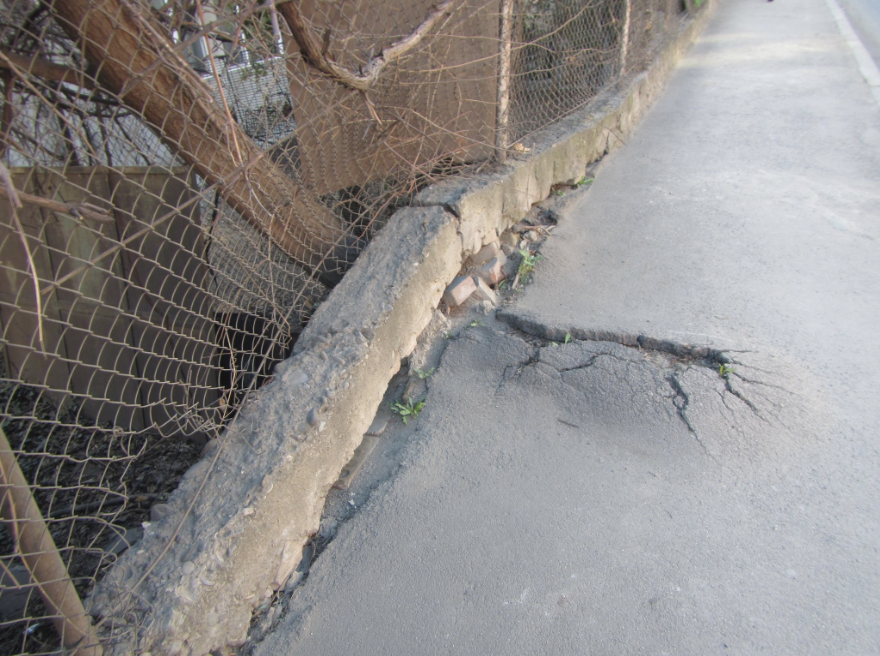
Figure 1. Tree roots bursting up from concrete.
Saburtalo, Tbilisi. (2026) Source: Photograph taken by author.
Sensing Saburtalo
Urban environments are not merely passive backdrops; they play a significant role in shaping how we think, feel, and act. ¹*²
As life in Tbilisi, Georgia becomes increasingly crowded, noisy, and inhibiting, the few remaining pockets of ‘undefined’ space support alternative ways of being and relating to the landscape. These spaces are becoming increasingly restricted by unchecked urban development, while the city’s parks become increasingly restrictive places as the state employs landscaping and surveillance techniques that delimit acceptable behaviour.
Saburtalo, the neighbourhood in Tbilisi where three generations of my family have lived, has been one of the places at the forefront of the city’s unequal development. The following speculations have arisen from my experience of living and walking in Saburtalo in recent years.
I began to view Bakhtrioni’s Forest as an archetype for certain kinds of undefined spaces in the city. Such spaces cling to the margins of Tbilisi’s city planning, and owe their survival to inertia. Their existence is eternally provisional; their obituaries already faintly outlined in pencil. Undesigned, they sprout up the wayside; held together by the tattered shreds of a landscape zoning law, a landowner in absentia, or a hitch in the schedule of a real estate developer. At their best, these spaces offer a chance to escape the proscriptions of urban life, re-sensitise, and relate to the environment in ways that are discouraged or openly prohibited in other parts of the city.⁴
Places in the neighbourhood that afford such possibilities are fast disappearing. Giorgi’s affinity for this hill reminded me of my own long-lost relationship with the overgrown garden of the Physics Institute in Saburtalo. It had been destroyed, like many such sites, by the onward march of development. All that remained of it was a faint sense of magic in the memories of nearby inhabitants.⁵
Attitudes to participation and agency in public space in Georgia have been shaped by changing state regimes. Under the Soviet Union, urban parks were a staging ground for state-run demonstrations and rallies. In a highly centralised socialist society that was under extensive surveillance, these supposedly common spaces turned into ‘no-one’s space’.⁶ After the Soviet Union fell, Georgia’s economy crashed and civil war broke out on multiple fronts. Meanwhile, a different kind of ‘no-one’s space’ began to appear – one that no longer felt governed by a coherent power. Tbilisi’s parks became disorderly; dirty, overgrown, and dotted by vernacular architecture as the public began to lean on the commons for subsistence and shelter.⁷ In the absence of institutional oversight, green space in Saburtalo began teeming with unchecked life. On Tamarashvili Street, the garden of the Physics Institute was swallowed by thick grass and snakes. Wild dogs roamed beside an open, meandering stream laced with broken glass. My friends and I lit fires, climbed roofs, and furnished a wooden shack that had been established by so-called ‘alcoholics’.⁸ Across the street, the Soviet-era hippodrome fell into lively decay; becoming host to a wide range of actors who used it for different purposes. The uncertainty of the city’s parks reflected the uncertain identity of the country at large; yet ruin, in this context, provided shelter for certain kinds of life and certain forms of relation to space that were temporarily unmediated by the state.
This state of affairs culminated with Georgia’s Rose Revolution of 2003, which swept President Mikheil Saakashvili into power and ushered in a new epoch for Tbilisi's built environment. The incipient government sold off swathes of public land as a new economic and aesthetic agenda began to reshape the country. Saakashvili made the country's break from its past visible through architecture, which quickly began to alter the nation’s capital city. Inexplicably shaped structures began to appear in Tbilisi's historic quarters like objects dropped from the sky. Elaborate public fountains were installed in parks as icons of prosperity, whilst glass-fronted police stations symbolised the state’s newfound transparency.
Saakashvili's neoliberal reforms salvaged the nation's failed economy, but they did not assert a sustainable model for public good.⁹ The mass sell-off of land left very little in common ownership; in private hands, financial greed and a woeful disregard for urban planning distorted the face of the capital city.¹⁰ The president's crackdown on corruption was coupled with a spike in police brutality, and harsh laws were implemented in response to the epidemic of drug use that had emerged in the country.¹¹ Meanwhile, a construction frenzy began blindly remaking the city’s identity.¹² Since Saakashvili’s departure from power in 2012, non-stop construction has continued throughout the following government's four consecutive terms in power. Tbilisi finds itself increasingly studded by casinos, luxury hotels, and high-rise complexes. Meanwhile, many Georgians have been pushed by meagre wages and high unemployment into crippling debt or economic migration.¹³ Yet the construction boom continues, prompting the question: why, and for whom?
In Tbilisi, the unevenness of these changes has felt particularly apparent in the neighbourhood of Saburtalo where I live. On the periphery of the old hippodrome by Tamarashvili Street, a vestige of woodland with century-old trees is about to be razed to make way for Trump Tower Tbilisi, a skyscraper that is slated to be the tallest in the entire country.¹⁴ On an adjacent street, a casino-hotel resort named Central Park Towers is being built directly across the street from a string of pawnbrokers. Nearby, behind the traffic light where old women beg passing drivers for change, a former Soviet military base is being redeveloped into a luxury housing complex called Cityzen, with a skyscraper designed by Zaha Hadid Architects. When construction of the estate will be finished, the windows facing west will have a head-on view of Saburtalo cemetery behind them. Saburtalo is a site of confused identities, where conflicting experiences of the city overlap but are never to meet: one that sells an exclusive vision of a future under development, and another that is experiencing intentional neglect to make way for the next.
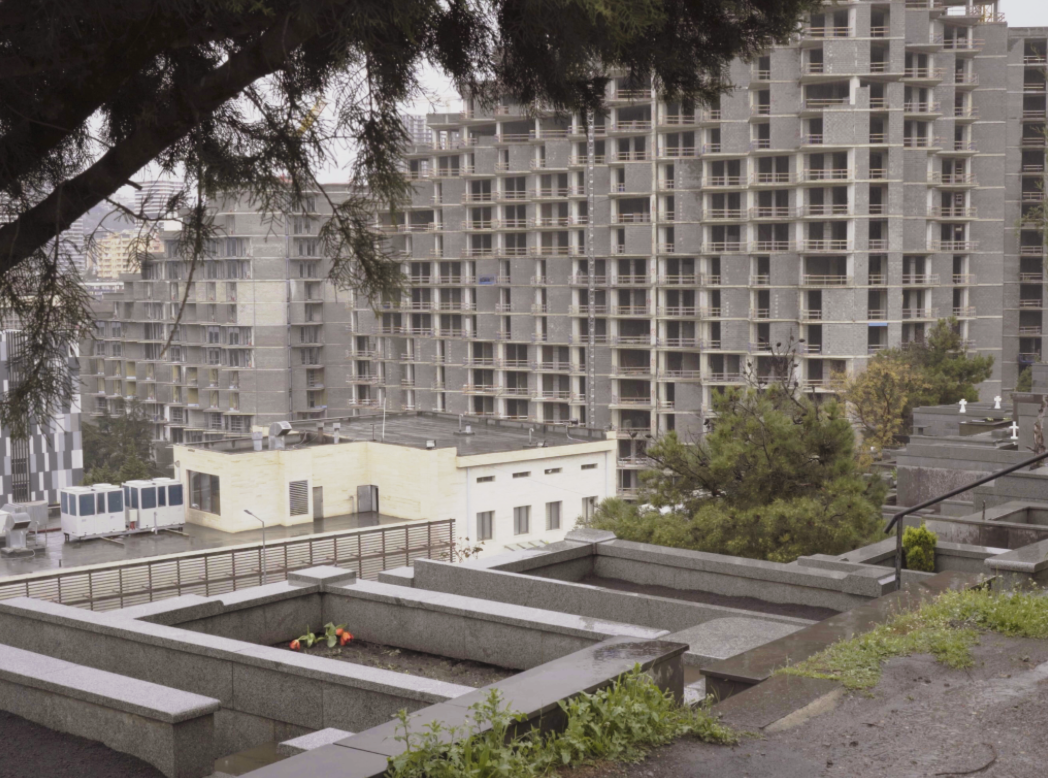
Figure 3. View of Cityzen from Saburtalo cemetery.
Saburtalo, Tbilisi. (2026) Source: Photograph taken by author.
In the early hours of the morning on New Year’s Day, I pay another visit to Bakhtrioni’s Forest. Taking in the sober view of Saburtalo from the hill, I feel that the city has come to resemble a cemetery. Graves in Georgia are rarely housed in uniform plots, and as cemeteries expand they can produce a landscape that is erratic and hard to navigate. The broader city, with its uneven enclosures, ad-hoc urban planning, and frustrated mobility, has begun to feel this way: a place not meant for life. With a ground that is suffocated by concrete, mountains cut in half to make highways, and streams buried underground, the hill that I stand on represents one of the few places where someone can go to experience a vestige of the area’s organic geography. But it’s not quite appropriate to compare the city to a cemetery. In fact, the sanctity of graves in Tbilisi’s actual cemeteries has been a red line preventing companies from redeveloping what is otherwise often prime real estate.¹⁵ In a city where almost everything has become available for a price, Tbilisi’s actual cemeteries have become sanctuaries for life that is otherwise, increasingly, relegated.
Another way in which Tbilisi's architectural development diverges from a cemetery is in its rebuttal of history. The city today doesn’t appear intent on memorialising the past – but in breaking clean from it. Take the monosyllabic courtyards and stairwells of m², a construction company that builds residential complexes in Tbilisi, with their wipe-down surfaces and round-the-clock security. Or White Square, another prolific construction company, which advertises itself with the slogan, ‘start life from a clean page’.¹⁶ These developments eat away at the city’s last remaining open spaces, and are tailed by an increasingly sterile approach to managing what little green space is left. We could see the push to create ‘legible’, ‘tamed’, and simplified landscapes as attempts to clean the slate of history, and to live in a world where the space for action is uncontaminated by social, historical, or political context. Such ideals conceal the pernicious ways in which these spaces themselves condition the scope for action — establishing a homogenous environment that hinges on a series of implicit assumptions. You can be whoever you want, if you’re all more or less the same.
The anonymous aesthetic of private developers is being echoed in public landscaping. This is particularly evident in the masterplan for the redevelopment of Saburtalo’s old Soviet-era hippodrome, which represents the last open space of its kind in the area. Following a long, unsuccessful campaign by local activists, this site is being developed by a Dutch landscape architecture firm into Tbilisi’s ‘Central Park’, with ‘French’ and ‘Japanese’ gardens.¹⁷ Even the central park of our capital city has been designed as a simulacrum of other places.
Tbilisi’s parks also offer limited autonomy to plants, insects, and animals. Long grass is mown. Dead leaves are prevented from rotting. Ruderal is sprayed with herbicides. Native plants are passed over for imported species. Shrubs are often placed at regimented distances, with identically pruned bushes planted at equal spaces between trees. Nature is thus increasingly made ‘legible’, much like the desired human subject under the state – designed, uniform and easy to control and maintain.¹⁸ As ever-greater numbers of people are packed tightly into concrete tower blocks, public parks – the few green spaces that remain accessible – provide little room to establish meaningful, reciprocal or multivalent relationships with other forms of life.
Some people might regard these spatial dislocations as an expression of our species’ liberation from constraints; an overcoming of space and time for the global, ‘seamless’ flow of styles and commodities. Yet in Georgia, these developments are rising in step with the increasing authoritarianism of the state.¹⁹*²⁰ Recent years have seen a proliferation of CCTV cameras in the city’s parks and streets, and the increasing restrictions on people’s right to space has been crystallized by the state’s approval of a law that – having exhausted all other means of discouraging public protest – criminalises obstructing the pavement. Today, the mere act of standing on a pavement with the ‘wrong’ political intent can land you in prison.²¹ As the state attempts to impose itself into every environment it can access, it feels ever more important to foster and protect spaces that resist domination.
One hot summer’s day, I was walking in the vicinity of Lisi Lake, a large recreational area on the periphery of Saburtalo. Despite its social and ecological significance, the land around the lake had been sold to developers who had begun to build expensive housing on it. Staring at the ground as I walked through the trees, I was disturbed by the sight of thousands of ailanthus altissima seedlings. In many cases, the eager saplings of this invasive tree were growing directly at the base of the existing tree trunks. Overcome by an urge to share my civic concern, I approached a man on a nearby bench to relay the news to him. He was unperturbed; amused, even. “This is private land. I’m sure the owner’s taking care of it.” I noted that this didn’t seem to be the case. "Well," he said, "this is private land, so it’s up to the owners what they do with it.” That’s beside the point, I replied. Seeds don't recognise the borders that our species draws between private and public space.²² The man leaned in towards me with a sudden look of interest.
“What about drug addiction? Do you care about that?” Startled, I asked him what he meant. “Why don’t you talk to me about drug addiction? Or other important social problems? Do you think trees are more important?”
There were several interesting things in what he had said. The man was clearly privileging a social problem like addiction over the local environment. Yet he had unknowingly forged a productive connection; rather than imposing an artificial boundary between the two realms, it started to feel like addiction and ecology should be talked about within the same breath.
The dislocation theory of addiction suggests that the underlying reason for the rising social prevalence of addiction in recent centuries – from addiction to substances, to commodities, money, and beyond – corresponds to the emergence of free market societies. With their ‘unrelenting pressures towards individualism, competition, and rapid change’, these factors have dislocated people from their psychosocial lives, leading them to fill the gaps with substitutes that become destructive.²³ Could the rapid changes that Georgian society had undergone with marketization have been a determining factor in the rise of addictive behaviours? Certainly, it felt like developers in Georgia were addicted to acquiring land, destroying habitats and building high-rises, despite the ever-increasing inability of the city to absorb these changes.²⁴
Curiously, the same associations were presented to me by another encounter in the vicinity of Lisi Lake. I was walking slowly through the woodland and bending down frequently to look at plants – behaviour that aroused the suspicion of three policemen, who sheepishly approached and asked to search me. They suspected me of searching for hidden drugs.
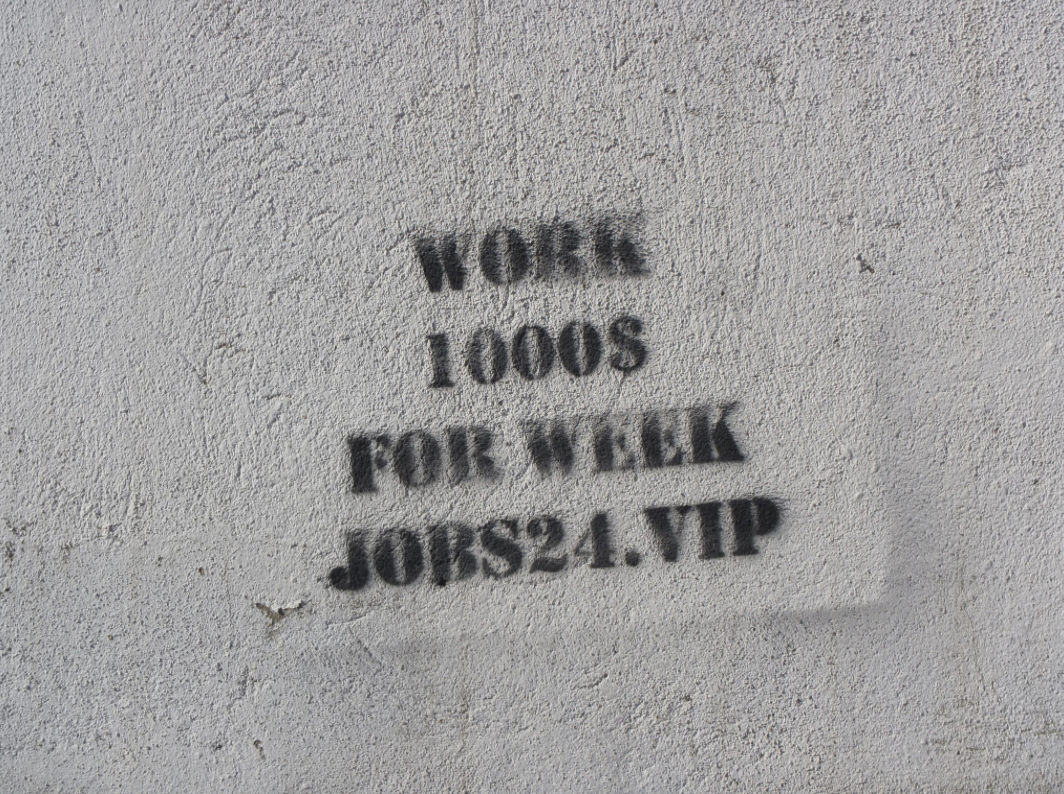
Figure 4. Drug courier vacancy spray-painted on a wall in the neighbourhood. Saburtalo, Tbilisi. (2026)
Source: Photograph taken by author.
This may not have been an unfair suspicion. In Georgia, harsh penalties for drug possession and trade have produced an extensive underground economy, which relies on bitcoin transfers and anonymised drop-offs of narcotics in public places to shield the activity from authorities.²⁵ Consequently, Tbilisi’s parks and hiking routes are often patrolled by police, who regularly intercept passing civilians to conduct stop-and-searches. Interestingly, the very forms of behaviour that an individual with a keen interest in the natural world might exhibit – such as walking slowly, staring at the ground, and crouching down to inspect plants – can be mistaken by the authorities as the gait of a potential drug user looking for illegal substances.²⁶ Perhaps there is also something subversive about the act of paying attention to one’s environment?
To take these speculative associations further, it might be worth considering the particular kinds of places that drug users in Tbilisi seek in their attempts to evade being caught. Manicured parks will not do for this purpose. Wild, grubby spaces are much better – the same kinds of places where the insects, weeds and dead leaves have been cast out. In their attempts to gain distance from the condemnation of society, drug users might be some of the most intimate acquaintances of wild(er) nature.²⁷ Georgia has one of the highest rates of injection use in Europe;²⁸ any trip through the bushes in Tbilisi's urban peripheries bears a likelihood of encountering material remnants of drug use. If we thought about what caused their addictions in the first place, that very loss of contact with the sensuous, beyond-human world might rank as a contender. Here they are with their needles, in the embrace of nature; the addict, and the healer; in exile from the city where fruit rots vacantly into the concrete and life finds refuge in cemeteries…
The rapid growth of high-rise buildings in Tbilisi also entails another form of dislocation: one that disconnects people from the sky and the ground beneath their feet. In Saburtalo, tall buildings increasingly compete with the scale of the surrounding mountains; from a ground-level vantage point, their proximity can be increasingly hard to make out. Many new apartment blocks are more than a dozen storeys high as far-reaching views become increasingly privatised, available first and foremost to those who buy apartments in the newest and highest complexes. These views are won at a cost, as the right to look far comes alongside a loss of contact with the ground. Those with access to lofty views may have greater insight into the breadth of their surroundings, but they receive this knowledge in a way that is perhaps partial, incomplete. One is entitled to view, without being a participant in the space. Meanwhile, those who dwell below lose access to the sky and become ready objects of surveillance from above.
What happens to our sense of time, and our ‘feel’ for the future when our eyes can’t reach into the distance, or take in the open sky? The right to see beyond your own immediate vicinity is becoming as much of an economic privilege as the right to extrapolate into the future. In this respect, we might say that the increasing monetisation of views in Tbilisi is establishing divergent spatial experiences, skewed along class lines, which optically express the degree of the citizen’s temporal agency.²⁹ Those who live higher up can see ‘further’, in a visual and temporal sense; those who are crowded out by buildings cannot see far at all, neither of their area nor, perhaps, of the ‘space’ of their future.
This brings me back to the summit of Bakhtrioni’s Forest. Here, it remains possible to plant your feet on soil and to see into the distance at the same time; a holistic engagement of the body and senses that is difficult to equate to the perspective one might receive from the window of a 20-storey-high apartment. Even better, this experience is free. Positioned in the middle of a densely inhabited residential neighbourhood, the hill offers a sense of privacy and seclusion. In the daytime, few people visit and there is no visible sign of surveillance. At night, the hill is an island of soft darkness, surrounded by a sea of artificial light. Here, plants can grow relatively uninhibited, and animals and insects are not threatened by street lights, adjacent roads, or persistent foot traffic.³⁰ It’s not a remedy to the city, and many of its problems wash ashore – construction waste, used needles, invasive trees and buried drugs – but visits to the hill continue to offer a palliative for the senses.
In the last two centuries, the global proportion of people who live in cities has swelled. Our ancestors may have relied on their sensitivity to their environment to survive, but in today’s city it has become almost an imperative to feel less. Like a callus that appears on a foot in response to friction, numbness has become a mechanism for survival in the city. Today, more than half of Georgians live in urban centres, and around a third of people live in Tbilisi.³¹ The city is increasingly packed with dissonant registers; it’s natural that our senses would respond to this overload by withdrawing. Withdrawal, however, does little to resolve the issues that we face. When a callus appears, it continues to thicken unless we improve our circumstances. Instead of treating the callus as an innate feature of our bodies, we could try a different pair of shoes — or learn to walk differently. But without access to unregulated spaces that encourage us to open our senses, I fear that our minds will squirrel down increasingly blind tunnels and we will lose perspective on how our lives and our society could be otherwise.
I first began to contemplate the role of undefined space when a friend of mine, Giorgi, led me to a hill in our neighbourhood that had become important to him. The hill appeared to be unmarked and unnamed³; Giorgi had nicknamed it Bakhtrioni’s Forest [ბახტრიონის ტყე] – presumably due to its proximity to Bakhtrioni Street. Surrounded on all sides by development, the hill was a hold-out for wildlife and seclusion. It also provided a rare vantage point from which to reflect upon the city. A rough, uneven path led Giorgi and I to the summit, and the spectacularly congested high-rises of Saburtalo opened out into view. As we paused to rest, my friend instructed me to take some deep breaths. The air was different here, he observed; the altitude, and distance from the traffic and noise, gave him space to clear his mind and breathe. In the years that followed, we would visit this place frequently.
Giorgi, an unemployed artist who lived on almost no money, relied on an economy of gifts, barter and gleaning to obtain material goods and services. When he took an interest in herbal medicine, he would identify plants on the hill and forage them to make teas and infusions. During bouts of insomnia, he escaped his family home to wander the hill at dawn. In winter, when his house lacked central heating, he visited the hill to gather firewood. Bakhtrioni’s Forest became a resource for him: a place that belonged, seemingly, to no one, it invited him to forge an agential relationship to the landscape.
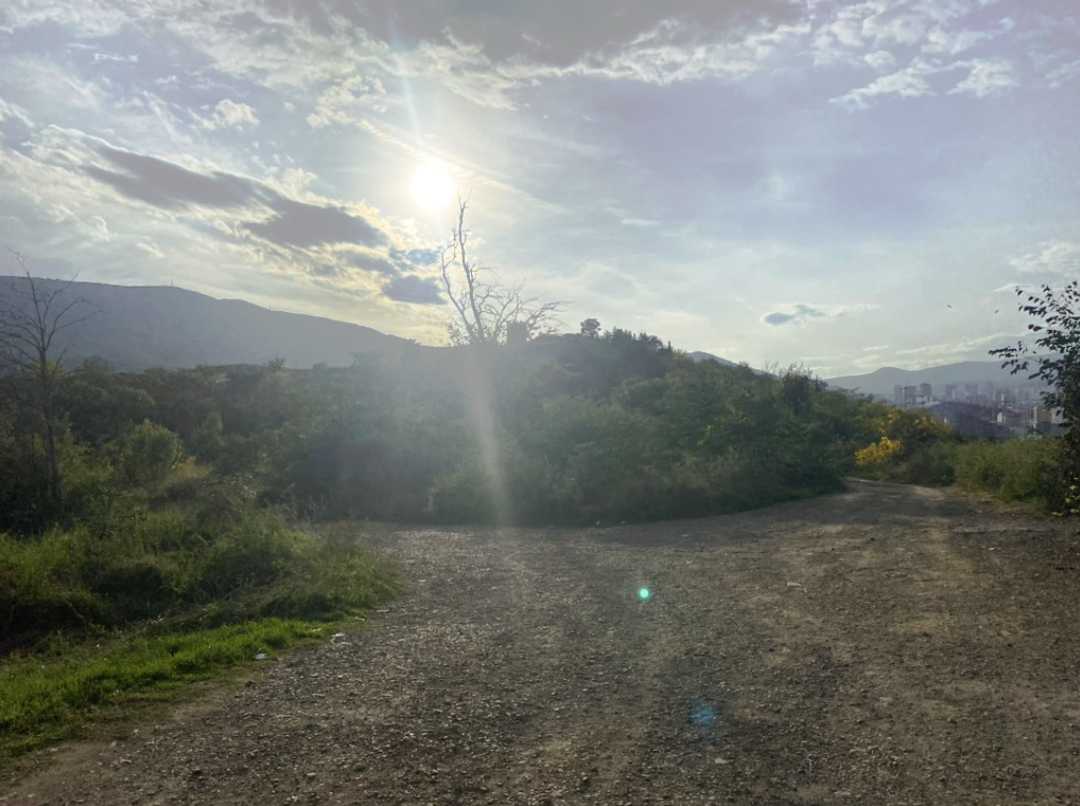
Figure 2. Approaching the summit of Bakhtrioni’s Forest.
Saburtalo, Tbilisi. (2026) Source: Photograph taken by author.
¹ Reliance Structures: How Urban Public Policy Shapes Human Agency by Matthew Noah Smith, 2018.
² Environmental Psychology: a Psycho-social Introduction by Mirilia Bonnes and Gianfranco Secchiaroli, 1995.
³ Levan Kalandarishvili, an architect who grew up in the neighbourhood, remembers locals referring to it as იყალტოს გორა - Ikalto’s Hill.
⁴ Common knowledge amongst inhabitants of Tbilisi.
⁵ Oral reminiscences with former residents of 10 Tamarashvili Street.
⁶ Learning to Use ‘Public Space’: Urban Space in Post-Soviet St. Petersburg by Anna Zhelnina, 2013.
⁷ Author’s personal recollections, corroborated by multiple sources over time.
⁸ Shared perception between author and her childhood neighbours from 10 Tamarashvili Street, Tbilisi, Georgia.
⁹ Post-Soviet Georgia: the rocky path towards modern social protection by Eveline Baumann, 2010.
¹⁰ Multiple transformations, coordination and public goods: Tbilisi and the search for planning as collective strategy by Joseph Salukvadze and Kristof Van Assche, 2022.
¹¹ Policing, massive street drug testing and poly-substance use chaos in Georgia – a policy case study by David Otiashvili, et al., 2016.
¹² City as a geopolitics: Tbilisi, Georgia — A globalizing metropolis in a turbulent region by Joseph Salukvadze and Oleg Golubchikov, 2016.
¹³ These problems are widely felt amongst Georgia’s population; financial support from Georgian emigrants plays a crucial role in the everyday survival of many families.
¹⁴ Trump Tower in Georgia to be built on land part-owned by son of US sanctions-hit leader by Daniel Boffery in The Guardian, 2026.
¹⁵ The many lives of the dead: What cemeteries in Tbilisi do by Ketevan Gurchiani, 2025.
¹⁶ Promotional post on White Square’s instagram page.
¹⁷ Tbilisi Central Park in LAP Landscape & Urban Design, 2020.
¹⁸ Seeing Like a State: How Certain Schemes to Improve the Human Condition Have Failed by James C. Scott, 1998.
¹⁹ A view that is widely held by a substantial proportion of the Georgian public that the author has come into contact with.
²⁰ Georgia: Anatomy of Repression: 500 Days of Protest, Crackdown and Resilience by Amnesty International, 2026.
²¹ Several protesters have been sentenced to jail for allegedly obstructing pavements, and repeat offences can carry up to a year in prison.
²² Common sense, particularly amongst farmers and people with gardens who struggle to prevent certain plant species from crossing borders and appearing on their land.
²³ The Globalization of Addiction: A Study in Poverty of the Spirit by Bruce K. Alexander, 2008.
²⁴ A judgement that has been echoed by numerous friends, family and acquaintances in Tbilisi over the years.
²⁵ Common knowledge amongst residents of Tbilisi.²⁶ Based on my own experience of being stopped by police whilst inspecting plants.
²⁷ Many adult Georgians live in small apartments with their extended families; ‘third spaces’ such as parks and derelict buildings permit activities that might otherwise prove hard to undertake in privacy at home.
²⁸ Population size estimation of people who inject drugs in Georgia by George Kamkamidze et. al, 2023.
²⁹ Idea developed in conversation with family members.
³⁰ The geography of the hill makes this self-evident.
³¹ According to the National Statistics Office of Georgia (Geostat), 1,331,485 people – 34% of Georgia's population of 3,929,581 – lived in Tbilisi at the time of the 2024 Population Census.
SOURCES CITED
Published Sources:
Alexander, B.K. (2008) The Globalization of Addiction: A Study in Poverty of the Spirit. Oxford: Oxford University Press.
Amnesty International (2026) Georgia: Anatomy of Repression: 500 Days of Protest, Crackdown and Resilience. Available at: https://www.amnesty.org/en/documents/eur56/1115/2026/en/ (Accessed: 5 July 2026).
Baumann, E. (2010) Post-Soviet Georgia: The rocky path towards modern social protection. Paper presented at the ESPAnet Conference, Budapest, Hungary, September 2010. Available at: ResearchGate (Accessed: 18 June 2026).
Boffey, D. (2026) 'Trump Tower in Georgia to be built on land part-owned by son of US sanctions-hit leader', The Guardian, 25 May. Available at: https://www.theguardian.com/world/2026/may/25/trump-tower-georgia-tbilisi-land-part-owned-son-us-sanctions-leader (Accessed: 5 July 2026).
Bonnes, M. and Secchiaroli, G. (1995) Environmental Psychology: A Psycho-Social Introduction. London; Thousand Oaks, CA: Sage.
Geostat (2024) 2024 Population Census of Georgia results. Available at: https://www.geostat.ge/en/modules/categories/12/2024-population-census-of-georgia-results (Accessed: 6 July 2026).
George Kamkamidze et al. (2023) Population size estimation of people who inject drugs in Georgia. International Network on Health and Hepatitis in Substance Users (INHSU). Available at: https://inhsu.org/resource/population-size-estimation-of-people-who-inject-drugs-in-georgia/ (Accessed: 6 July 2026).
Gurchiani, K. (2025) 'The many lives of the dead: What cemeteries in Tbilisi do', History and Anthropology, pp. 1–21. Available at: https://doi.org/10.1080/02757206.2025.2498019.
LAP Landscape & Urban Design (2020) Tbilisi Central Park. Available at: https://laplab.eu/projects/tbilisi-central-park-georgia (Accessed: 6 July 2026).
Otiashvili, D., Tabatadze, M., Balanchivadze, N. and Kirtadze, I. (2016) 'Policing, massive street drug testing and poly-substance use chaos in Georgia – a policy case study', Substance Abuse Treatment, Prevention, and Policy, 11(1). Available at: https://doi.org/10.1186/s13011-016-0049-2.
Salukvadze, J. and Golubchikov, O. (2016) 'City as a geopolitics: Tbilisi, Georgia—A globalizing metropolis in a turbulent region', Cities, 52, pp. 39–54. Available at: https://doi.org/10.1016/j.cities.2015.11.013.
Salukvadze, J. and Van Assche, K. (2022) 'Multiple transformations, coordination and public goods: Tbilisi and the search for planning as collective strategy', European Planning Studies, 31(4), pp. 1–19. Available at: https://doi.org/10.1080/09654313.2022.2065878.
Scott, J.C. (1998) Seeing Like a State: How Certain Schemes to Improve the Human Condition Have Failed. New Haven: Yale University Press.
Smith, M.N. (2018) 'Reliance structures: How urban public policy shapes human agency', in Boonin, D. (ed.) The Palgrave Handbook of Philosophy and Public Policy. Cham: Palgrave Macmillan, pp. 809–825.
Zhelnina, A. (2013) 'Learning to use "public space": Urban space in post-Soviet St. Petersburg', The Open Urban Studies Journal, 6(1), pp. 57–66. Available at: https://doi.org/10.2174/1874942901306010057.
Published Gossip:
Tetri Kvadrati [@tetri_kvadrati] (2023) 'სახლია ადამიანი' [Instagram post], 18 July. Available at: https://www.instagram.com/p/Cu1MN6iMlrT/ (Accessed: 18 June 2026).
Direct Conversation:
Levan Kalandarishvili, p.c. online exchange of an earlier draft of this essay upon which he left comments. June 11, 2026.
Co-authored Knowledge:
Idea developed in conversation with Ketevan Japaridze, online, 2026.
A judgement that has been echoed by numerous friends, family and acquaintances in Tbilisi over the years.
Common Knowledge:
Common knowledge amongst inhabitants of Tbilisi that certain spaces can host activities – illegal or subject to societal disapproval – that are not tolerated elsewhere. Multiple sources over time. Tbilisi, Georgia, 1996-2026.
Multiple discussions with former neighbours over time, at formal and informal gatherings, in which the garden of the Physics Institute was lovingly remembered. Tbilisi, Georgia, 2005-2026.
Author’s personal recollections, corroborated by multiple sources in recent years, including in a taped conversation with former childhood neighbours about their memory of green spaces in Saburtalo in that period. Tbilisi, Georgia, 2025-2026.
Shared impression between the author and her childhood neighbours living in the apartments on 10 Tamarashvili Street, developed through multiple conversations over a span of years. Tbilisi, Georgia.
It is well understood by most Georgians that many citizens suffer from high levels of personal debt, and that unemployment remains high in the country. Multiple sources over time.
A view that is widely held by a substantial proportion of the Georgian public that the author has come into contact with.
Several protesters have been sentenced to jail for allegedly obstructing pavements, and repeat offences can carry up to a year in prison.
Common sense, particularly amongst farmers and people with gardens who struggle to prevent certain plant species from crossing borders and appearing on their land.
Common knowledge amongst residents of Tbilisi.
It is commonly understood that drug users in Tbilisi favour certain outdoor areas that are considered discrete for taking drugs in.
The geography of the hill makes this self-evident.