
Representing Wildlife by Rossella Sette (she/her)
DOI: https://doi.org/10.5281/zenodo.21403005
Published July 19, 2026.
Keywords: non-human agency, animal rights, representation, linguistics;
Representing Wildlife: London Zoo’s Discursive Construction
of Nonhuman Animals from an Ecolinguistic Perspective
4 | The Representation of the Humboldt Penguin
4.1 | Linguistic Representation
Overall, the penguins’ signage portrays the Humboldt penguin as an active agent, worthy of care and protection. The penguin is the central actor: they are explicitly mentioned, specified, individualised, nominated and humanised.
5 | Bringing Stories to the Fore
6 | Conclusion
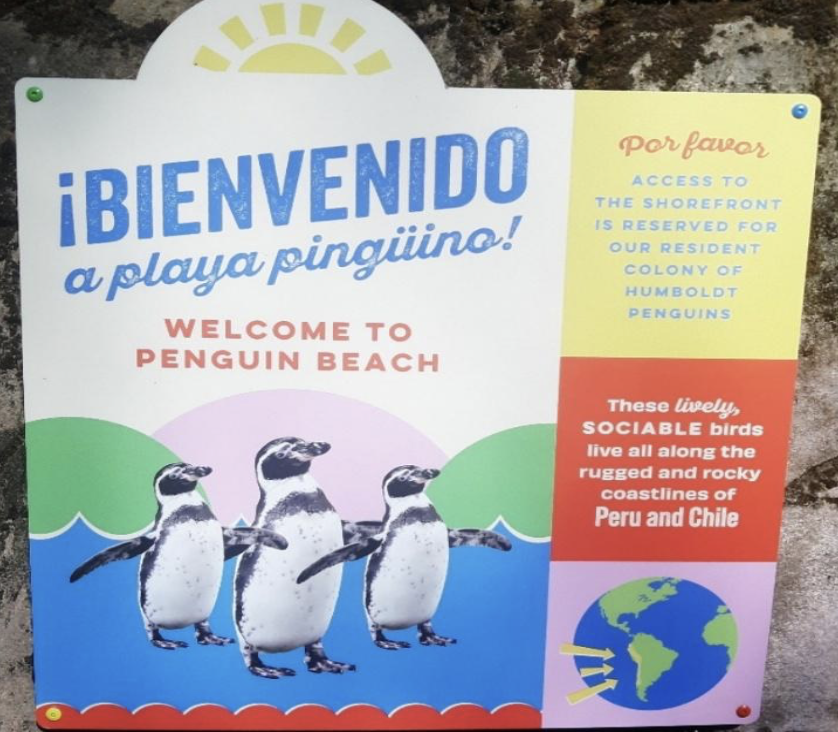
Here, Humboldt penguins are described as a “resident colony”, a phrase that highlights habitat and community. The term “resident” suggests that the penguins hold territorial rights by owning the space they inhabit, while the term “colony”, an instance of both assimilation and categorisation, is balanced by instances of activation, personalisation and nomination. Although the penguins are depicted collectively, categorised by social organisation and generalised as “birds”, they are also named by their species, “Humboldt”, and represented as active agents by being placed as the subject preceding the verb “live”. In terms of personalisation, they are described as “lively” and “sociable”, which humanises them by attributing human-like social qualities. A few penguins are even given proper names and singled out for their distinctive personalities, with visitors encouraged to identify them by the different coloured armbands and beads attached to their wings.²⁹
FIGURE 1. Bilingual welcome sign at ‘penguin beach’.
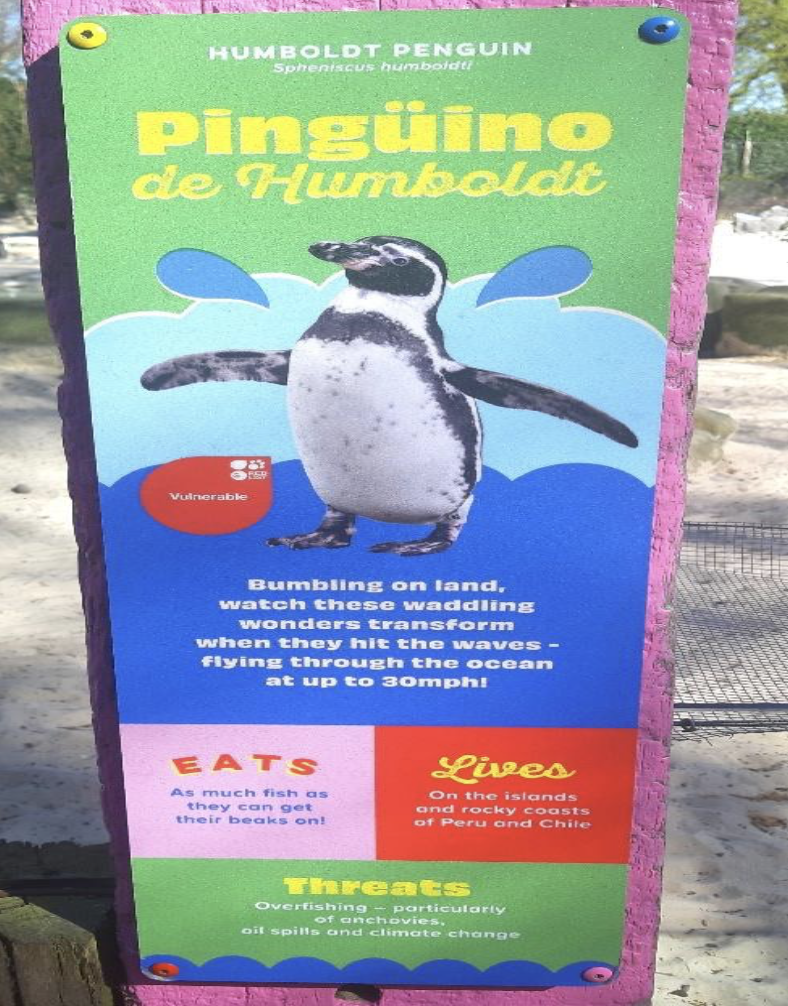
In Figure 2, penguins are both included and specified as representatives of their species (“Spheniscus humboldti”) and as individuals (“Pingüino de Humboldt”). Interestingly, the Spanish translation further emphasises their individual representation by symbolically linking them to their natural habitat (Peru and Chile), where Humboldt penguins actually live. This connection is also reflected in the enclosure design, which resembles Patagonian beaches where visitors can watch the penguins swim in the ‘sea’ or interact with them while enjoying Latin music in the background.³⁰ Penguins are also depicted as agents of their own actions (e.g., “bumbling”, “flying”) and personalised through the metaphor “waddling wonders”. This humorous portrayal invites visitors to sympathise with them.
FIGURE 2. Pingüino de Humboldt.
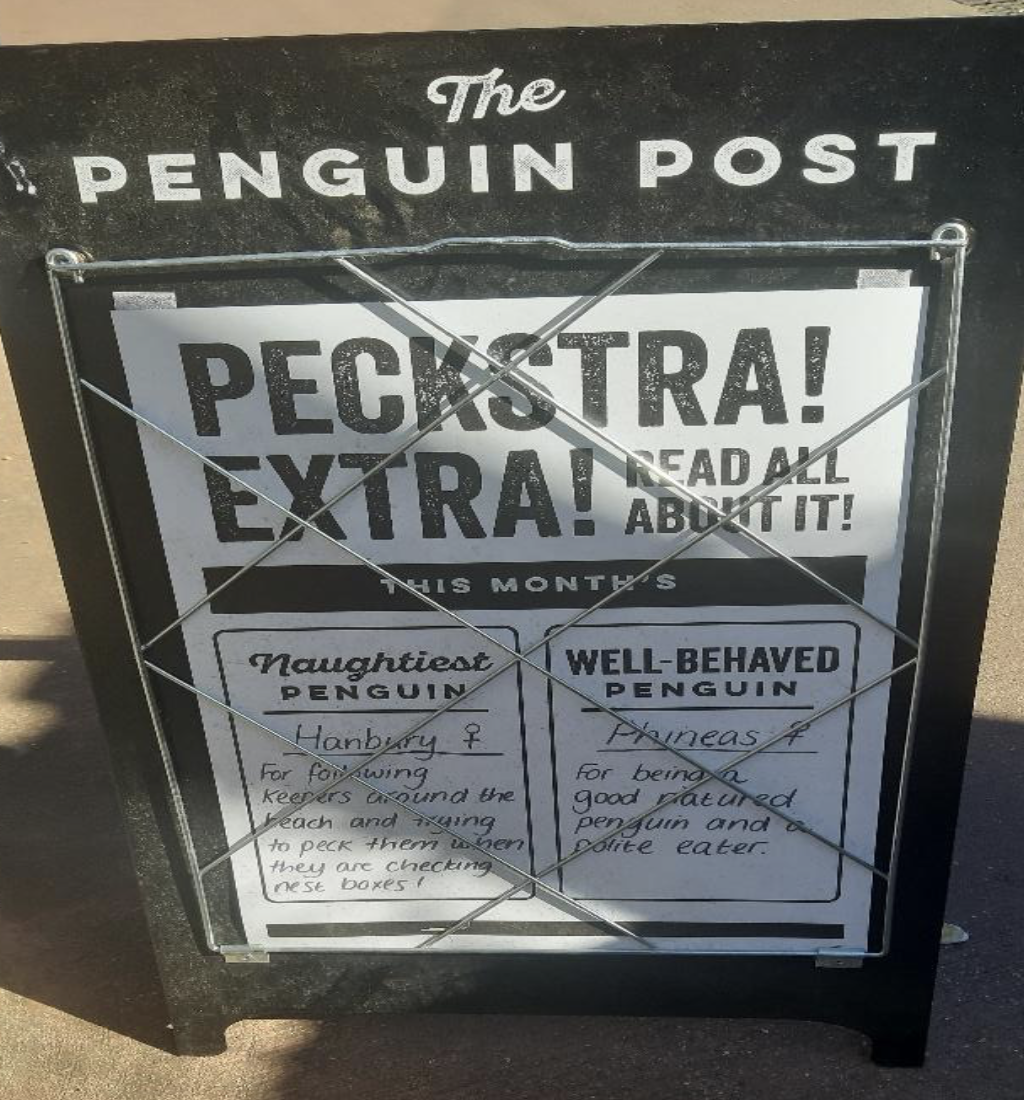
Interestingly, two specific penguins (“Hanbury” and “Phineas”) are not only nominated but also personalised through the attribution of moral qualities (“naughtiest” and “well-behaved”). This moral framing, distinguishing good behaviour (Phineas is a “polite eater”) from bad behaviour (Hanbury follows keepers and “peck[s]” them), reinforces human authority over the penguins’ conduct.
FIGURE 3. The penguin post.
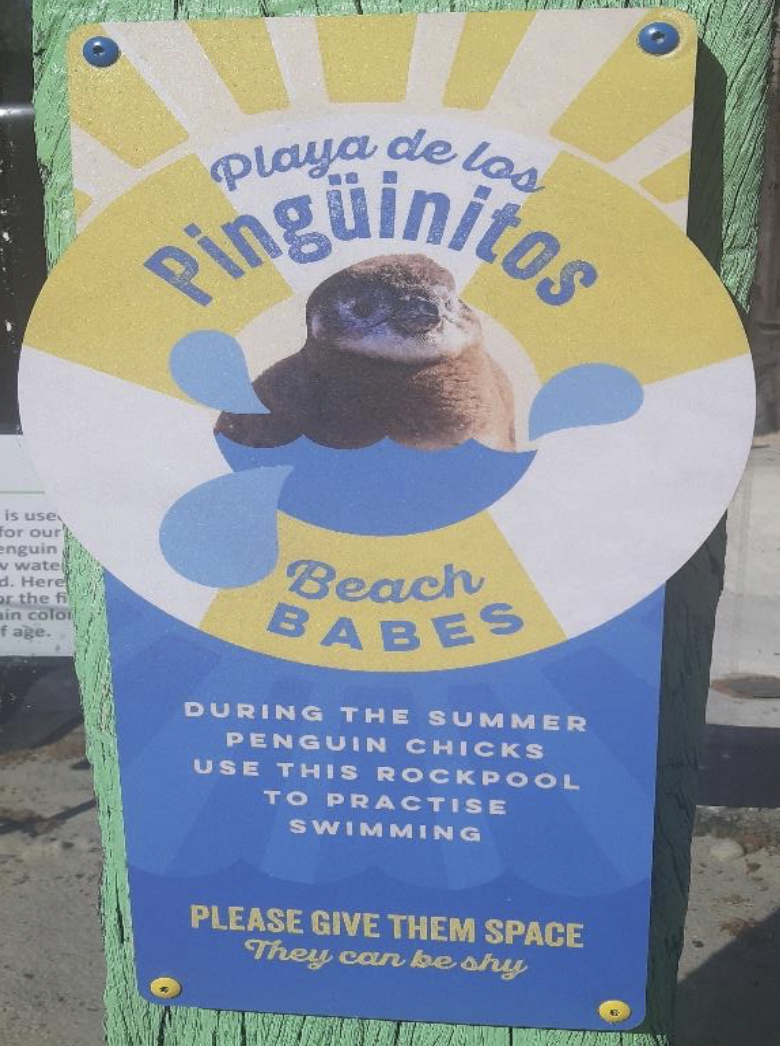
Here, the penguin chicks, infantilised with the Spanish diminutive “-itos” in “pingüinitos” and the nickname “babes”, are portrayed as vulnerable and cute, in need of space and protection, as they can also be “shy.”
Nevertheless, when zooming in on the actions/reactions attributed to them, a clearer picture begins to emerge…
FIGURE 4. Playa de los pingüinitos/beach babes.
Penguins are represented as capable of performing material actions; however, their agency³¹ is subtly backgrounded by the implicit presence of human actors and their actions. Penguins are activated as the doers of several material processes: they “hit the waves”, “fly”, “eat” (Figure 2), and “practise swimming” (Figure 4). These physical actions grant agency to penguins, constructing them as biological actors and emphasising their ecological role. Notably, in Figure 1, the clause “access to the shorefront is reserved for our resident colony…” presents the penguins as self-governing residents while obscuring the human agent. Yet, the possessive pronoun “our” subtly indicates that humans ultimately control the space. This exemplifies ‘possessivation’, a linguistic strategy used to passivate a social actor and downplay their agency.³² Additionally, in Figure 2, penguins are passivated by the verb “watch”, which positions visitors as spectators and penguins as objects of the human gaze. This representation is corroborated by the design of an audience theatre where visitors can watch the penguins from an elevated viewpoint³³, literally looking down on them and symbolically exerting human dominance. Another instance of passivation in Figure 2 appears in the threats section. Here, penguins become patients (recipients of an action), passively enduring the effects of threats expressed through nominalisations such as “overfishing” and “oil spills”. Nominalisation transforms these material human actions into abstract phenomena, thereby purposely backgrounding human responsibility and guilt. This deagentialisation presents actions such as overfishing as though they were brought about by natural processes. In this way, the exclusion of human agents invites collective responsibility and calls to action, while simultaneously naturalising human ownership of penguin spaces, both natural and artificial.
4.2 | Visual Representation
Representational meaning (what is depicted and how)
The signs are characterised by both conceptual and narrative structures. Conceptual structures appear in Figures 1 and 4, where penguins are represented statically, without action vectors such as gestures or lines showing movement. In Figure 1, three penguins stand still in a row with their wings slightly spread, indicating a stylised, friendly posture. They are also set against a bright background with sun and waves motifs which symbolise their natural habitat. The globe with arrows pointing to their habitat further underscores the conceptual meaning by explicitly linking the penguins to Peru and Chile. Similarly, in Figure 4, a single penguin chick is depicted standing still; design elements such as sunrays and blue water droplets, together with the texts “beach babes” and “playa de los pingüinitos”, assign the symbolic attribute of cuteness to the chick. This conceptual structure positions penguin chicks as species in need of care rather than as independent actors! By contrast, Figure 2 presents a penguin in dynamic motion, illustrated through water droplets that complement the text “flying through the ocean at up to 30mph”.³⁴ Unlike conceptual structures, this narrative structure highlights action rather than passivity, encouraging visitors to admire penguins as lively creatures in a way that reflects their natural behaviour in the wild.
Interactional meaning (the relationship between image and viewer)
The signs are characterised by “offer” images (i.e., the actors do not look directly at the viewer), medium shots, frontal angles, and low “modality” (i.e., degree of perceived truth). With respect to gaze, all pictures are offer images. In none of the signs do penguins visually engage with the viewer, creating a sense of detachment and objectivity on the visitor’s part. For instance, in Figures 1 and 2, penguins are angled away and do not demand engagement. They are portrayed as objects of curiosity, to be observed and entertained by. Similarly, the penguin chick depicted in Figure 4 looks slightly upward, avoiding the viewers’ gaze. This bolsters the penguin’s vulnerability and ‘shyness’, as described in the accompanying text. Notably, the enclosure design also contributes to interactional meaning, since a low-level viewing glass prevents direct contact with the penguins; however, visitors are permitted to touch and feed them during ticketed behind-the-scene experiences.³⁵ In terms of social distance³⁶, all signs depict penguins in medium shots, suggesting respectful closeness but not personal intimacy. Once again, penguins are meant to be appreciated and watched as wild NHAs, not as ‘pets.’ Also, when examining the camera angle, it can be noticed that all penguins are depicted frontally, which creates a sense of equality between viewers and penguins, encouraging involvement. Furthermore, modality is relatively low. The penguins’ images in Figures 1, 2, and 4 are photographically realistic; nevertheless, the fun-stylised and minimal background, lacking shadow effects and depth, reduces modality. This may reflect the penguins’ transposition from their natural habitat into a man-made, confined space, constructing penguins as entertaining residents of an exoticised environment rather than NHAs integrated in the larger ecosystem!
Compositional meaning (how visual elements are arranged)
In Figure 3, the left/right organisational structure clearly divides the given (left) from the new (right): the “naughtiest” penguin on the left represents what is assumed, whereas the “well-behaved” penguin on the right represents what is aspired to. This frames mischief as typical behaviour and politeness as desired novelty. Also, the large bold headline “PECKSTRA! EXTRA!” is the focal point, drawing visitors’ attention to the “news” and, together with the vintage typeface, reinforcing the humorous tone. Strong framing is also evident, with the two opposing moral qualities framed in distinct boxes. By separating penguins into contrastive identities, the sign invites viewers to observe, judge and entertain themselves. The zoo’s moralisation of penguins’ actions further entrenches human authority over NHAs. The penguin beach is also a site of entertainment, where the small font size of the term “vulnerable” (Figure 2) on its signage indicating the penguin conservation status is visually deemphasised.
The analysis revealed several types of stories, which were then judged against my ecosophy ‘Co-living!’, grounded in an ecocentric worldview. The story of salience appears to value the lives of the Humboldt penguins by representing them as sentient beings worthy of respect and care; through anthropomorphic³⁷ language, visitors were seemingly encouraged to view them as equal and value their agency. Nonetheless, the inherent paradox of zoos, which emphasise connection with NHAs and conservation while simultaneously removing NHAs from their natural environment and confining them in enclosures for human pleasure³⁸, was evident in the remaining stories. Salient aspects of NHAs were overshadowed by the erasure of their agency, suffering and ecological role. This was realised linguistically through nominalisations and passivation, and visually through conceptual structures. The masking of specific human agency in the ecological crisis buttressed an anthropocentric perspective on both NHAs and nature. Moreover, the story of conviction positioned humans as the sole agents responsible for the NHAs’ survival in the wild, legitimised captivity as necessary for conservation, strengthened the assumed ‘right’ of humans to control nature, and promoted the belief that NHAs live freely in their artificial enclosures. Also, the various frames activated in people’s minds through the zoo’s depictions of the penguins reinforced the hegemonic ideology of anthropocentrism, constructed around the themes of human control, power, ‘othering’ and exploitation. Overall, I judged the stories uncovered as destructive, since they counter the principles of the ecosophy of co-living!, which emphasises equality among all species, the intrinsic worth of NHAs and nature, and the entanglement of all creatures.
Although I strongly align with Hancocks, who suggests that zoos should be reinvented altogether³⁹, alternative solutions might still help create a bond between NHAs and humans. With the hope of fostering more harmonious relationships between humans, NHAs, and ‘nature’ more broadly - I would say the following if I had the chance to speak to policymakers and zoo stakeholders. First, the agency of humans in actively harming NHAs and their natural habitat could be made salient both linguistically and visually. Linguistically, this could be realised by providing detailed explanations of the causes underlying the exploitation of NHAs and natural resources, as well as the effects on the environment and NHAs’ lives; visually, this could be achieved by displaying vivid images of the aftermath of ecological destruction, such as deforested land. Second, as Milstein suggests,⁴⁰ zoos could add live-streaming videos of NHAs in nature, both in situ and on digital platforms such as the zoo’s website and social media, to raise ecological awareness and educate visitors about the real lives of NHAs and their interconnectedness with the physical environment. This could further help recognise the agency of NHAs as they lead independent lives in their habitats. Third, zoos’ educational initiatives could include the display of wildlife documentaries that narrate the stories of NHAs, from the tiniest ant to the largest whale, as victims of human ecological destruction, with the stories told from their perspectives using anthropomorphic language. This strategy would strongly encourage people to empathise with them and, in turn, prompt actions towards a more sustainable and balanced human-NHA co-existence. These suggestions could contribute to generating a more conscious engagement with the only planet capable of sustaining our precious, albeit fleeting, lives.
This text has provided an account of the examination of London Zoo’s discursive construction of the Humboldt penguin from an ecolinguistic perspective in order to raise ecological awareness by uncovering the stories underlying the zoo’s educational and conservation initiatives, and to suggest alternative ways of fostering a more balanced human-animal co-existence. The stories identified in the zoo discourse were those of salience, erasure, evaluation, conviction, framing and ideology. While salience tactically foregrounded the role of NHAs as active agents and sentient beings worthy of respect and care, the other stories reinforced an anthropocentric ideology that naturalises human control and exploitation of NHAs and natural resources, often disguised as conservation and care. Hence, I judged the stories as destructive; perpetuating unequal power relationships in which NHAs continue to be subdued by humans. As a possible interdisciplinary approach to unsettle anthropocentrism, future research could incorporate less conventional methods (already used in other fields, e.g., animal studies), such as animal biographies, which employ the anthropomorphic narration of other beings’ “ways of being in the world”⁴¹ that can “destabilize and question the idea of what it is to be human”.⁴² Furthermore, the employment of a ‘multispecies approach’, which examines the entangled relationships between humans and other species within shared ecological settings⁴³, can help undo the human-NHA and captive-wild binaries. This is a call for us to cultivate a more meaningful relationship with the Earth, where all lives can equally flourish in their interdependent, entangled existence.
When I was 7 years old, I stood in front of the polar bear enclosure at a local zoo in Southern Italy
on a really hot summer day, and I felt like something was terribly wrong. They looked deeply distressed.
They kept twisting their neck and pacing back and forth over and over again.
It just didn't make sense to me that animals meant for Arctic climates were stuck in the heat,
living in small enclosures instead of roaming vast natural landscapes.
Seeing their obvious suffering completely broke my heart.
I burst into tears and promised myself I would never visit a zoo again.
1 | Introduction
In our contemporary society, nonhuman animals¹ (henceforth NHAs) have been increasingly erased in humans’ lives, featuring primarily as sources of food (e.g., meat), commodities or objects of human gaze. Despite this ‘distancing’², the urgency to foster human-animal co-existence has grown amid environmental degradation. Habitat loss and diminishing wilderness highlight human accountability; these concerns have drawn scholars from various fields of study to delve deeper into this matter³, aiming to shed light on issues rooted in an anthropocentric⁴ worldview. This worldview is exemplified in zoos’ attempt to avoid positioning zoo’d⁵ animals as spectacles, instead exhibiting them in quasi-natural environments where NHAs seem to have autonomy, privacy and the ability to elude the human gaze.⁶
Yet, from the past to contemporary times, zoos have embodied two core themes: gaze and power.⁷ By exhibiting zoo’d animals, humans exercise near-total control over their activities and movements, denying them the ability to express their own preferences or priorities. Also, zoo’d animals are ‘‘subject (irrespective of their own preferences) to constant scrutiny, monitoring and examination’’.⁸
Drawing on my empirical research on the London Zoo’s discursive⁹ construction of NHAs from an ecolinguistic¹⁰ lens, this text - adapted from my more in-depth research, aims to raise ecological awareness by uncovering ‘stories’¹¹ lying in the zoo’s educational and conservation initiatives. It also aims to offer alternative ways to foster a more balanced human-animal co-existence and, therefore, renew our commitment to the Earth. The broader research project employs photographs of the zoo signage alongside field notes to analyse the ways in which the Humboldt penguin, the Asiatic lion and the Sumatran tiger are represented linguistically and visually in the zoo signage.
Due to space constraints, this text focuses solely on the Humboldt penguin, classified as vulnerable according to IUCN red list. The penguin was selected because it is one of the zoo’s major visitor attractions¹², and their exhibit includes extensive signage. The text serves as an introduction to the topic and to some key questions surrounding the zoo discourse, conservation, and human-animal relationships. It introduces the main ideas of ecolinguistics and the methodology employed; it analyses examples from the London Zoo and considers how alternative stories can promote a more balanced relationship between humans and NHAs.
2 | Stories we live by and Ecosophy
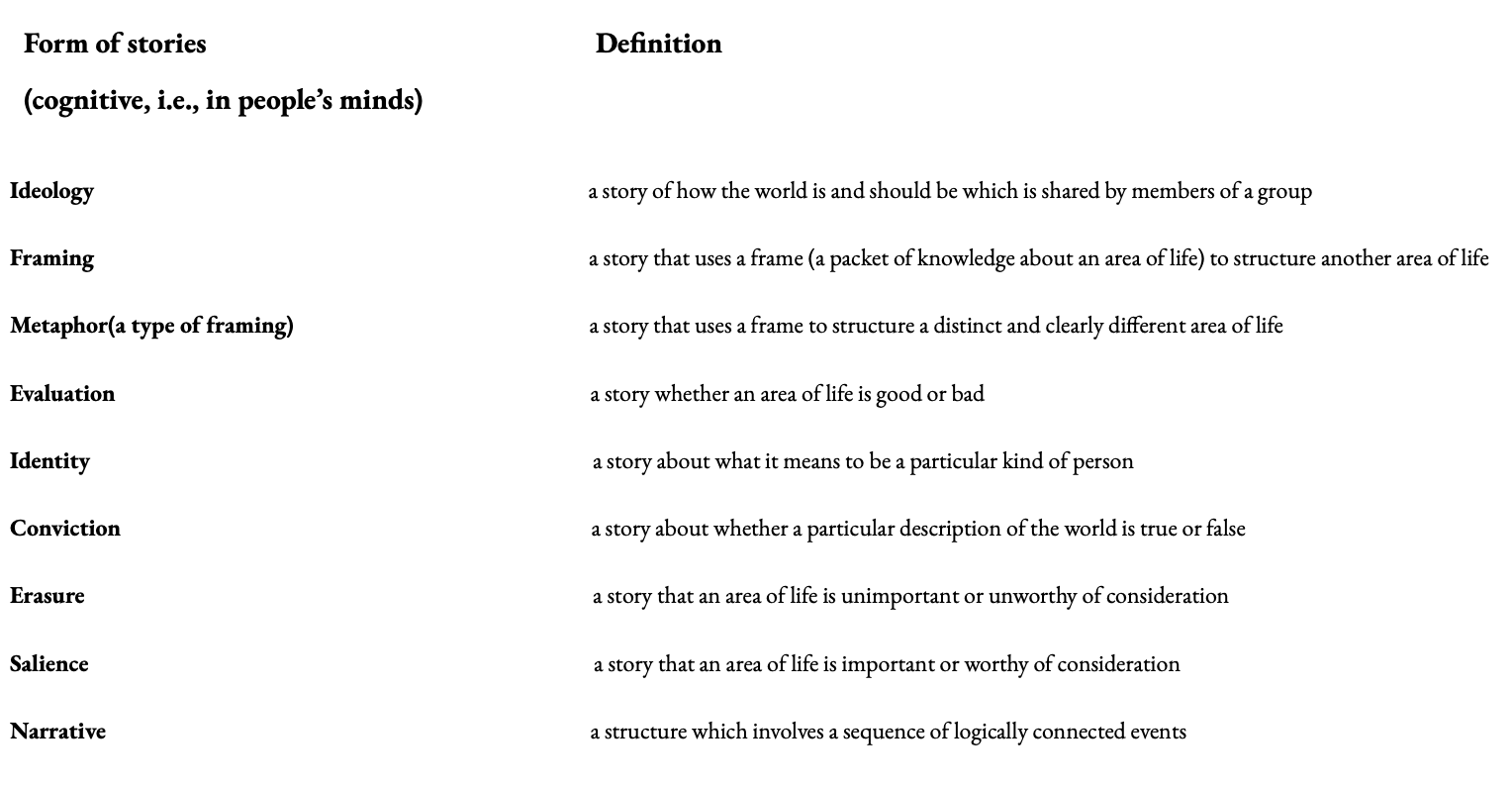
To analyse the linguistic patterns that shape how humans think about and treat other species and the world, ecolinguistics examines what Stibbe refers to as ‘the stories we live by’,¹³ which lie at the core of the environmental issues we (both human and nonhuman beings) are facing; these stories are then questioned from an ecolinguistic perspective, explicitly guided by the researcher’s “ecosophy”. Given that stories are mental models, they cannot be analysed directly; thus, ecolinguistic analysis draws from various linguistic theories, with each theory helping reveal a specific form of stories (see Table 1). Stories are exposed to either promote or challenge them, and to look for new stories that could work in the current state of the world. This process is guided by what Naess refers to as “ecosophy”,¹⁴ which denotes a set of philosophical principles that encompass ecological considerations. Notably there is no universal ecosophy; each researcher develops their own ecosophy based on their personal values, using it to evaluate the stories revealed in the analysis.¹⁵
TABLE 1 ¹⁶
2.1 | Positionality: Personal Ecosophy
My personal ecosophy for this project can be summed up in a single word: ‘co-living!’ It draws on Deep Ecology¹⁷ and feminist ethics.¹⁸ The exclamation mark in a personal ecosophy indicates that it is something to be valued and celebrated.¹⁹ All living beings, from the seed of a plant to an elephant, value their own lives which are inherently interconnected. I believe that the interconnectedness of all creatures, including humans, establishes an equal relation that calls for a shift in perspective. From an ecocentric standpoint, all lives have a right not merely to survive, but to live. Applied to NHAs, this implies that we humans should not perceive them solely as spectacles or resources to exploit. Humans are neither superior nor separate but part of the larger physical environment, with a responsibility to care for the well-being of all NHAs, whether ants or dogs, show empathy towards them by acknowledging the impacts of their actions on other sentient beings and, more generally, strive to harmonise with nature. An ethic of care recognises that human actions profoundly affect the lives of other living creatures within the web of life. Thus, the health of the planet lies in our recognition of the interdependence of all beings and in embracing the principle that living equals co-living!
3 | Methodology
To analyse how the Humboldt penguin is represented both linguistically and visually, I employed a multimodal analytical approach. Multimodal analysis examines how various semiotic tools, such as written language, gaze, images and proximity, combine to construe meaning.²⁰ Hence, language is not the sole or dominant mode for meaning-making, but one of many other modes, where each mode is a socially and culturally shaped semiotic resource.²¹ I therefore focused on both the material tools of communication (e.g., written language, image, colour in the signage) and how the uses of these tools are socially regulated. Multimodal analysis enabled me to investigate how different modes interact, reinforce or contradict one another, offering a richer understanding of how meaning is created and expressed.²² This approach is well-suited to contexts such as zoos, where the combination of various semiotic elements plays a fundamental role in shaping visitors’ perceptions of NHAs. Accordingly, I took 16 photographs within the penguin exhibit and selected 4 that balanced information about conservation and education with more engaging narratives. However, aware that photographs alone could not capture dynamic aspects, such as visitors’ interaction with NHAs and contextual elements key to uncovering hidden ideologies embedded in discourse, I also recorded field notes immediately after the zoo visit. I documented details such as the design of the enclosure alongside my observations. My choice to use multiple data collection methods allowed me to approximate an emic (insider) standpoint by examining how zoo signage mediates human interpretations of NHAs’ lives, experiences and agency.
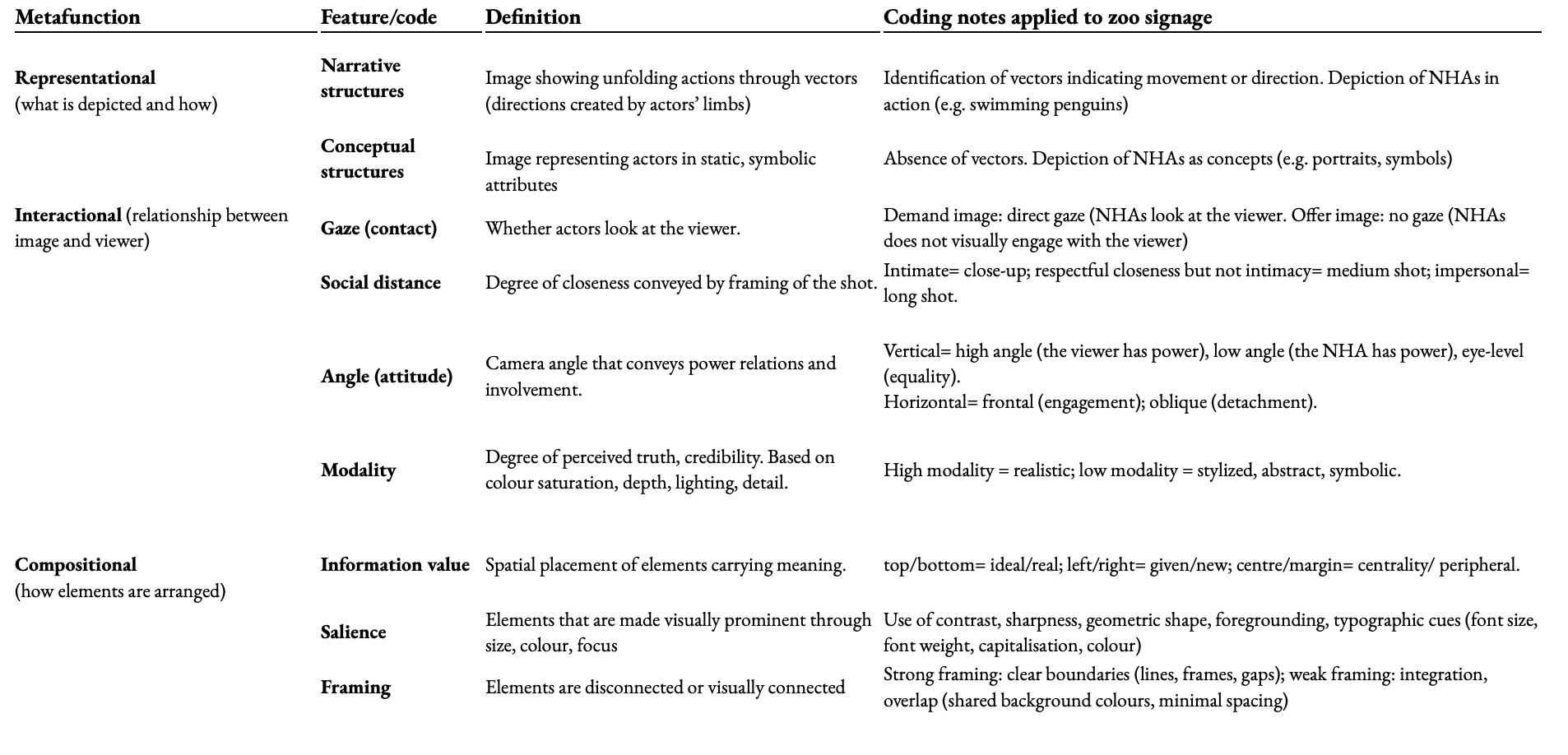
The broader study draws on two methodological frameworks²³: van Leeuwen’s social actor and social action theory and Kress and van Leeuwen’s visual grammar. van Leeuwen’s framework is apt for the linguistic analysis of the zoo signage, as it provides tools for examining how social actors²⁴ are purposely included or omitted and how social actions are described in relation to these actors. To complement the language analysis, I used Kress and van Leeuwen’s (2006) framework to examine visual representations of social actors in the zoo signage. The scholars argue that just as the grammar of language describes the way in which words combine into clauses and sentences, visual grammar²⁵ explains how depicted elements, such as objects and actors, are combined into coherent visual ‘statements’. Overall, the integration of these frameworks in the multimodal analysis allows a rich, multilayered account of how the zoo discursively portrays NHAs and ultimately helps reveal the types of stories embedded in the zoo discourse.
TABLE 2 ²⁶
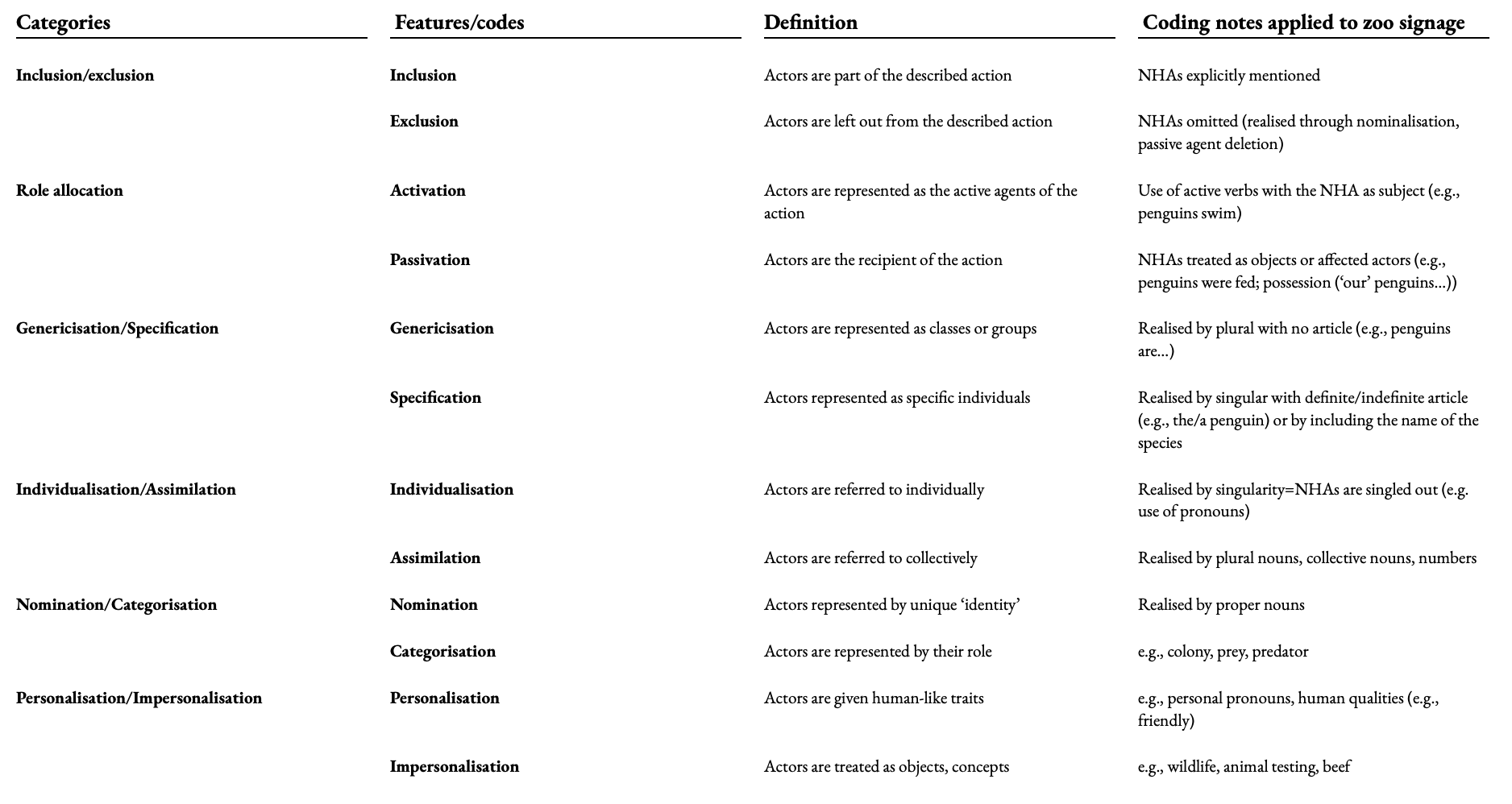
TABLE 3 ²⁷
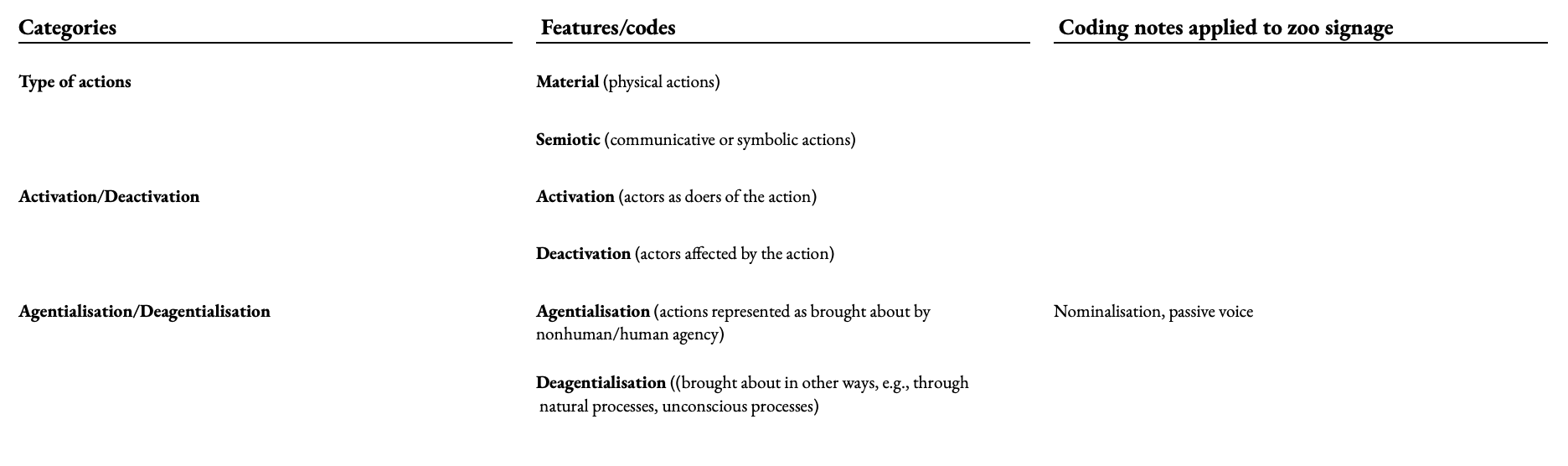
TABLE 4 ²⁸
¹ The term ‘nonhuman animal’ is used throughout the text to challenge an underlying assumption that humans and ‘animals’ are two separate entities, organised in a hierarchical relation. Following Darwin’s (1872) argument that both physical and mental traits exist along a continuum shared by humans and NHAs, humans are animals in biological terms. This nomenclature positions human animals and NHAs as equal beings.
² Discipline and distancing: Confined pigs in the factory-farm gulag by J. Novak, 2012.
³ “A pig is a person” or “you can love a Fox and hunt it”: Innovation and tradition in the discursive representation of animals by G. Cook, 2015.
⁴ Anthropocentrism’ refers to the tendency to classify NHAs according to the usefulness of humans (Cook and Sealey, 2018).
⁵ The term ‘zoo’d animal’ rather than ‘zoo animal’ is adopted in this text, aligning with Milstein’s (2013) view that humans are the implicit agents in the process of removing NHAs from their habitats and confining them in zoos.
⁶ “Touch the magic” by S. Davis, 1996.
⁷ The wild animal in late modernity: The case of the Disneyization of zoos by Beardsworth and Bryman, 2001.
⁸ ibid p.88.
⁹ The notion of ‘discourse’, in the Foucauldian sense, is defined as: “Discourses are ways of referring to or constructing knowledge […] a cluster […] of ideas, images and practices, which provide ways of talking about, forms of knowledge and conduct associated with, a particular topic, social activity or institutional site in society” (Hall, 1997, p.6). A discursive approach, then, is concerned not only with how language (and other semiotic tools) and representation produce meaning, but also with how the knowledge produced by a specific discourse links to power and regulates behaviour (ibid.).
¹⁰ Ecolinguistics examines the interaction between language and ecology. The link between these two domains is that human thoughts, ideologies and worldviews, all of which are shaped by language, influence how humans treat other humans and the natural world (Stibbe, 2021). It is through language that the latter is mentally reduced to exploitable resources, and it is through language that human beings can be encouraged to care for the physical environment that supports life (ibid.). Hence, ecolinguistics examines “the role of language in the life-sustaining interactions of humans with other humans, other organisms and the physical environment” (ibid., p.9). Ecologically, an ecolinguistic approach focuses on exposing different types of discourses that are ecologically destructive and also aims to find and promote alternative discourses that can aid the protection of the conditions that sustain life.
¹¹ Stories are mental models or cognitive structures that exist in each person’s mind. They can manifest not only in language but also in other ways, such as in visuals. These stories, such as those of conservation, are shared by large groups of individuals. They circulate mentally throughout society as part of what van Dijk (2009, p.19) terms “social cognition”.
¹² It is widely recognised that the penguin exhibit remains one of London Zoo's premier visitor attractions, and Penguin Beach stands out as a flagship feature.
¹³ Ecolinguistics: Language, ecology and the stories we live by, by Stibbe, 2021.
¹⁴ An abbreviation of ecological philosophy by Naess, 1995.
¹⁵ As Stibbe reiterates in Ecolinguistics: Language, ecology and the stories we live by, 2021.
¹⁶ Adapted from Stibbe, 2021, p.17.
¹⁷ Deep Ecology is an environmental philosophy that recognises the intrinsic worth of humans, NHAs, plants and the natural world (i.e. their value regardless of their usefulness to humans (Naess, 1995).
¹⁸ Feminist ethics (or most notably ecofeminism) is a theory that advocates, inter alia, for an ethics of care, which emphasises relationality and empathy. Our moral obligation to the natural world should stem from our dependence on the interwoven ecological systems, as well as from an understanding of vulnerability (Peterson, 2001).
¹⁹ Stibbe, 2021.
²⁰ Multimodal analysis within an interactive software environment: Critical discourse perspectives by O’Halloran et al., 2011.
²¹ The Routledge encyclopedia of research methods in applied linguistics by Mehdi Riazi, 2016.
²² Multimodal discourse: The modes and media of contemporary communication byKress and van Leeuwen, 2001.
²³ Both frameworks are based on Critical discourse analysis (CDA). As a theoretical approach, it aims to uncover evidence of covert exercise of power and ideological presuppositions about what is socially constructed and ‘naturalised’ in discourse through language and visuals. As an analytical approach, CDA seeks to reveal hidden ideologies embedded in discourse by examining linguistic and visual features present in texts and images (Stibbe, 2021). Most importantly, CDA inevitably intervenes “on the side of dominated and oppressed groups (NHAs in this context) and against dominating groups” (Fairclough and Wodak, 1997, pp.258-259).
²⁴ Participants represented in the discourse analysed here (van Leeuwen, 2008).
²⁵ Here, ‘grammar’ is defined as follows: “Grammar goes beyond formal rules of correctness. It is a means of representing patterns of experience [...] It enables human beings to build a mental picture of reality, to make sense of their experience of what goes on around them and inside them” (Halliday, 1985, p.101).
²⁶ van Leeuwen’s social actor theory coding framework from Discourse and practice: New tools for critical analysis, 2008.
²⁷ van Leeuwen’s social action coding framework in ibid.
²⁸ Kress and van Leeuwen’s coding framework for visual analysis from Reading images: The grammar of visual design, 2006.
²⁹ picked up from observations and recorded in field notes.
³⁰ recorded in field notes.
³¹ Bekoff (2007) defines animal agency as the ability of NHAs to engage in goal-directed behaviour and to make choices based on their own experiences and preferences.
³² Discourse and practice: New tools for critical analysis by van Leeuwen, 2008.
³³ recorded in field notes.
³⁴ Although the water droplets are identical in both Figures 2 and 4, the choice to include a text suggesting movement in Figure 2 adds a different meaning to this visual feature. This is an example of how different semiotic tools (i.e., language and images) combine to construe meaning.
³⁵ picked up from observations and recorded in field notes.
³⁶ i.e., the degree of closeness conveyed by the framing of the shot.
³⁷ ‘Anthropomorphism’ refers to the projection of human traits and emotions onto NHAs (Stibbe, 2012).
³⁸ Ecolinguistics: Language, ecology and the stories we live by, by Stibbe, 2021.
³⁹ Different nature: The paradoxical world of zoos and their uncertain future by Hancocks, 2001.
⁴⁰ “Somethin’ tells me it’s all happening at the zoo”: Discourse, power, and conservationism by Milstein, 2009.
⁴¹ Animal autobiography; or, narration beyond the human by Herman, 2016, p.1.
⁴² “But she was woman; he was dog” - A posthumanist approach to canine subjectivity in Virginia Woolf’s Flush by Chakraborty, 2021, p.58.
⁴³ Multispecies discourse analysis: The nexus of discourse and practice in sea turtle tourism and conservation by Lamb, 2024.
SOURCES CITED
Published Sources:
Baratay, E. and Hardouin-Fugier, E. (2002). Zoo: A history of zoological gardens in the West. London: Reaktion Books.
Beardsworth, A. and Bryman, A. (2001). ‘The wild animal in late modernity: The case of the Disneyization of zoos.’, Tourist Studies, 1(1), pp. 83–104. doi:10.1177/146879760100100105.
Bekoff. (2007). The emotional lives of animal: A leading scientist explores animal joy, sorrow, and empathy—and why they matter. Novato: New World Library.
Chakraborty, S. (2021) ‘“But she was woman; he was dog” - A posthumanist approach to canine subjectivity in Virginia Woolf’s Flush’, Consortium: An international journal of literary and cultural studies, 1(2), pp. 52–59.
Cook, G. (2015). ‘“A pig is a person” or “you can love a Fox and hunt it”: Innovation and tradition in the discursive representation of animals’, Discourse & Society, 26(5), pp. 587–607. doi:10.1177/0957926515576639.
Cook, G. and Sealey, A. (2018). ‘The discursive representation of animals’, in A.F. Fill and H. Penz (eds.) The Routledge Handbook of Ecolinguistics. New York: Routledge, pp. 311–324.
Darwin, C. (1872). The expression of the emotions in man and animals. London: John Murray.
Davis, S. (1996). ‘“Touch the magic”’, in W. Cronon (ed.) Uncommon ground: Rethinking the human place in nature. New York: W.W. Norton & Company, pp. 204–217.
Fairclough, N. and Wodak, R. (1997). ‘Critical discourse analysis’, in T. van Dijk (ed.) Discourse as Social Interaction. London: Sage, pp. 258–284.
Hall, S. (ed.) (1997). Representation: Cultural representations and signifying practices. London: SAGE Publications.
Halliday, M.A.K. (1985). An introduction to functional grammar. London: Edward Arnold.
Hancocks, D. (2001). Different nature: The paradoxical world of zoos and their uncertain future. Berkeley: University of California Press.
Herman, D. (2016). ‘Animal autobiography; or, narration beyond the human’, Humanities, 5(4), pp. 1–17. doi:10.3390/h5040082.
IUCN. (2025). The IUCN red list of threatened species. Available at: https://www.iucnredlist.org/ (Accessed: 01 June 2025).
Kress, G. and van Leeuwen, T. (2001). Multimodal discourse: The modes and media of contemporary communication. London: Arnold.
Kress, G. and van Leeuwen, T. (2006). Reading images: The grammar of visual design. 2nd edn. Milton Park, Abingdon: Routledge.
Lamb, G. (2024). Multispecies discourse analysis: The nexus of discourse and practice in sea turtle tourism and conservation. London: Bloomsbury.
Mehdi Riazi, A. (2016). The Routledge encyclopedia of research methods in applied linguistics. Milton Park, Abingdon: Routledge.
Milstein, T. (2009). ‘“Somethin’ tells me it’s all happening at the zoo”: Discourse, power, and conservationism’, Environmental Communication, 3(1), pp. 25–48. doi:10.1080/17524030802674174.
Milstein, T. (2013). ‘Banging on the divide: Cultural reflection and refraction at the zoo’, in E. Plec (ed.) Perspectives on human-animal communication: Internatural communication. New York: Routledge, pp. 162–181.
Naess, A. (1995). ‘The shallow and the long range, deep ecology movement’, in A. Drengson and Y. Inoue (eds.) The deep ecology movement: an introductory anthology. Berkeley: North Atlantic Books, pp. 3–10.
Novak, J. (2012) ‘Discipline and distancing: Confined pigs in the factory-farm gulag. ’, in A. Gross and A. Vallely (eds.) Animals and the human imagination: A companion to animal studies. New York: Columbia University Press, pp. 121–151.
O’Halloran, K.L., Tan, S., Smith, B.A. and Podlasov, A. (2011). ‘Multimodal analysis within an interactive software environment: Critical discourse perspectives’, Critical Discourse Studies, 8(2), pp. 109–125. doi:10.1080/17405904.2011.558687.
Peterson, A.L. (2001). Being human: Ethics, environment, and our place in the world. Berkeley: University of California Press.
Stibbe, A. (2012). Animals erased: Discourse, ecology, and reconnection with the natural world. Middletown: Wesleyan University Press.
Stibbe, A. (2014). ‘Ecolinguistics and erasure: Restoring the natural world to consciousness’, in C. Hart and P. Cap (eds.) Contemporary critical discourse studies. London: Bloomsbury, pp. 583–602.
Stibbe, A. (2021). Ecolinguistics: Language, ecology and the stories we live by. 2nd edn. Abingdon: Routledge.
van Dijk, T.A. (2009). Society and discourse: How social contexts influence text and talk. Cambridge: Cambridge University Press.
Van Leeuwen, T. (2008). Discourse and practice: New tools for critical analysis. New York: Oxford: University Press.
Common Knowledge:
Although the water droplets are identical in both Figures 2 and 4, the choice to include a text suggesting movement in Figure 2 adds a different meaning to this visual feature. This is an example of how different semiotic tools (i.e., language and images) combine to construe meaning.
It is widely recognised that the penguin exhibit remains one of London Zoo's premier visitor attractions, and Penguin Beach stands out as a flagship feature.
I.e., the degree of closeness conveyed by the framing of the shot.
Direct Conversation:
Picked up from and recorded in observations and field notes.
COPYRIGHT NOTICE:
The photographs included in this text were taken by the author. Any logos, trademarks, and graphic designs visible on the signage remain the intellectual property of the Zoological Society of London (ZSL). They are reproduced solely for the purposes of academic analysis and education.