
Meeting Bovine Bodies by Xena Louise Stockley White (she/her)
DOI: https://doi.org/10.5281/zenodo.21402850
Published July 19, 2026.
Keywords: beyond-the-human translation, urban ecologies, visual anthropology;
Meeting Bovine Bodies
ENDING AND BEGINNING
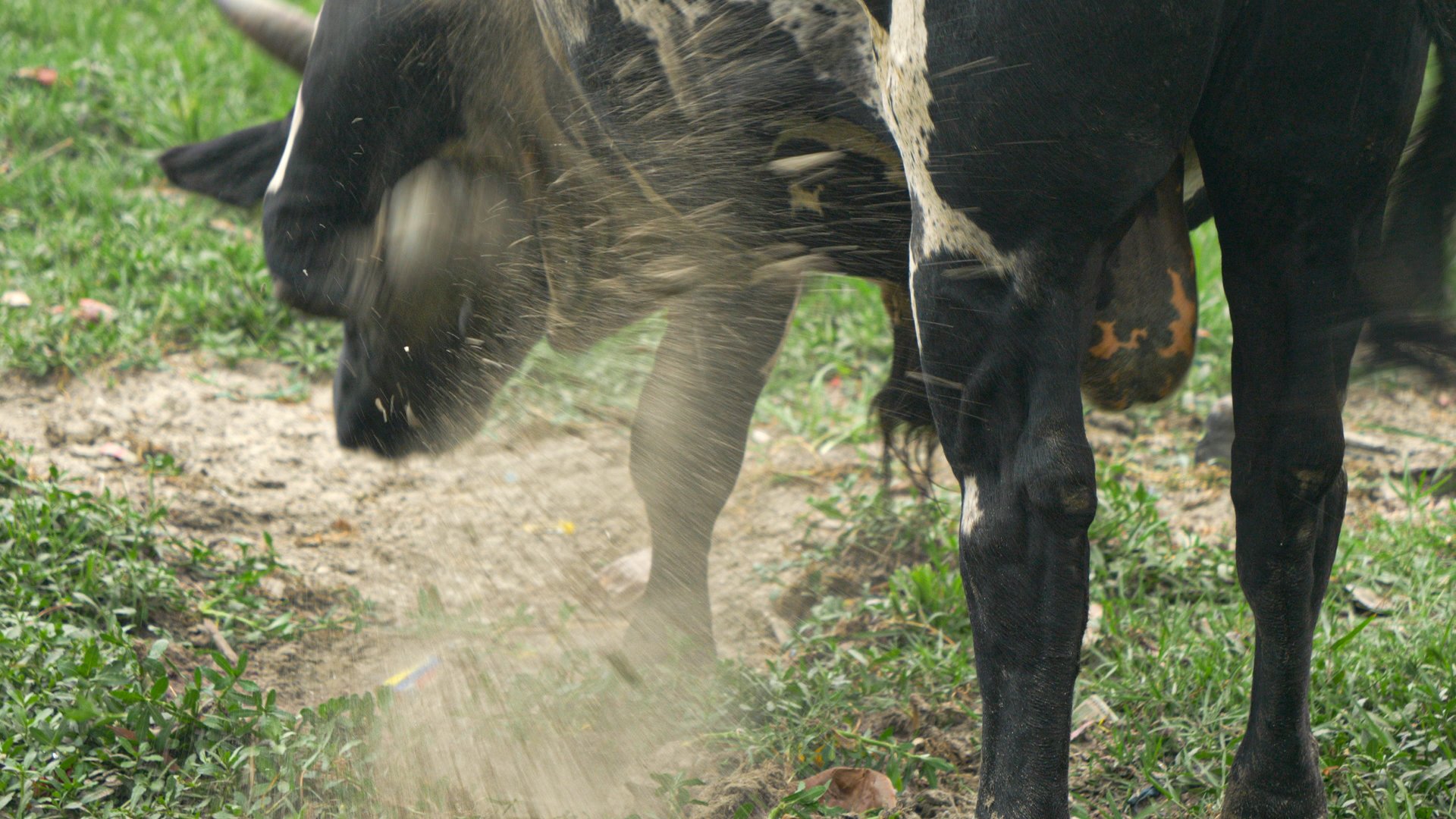
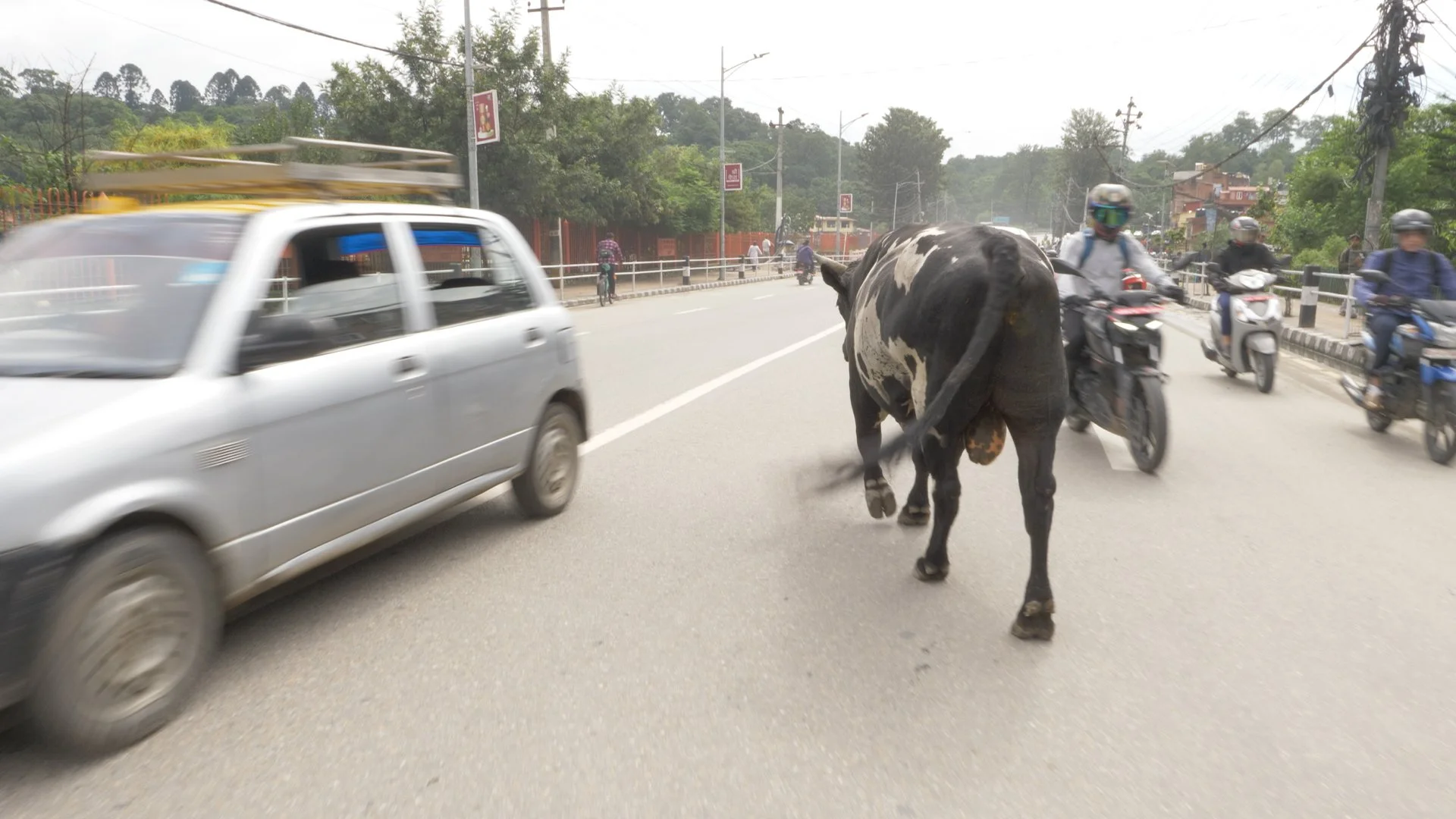
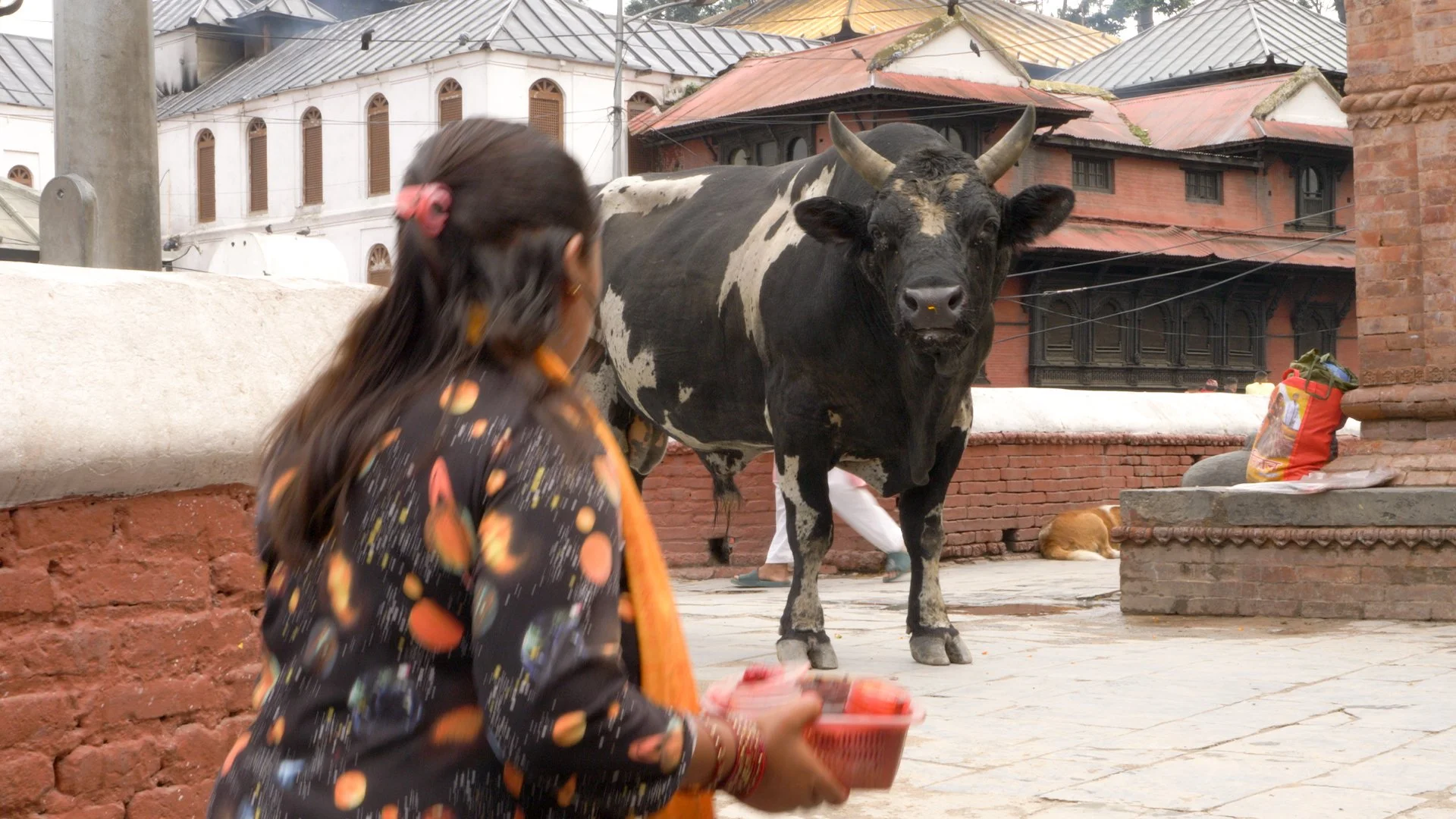
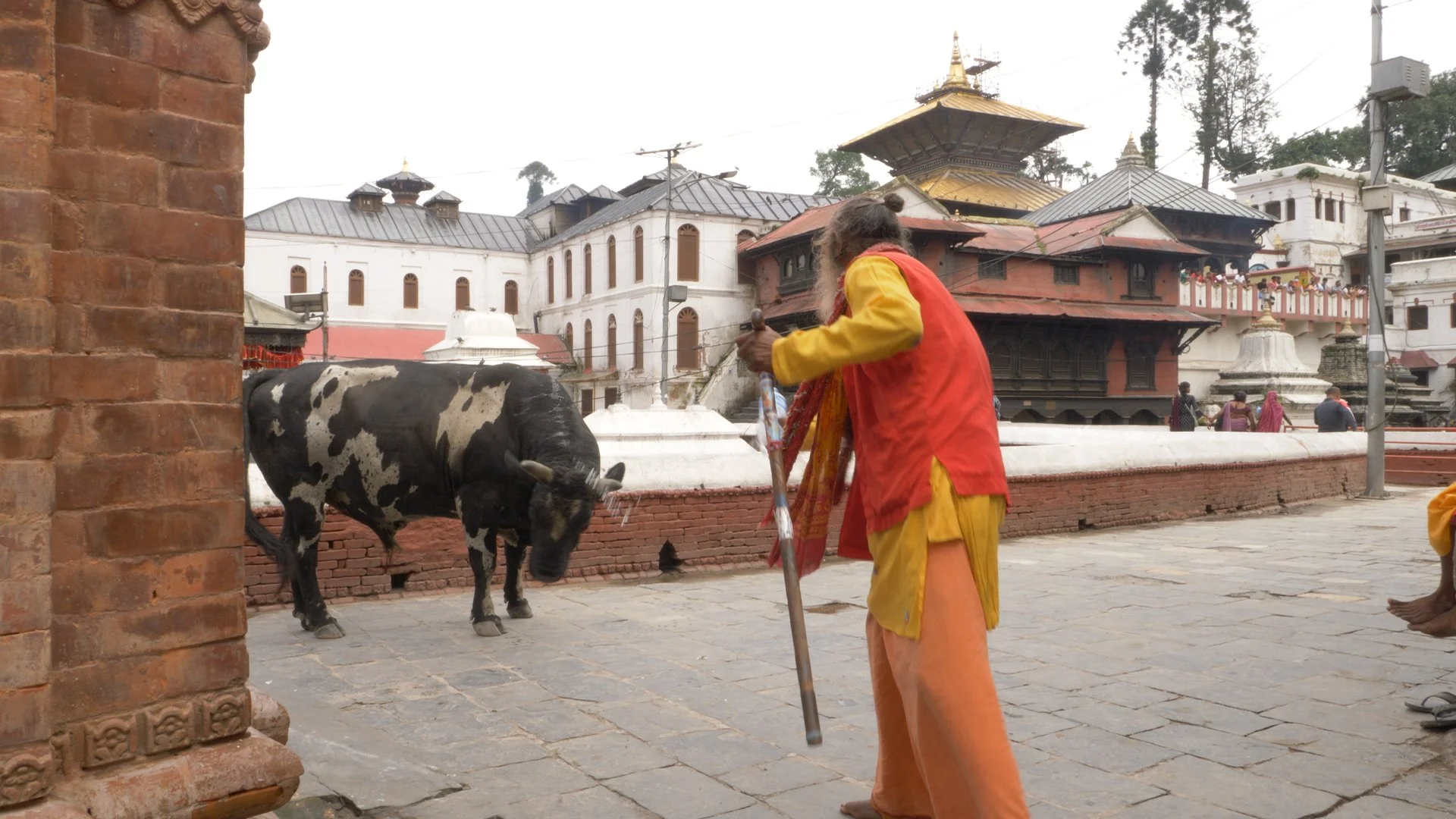
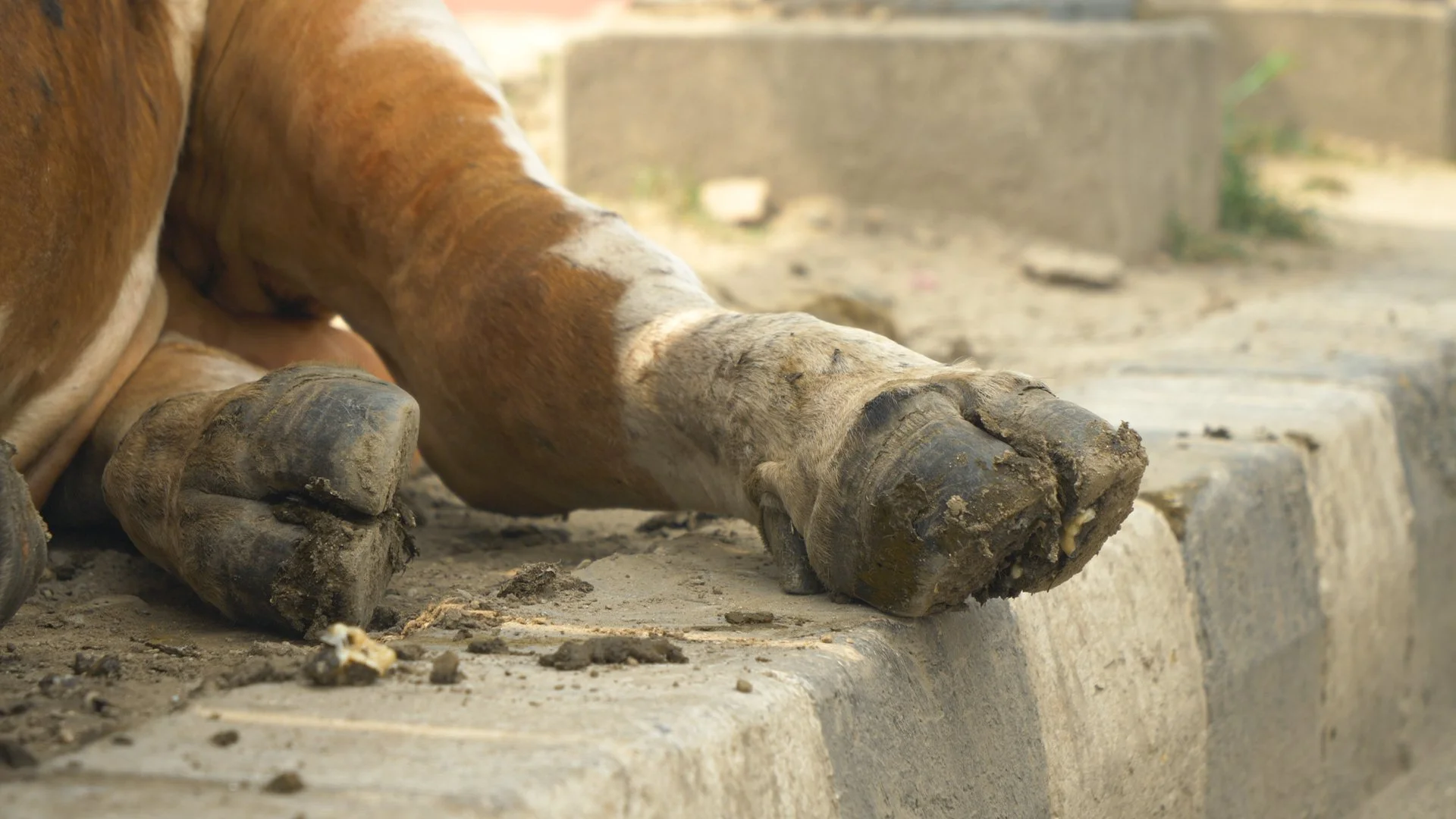
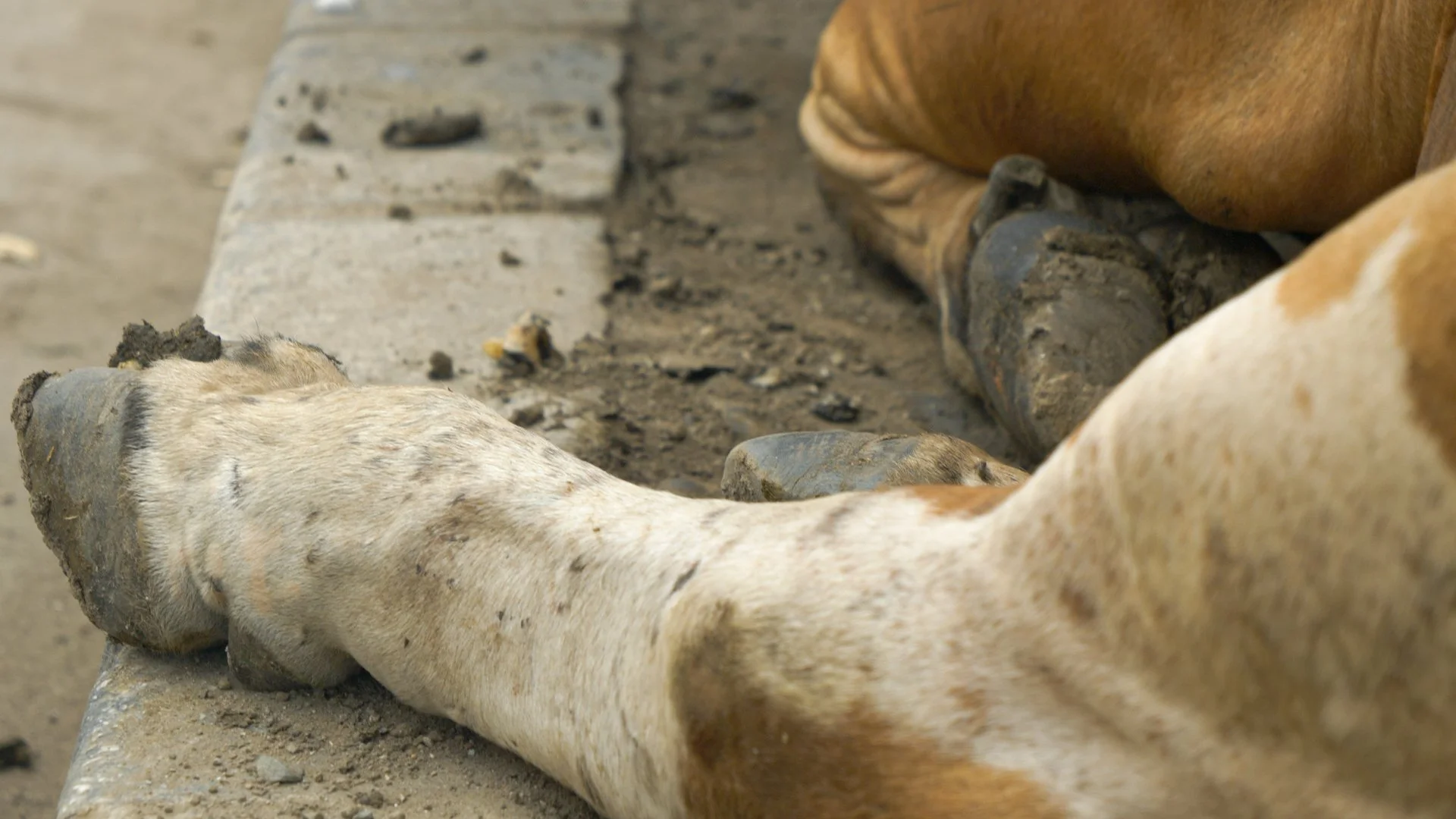
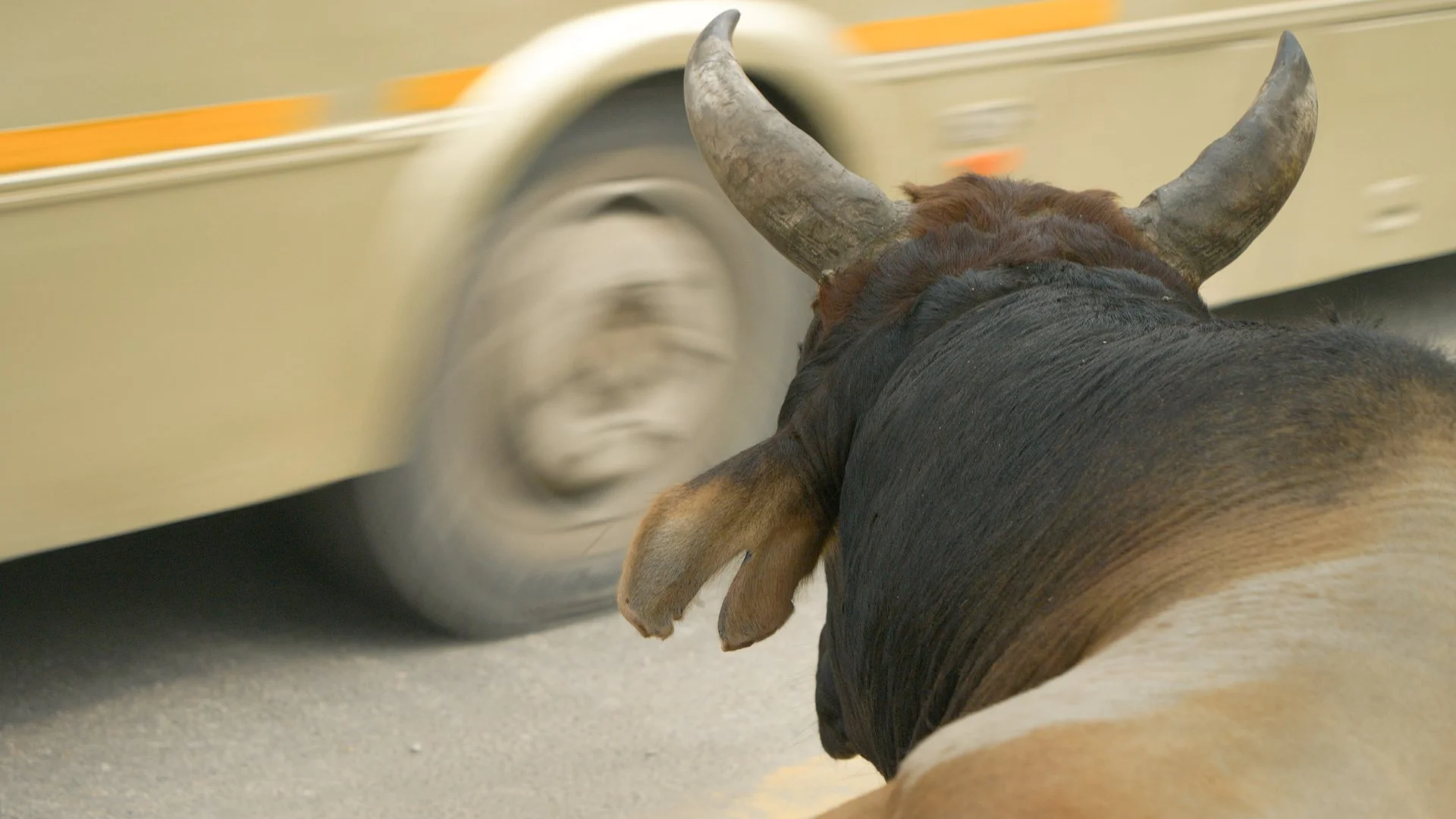
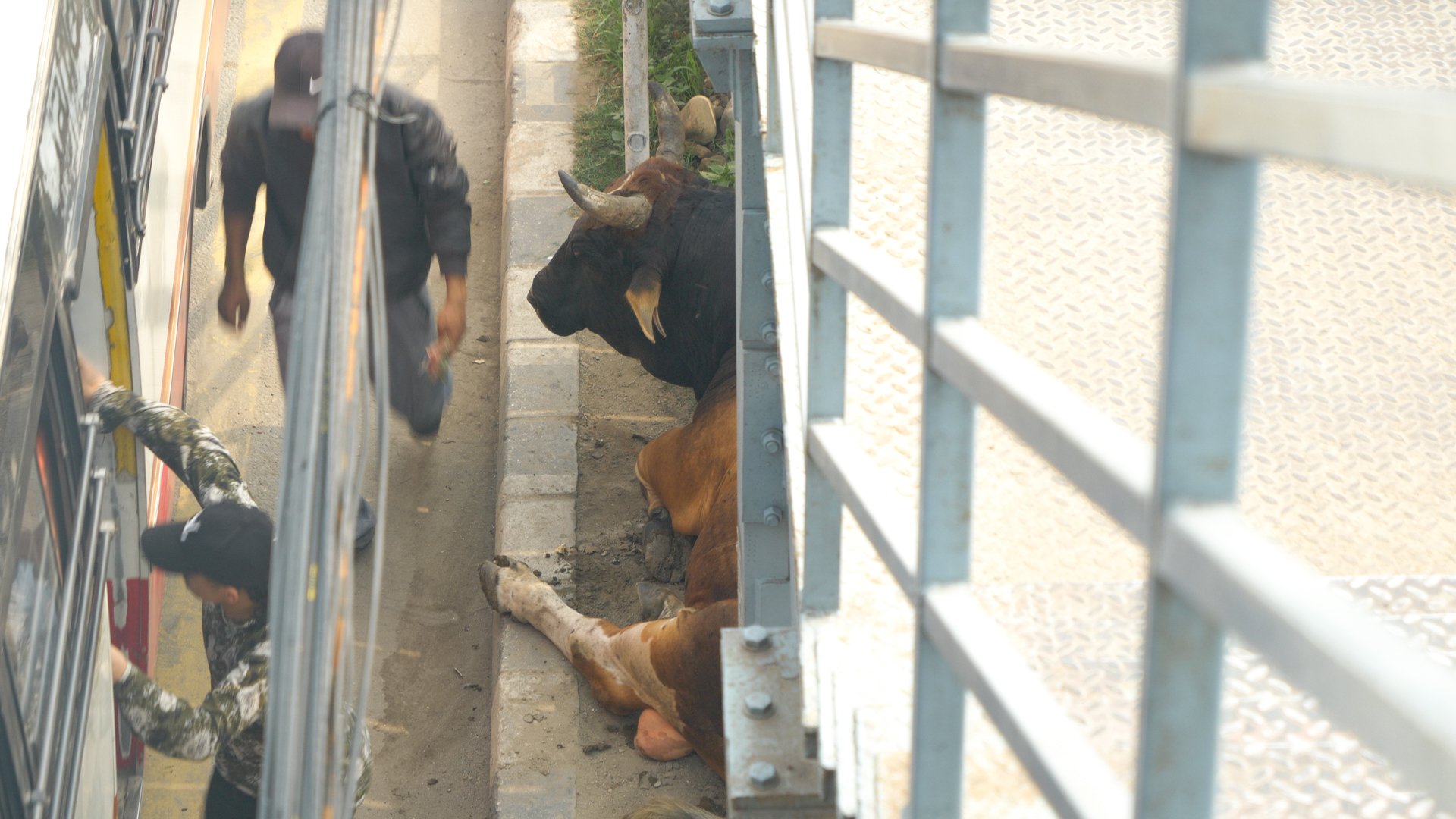
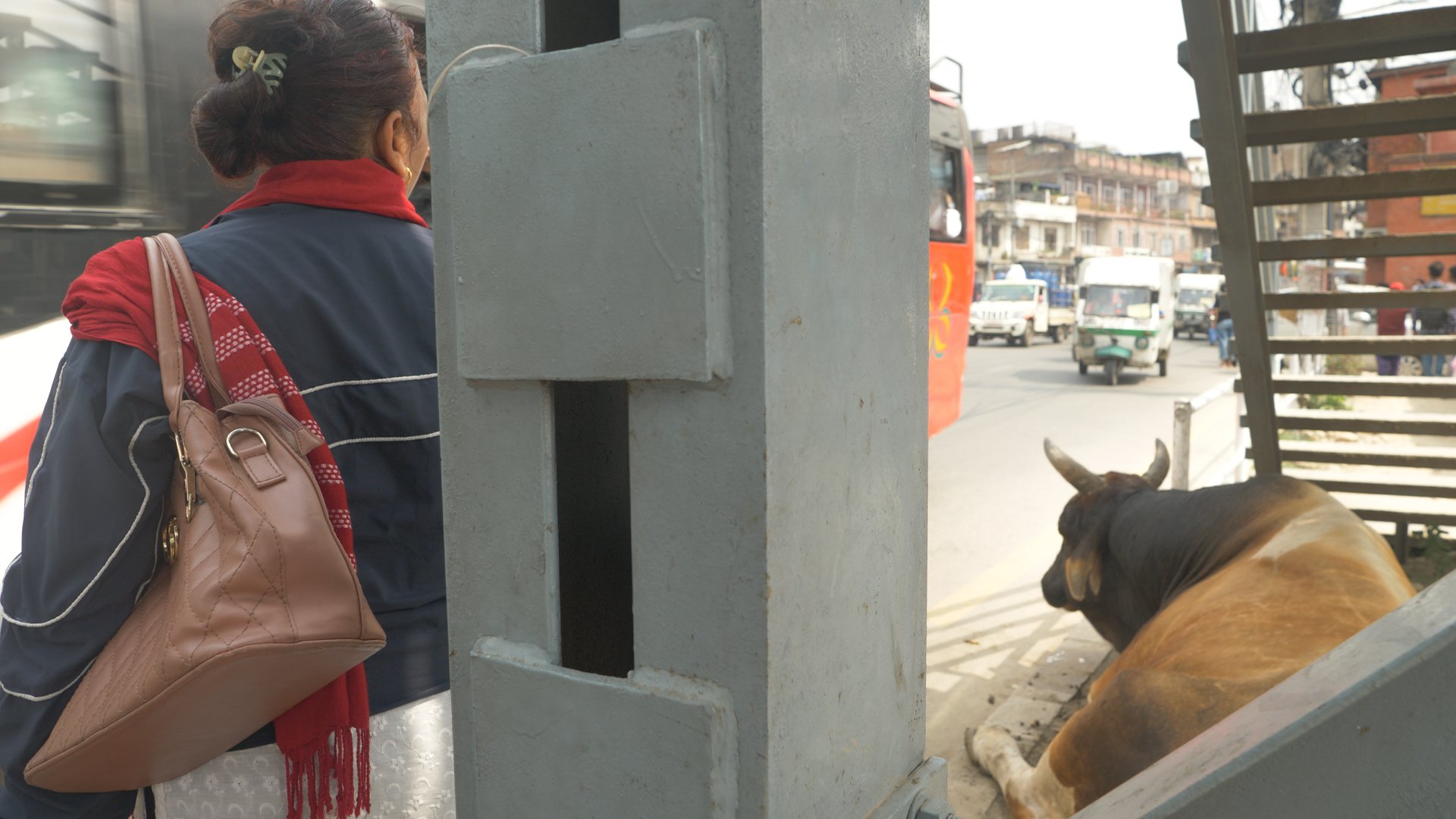
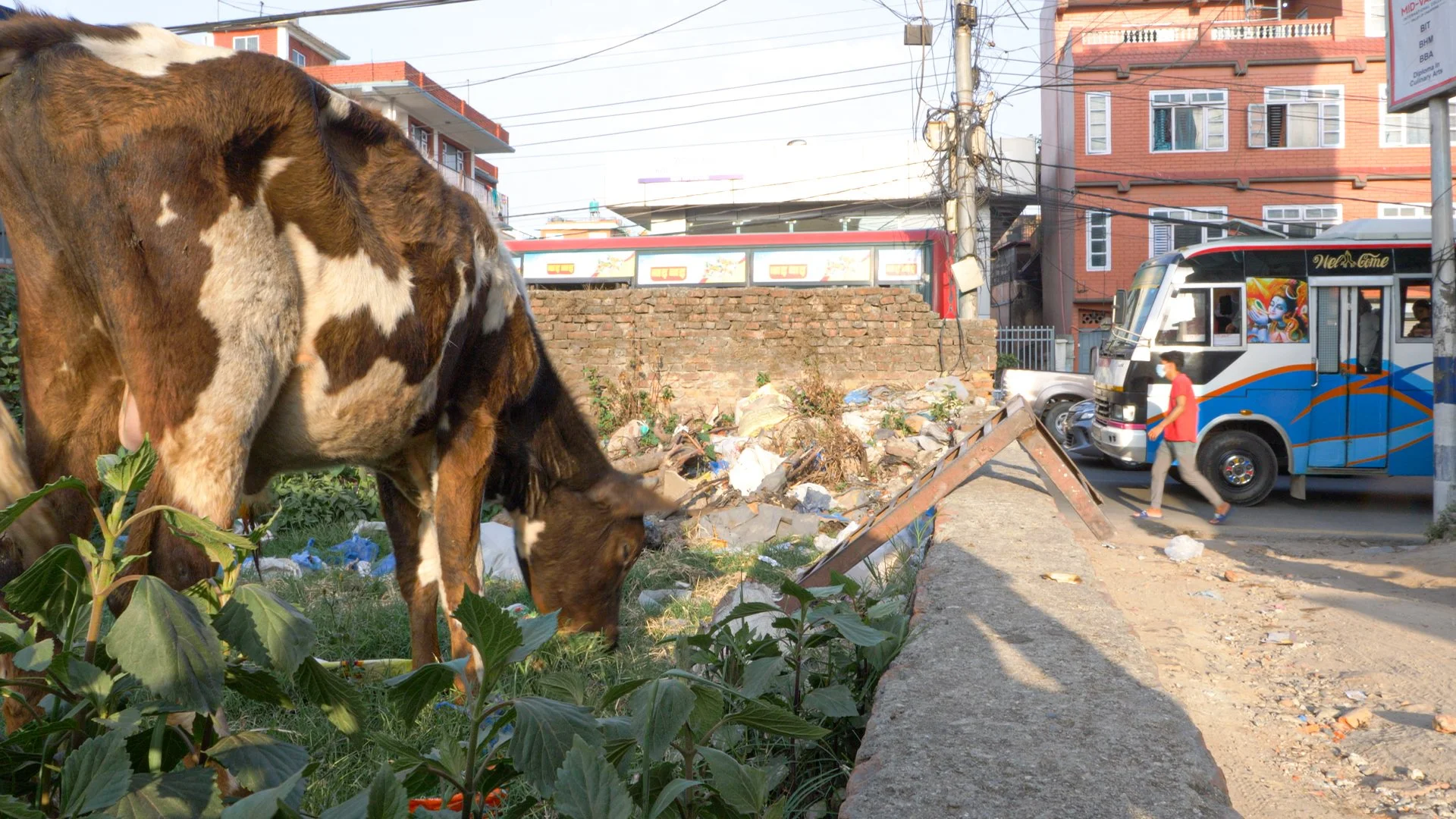
Filming bulls through the paradigm of encounters, I learnt that creating the conditions for co-existence to be sustained, required a reciprocal adjustment to ‘otherness’; cattle adjusted to human-infrastructure, such as crossing the road at a zebra crossings, yet conversely, human drivers predicted and anticipate the movement of bulls, leading them to driving habitually slowerer even when no bulls were present. Their routines also developed around species preference of the other, whereby cattle became socialized into human rhythms of temple life, gathering during morning and evening aarti to munch on ritual waste like marigold flowers,²³ yet they also ‘domesticated’ aspects of human behaviour, such as the spatial organization of shops, with one shopkeeper packing their sign down before 5pm, when Ghaumandi characteristically passed, to prevent it getting knocked over. Undoubtedly however, species differences motivated the intention for connection; all temple go-ers I met, majorly structured their relationship to cattle through religious narrative, and by positioning the cattle within the sacred order of the temple their encounters were shaped through symbolic modalities of relating.²⁴ They would feed the cattle and bless themselves through touching bovine bodies. However it is the nature and preference of cattle to not move away when feeling human touch, and to accept food offerings by hand, whereby cattle preferences and tolerances were the characteristics that enabled devotees to serve their gods. Co-existence, I came to find, is mediated by a shared interest in self-preservation and fulfilment, and how these shared interests, expressed through disparate ontologies can coalesce in the orchestra of the city. It requires recognizing each species' relational capacity; for humans majorly symbolic and for cattle primarily sensory. Power is always distributed in these meeting points as communication, habits and space are all up for negotiation challenging traditional assumptions of cattle passivity or instrumentality. This dissolves the simplistic binaries — wild or domestic, inalienable or commodified, human and cattle — toward the fluid, context-bound ways in which beings shape and are shaped by each other, and when they momentarily inhabit the other when sharing contact. The encounter is the true boundary from which both beings are changed.
Being inserted experientially into this encounter, as another component of it, brought me into the dialectic of human—non-human animal encounters, whilst bringing unstable boundaries of my own identity into the moment of meeting. My outsider status to both cattle and Nepal cannot, and should not, be abstracted from my positionality as my camera frames in Nandi and undoubtedly the sense of the outsider prevails in the film. This is perhaps even more apparent when Deepak takes the camera and films the herd with his own framing. He focuses on the teats - I assume as the milking capacity of the cows is what he attends to with greatest interest, whereby my own framing is less certain, more vague perhaps. My experience was not unique in the fact that my cultural blind spots lead to serendipitous misunderstandings, enabling me to see cultural patterns which were perhaps implicit. In a similar rhythm, the mishaps of not finding cattle, or disturbing them with my proximity informed my understanding of the preferences that punctuate their lives in a different cadence to my own, like what determined acceptable proximity, and what spaces (standing in the middle of the road, or in a rubbish pile) may be tolerable or even preferable to them with my mounting discomfort. It is important to also work diligently to avoid extractive research, and this becomes even more complicated when working with non-human others, but as I have shown, coming to understand those boundaries is inseparable from the method itself.
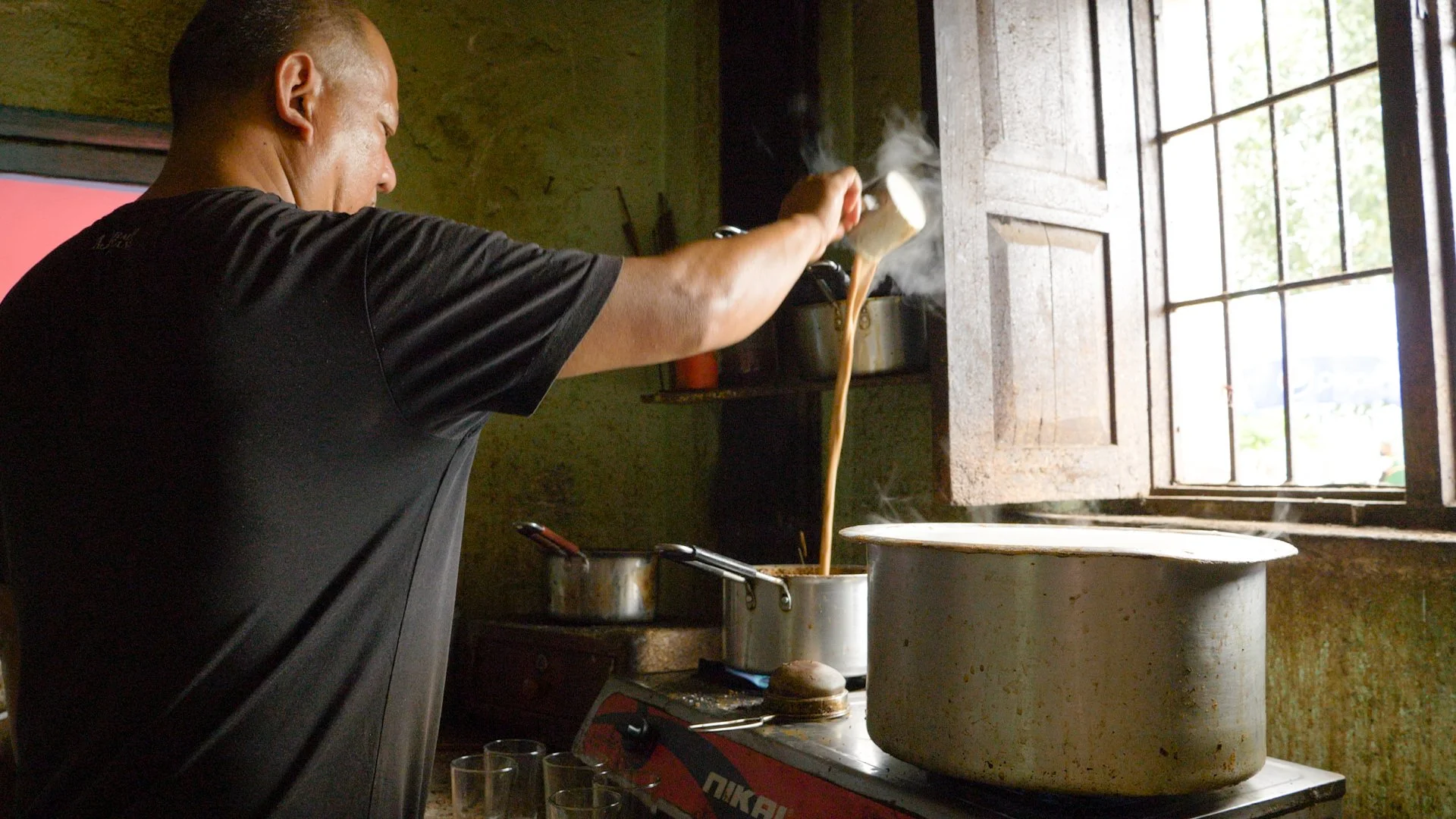
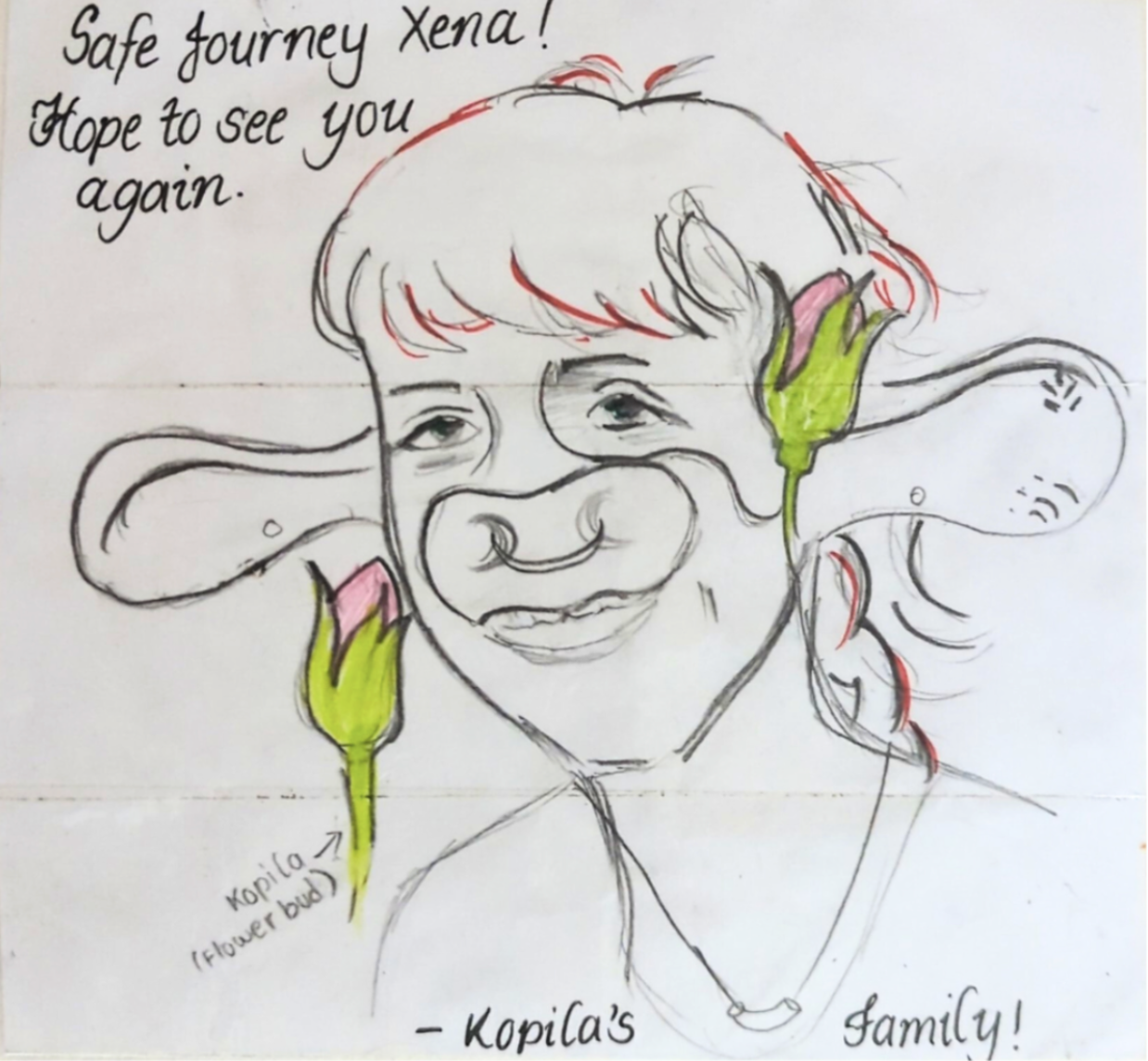
During my stay in Nepal I had rented a room from Kopila, who had invited me into the fold of her family. Alongside struggling through morning fitness classes together, discussing my research over spiced chiya²⁵, they also took me to visit family friends rearing cattle in peri-urban smallholdings. Weeks later, as I left Nepal, the daughter of Kopila handed me a drawing. Her playful depiction of my transformation is symbolic, blending human (myself) with non-human animal features—bull ears and nose—suggesting a merging of identities. On one level, this serves as a visual metaphor for my immersion into the world of the bulls I aimed to film, highlighting that to truly understand them, I needed to, in a sense, “become” one of them, underscoring the relational dynamics of fieldwork and the fluid boundaries between ‘self’ and ‘other.’
However, if anthropomorphism describes the risk of rendering animals in the image of the human, the drawing, a form of zoomorphism, enacted something else: a local relational epistemology in which prolonged association with cattle had made me, in the eyes of those around me, partially bovine. Both anthropomorphism, and zoomorphism can be harmful when they intend to misrepresent reality, in the former when non-human animals become valued only because they act like humans devaluing their intrinsic “animalness’ or in the case of the latter, assigning animalistic traits to humans can be used to demean, dehumanize, or strip people of their agency. But the boundary between ourselves and others is also a porous membrane, and when we encounter the radical strangeness of an "other," we are forced to confront the limits of our own humanity, unearthing the animal or unknown within ourselves. Encountering this "strangeness" strips away human exceptionalism, revealing our shared vulnerability and the constructed, rather than absolute, nature of our own boundaries.
As global capitalism continues to surge with its electric pulse, the Third Culture has lost the exclusivity of the past. Identity contradictions are common in a world where the shedding and acquisition of identity is often defined through consumption. As being “out of place” is now in place - the modern baseline, we must find comfort in the nuance of the ‘Third.’ Relying on dichotomies of the wild or domestic, although being comfortable, no longer find salience and reduce the complexity of lives in a justification of dominion. A willingness to meet the ‘Other’ and confront the ‘Otherness’ within ourselves, will be the power of staying with the murkiness.
I meandered up a narrow cobbled street on a dusty evening at dusk, passing ashrams¹ to my left and vegan cafes to my right. I was in the paradoxical town of Rishikesh in Northern India, a historic place for possession renunciation for spiritual pursuits now a modern hotbed of the commodification of ‘Eastern’ spirituality, with tourists flocking to the yoga capital of the world.
Rounding the corner, a large brown cow with a stiff bowed leg lumbered, and eventually stopped, blocking my passage. Her head moved towards the juicy mangos in my see-through plastic bag. I offered one. Her tongue swept across my palm—wet, insistent, warm. Then she turned and continued down the road to a destination unknown (to me).
My mother was born to two English parents, missionaries sent to farm rice in Bangladesh while she was sent to a boarding school in the rural Nilgiri hills in Southern India. A ‘Third Culture Kid,’ when moving back to the UK in her 20s she belonged to both everywhere and nowhere, with an acquired and required adaptability to the situation she found herself in. I too inherited a dispersed sense of home, and visited India to attempt to connect with the stories she had told me of her upbringing,² whilst I carried the baggage of this colonial legacy as part of my pack.
Perhaps that's partly why I became so intrigued by this cow blocking the path, seemingly somewhere yet no-where. The metaphoric ‘Third Culture Cow’ with their floating identity - living between the culture of commercial dairies, the temple, and the streets. Positioned at the margins of society, these cattle embody a liminal existence—caught in complex intersections of devotion and neglect, care and exploitation, poverty and greed, emotion and business, religion and politics, personal choices, and structural constraints.³
Questions accumulated in the wake of her departure. Where was she going? Did she follow routine and the familiar? Did someone consider her theirs? How had she come to inhabit that street? Who noticed her absence if she did not return?
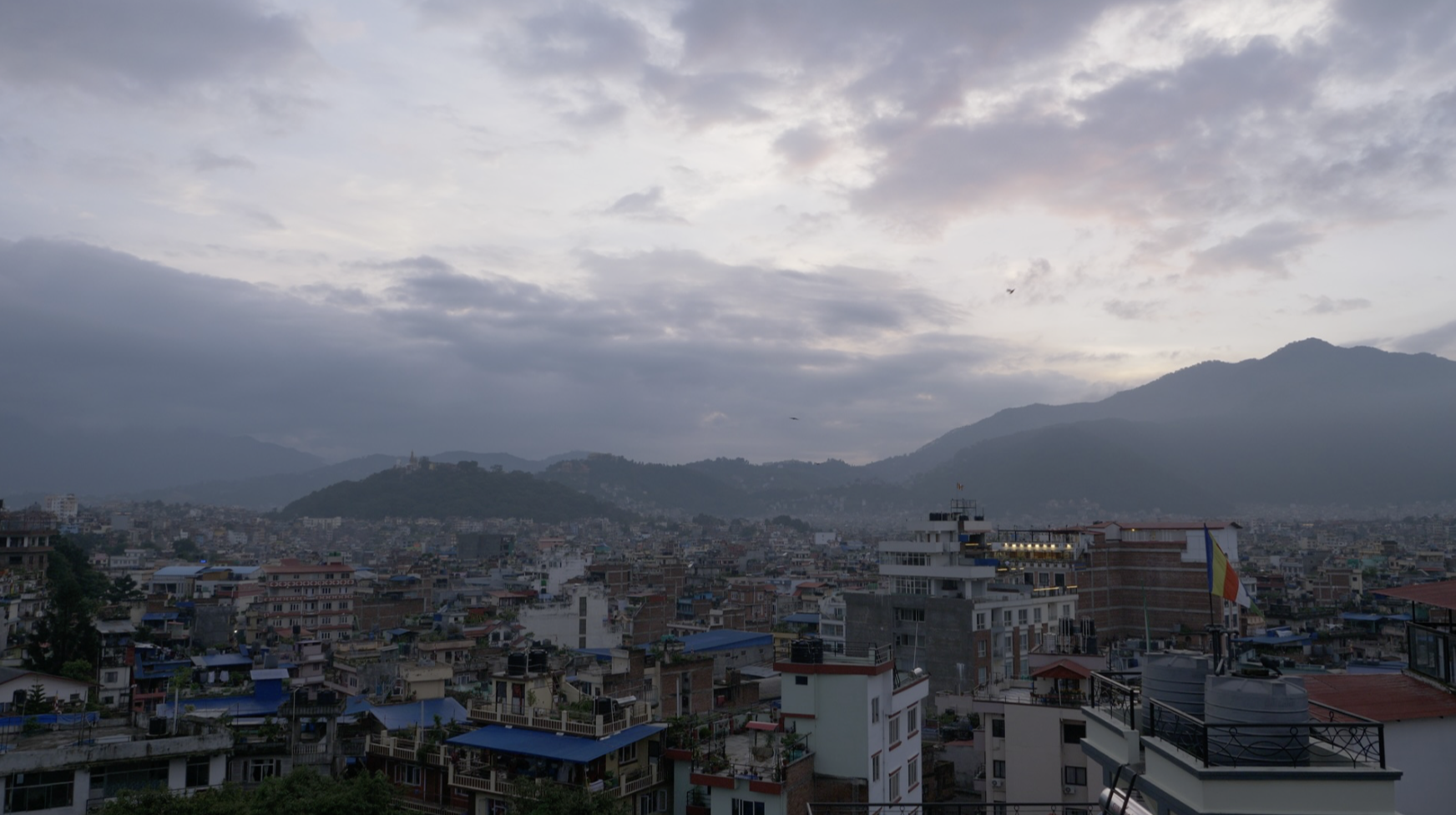
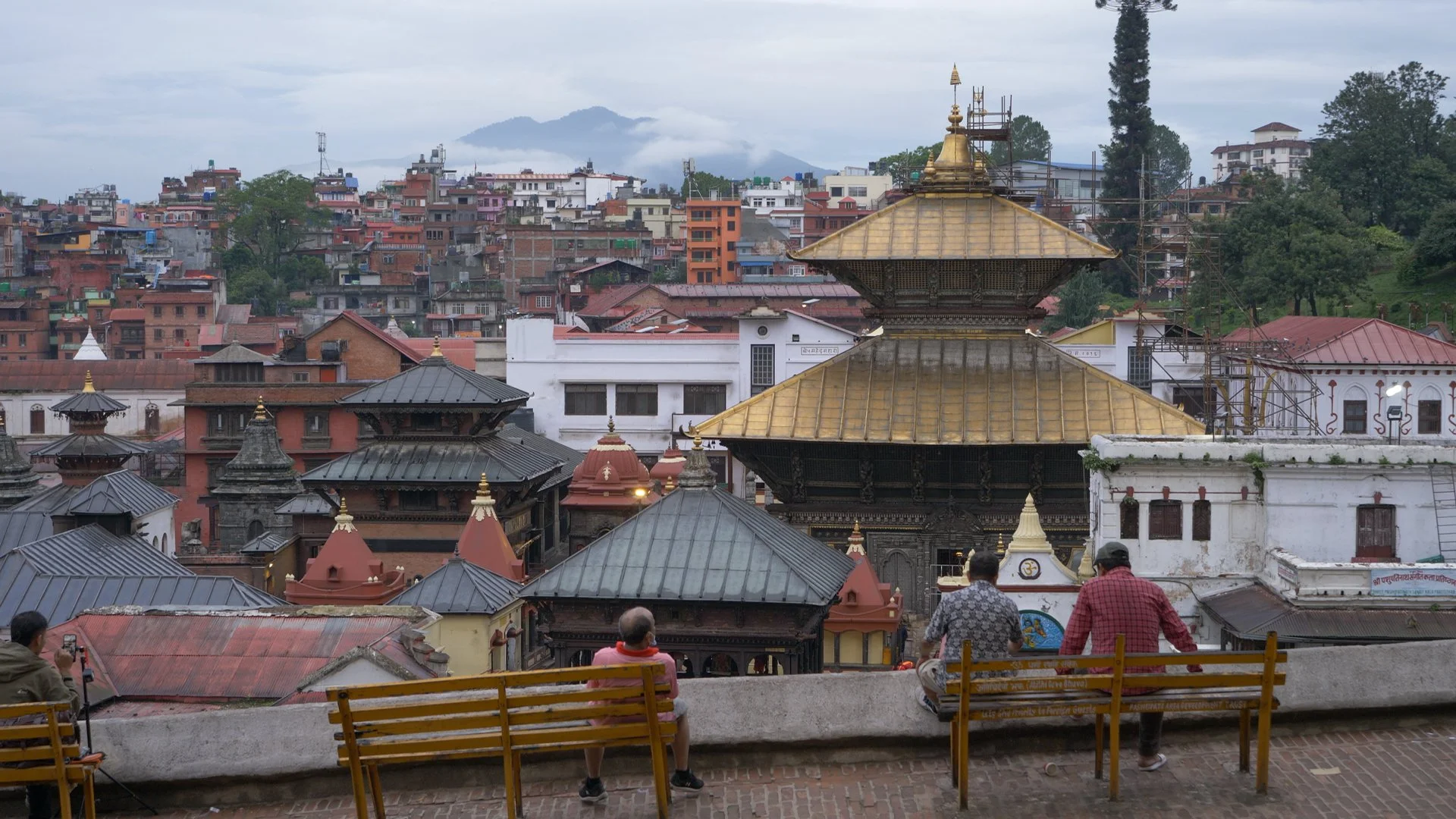
I pursued these questions for my visual anthropology thesis, when I travelled to Kathmandu, Nepal, to make a documentary following free-roaming cattle. With the camera I aimed to question what kind of co-existence on the streets was possible when cattle are released from urban dairies, by following everyday encounters between these stray cattle and the streets. Nepal, like India, has been shaped by Hindu values that dictate the protected, sacred status of cows and share the conundrum regarding the economic abandonment of unproductive cattle. Kathmandu’s cattle are present through a convergence of law, religion, and economy. Although Nepal is constitutionally secular, cow slaughter remains prohibited and the cow retains national status as the national animal.⁴ Mechanisation and artificial insemination have rendered many bulls economically redundant; maintaining non-productive males is costly. As a result many small scale farmers release cattle into urban environments, with the temple precinct Pashupatinath considered an auspicious site of surrender.⁵
What interested me was what happens after release. How does a domestic animal reconfigure itself in a city? Not as a return to ancestral grassland, but as a recalibration to asphalt, refuse, and traffic.
While the systemic tensions between values and economic realities are important, a discussion of these is better suited to text with its ability to grapple with abstract human constructs and the macro. Using film as the medium, I wanted to explore these tensions through a multispecies approach that shifts from macro-level systems where cattle could be rendered to passive statistics, stripped of context, and instead explore the messy entanglements of these tensions in the immediate, shared reality of subjective relationality; of co-existence. I take co-existence to mean the state of existing together, where the interest here is how cohabitation is managed across different states of being (human and non-human) through everyday micro negotiations. Consequently, ‘encounters’ became my framing, these quite broadly being the moments of meeting between stray cattle and corporal humans with whom they co-exist, but also how they encounter each other's distributed agency, for example through infrastructure, altered landscapes and waste.
When we think of encounters in anthropology, colonial representations of encounters could come to mind. Assumptions of unidirectional power are challenged in this literature by emphasizing the co-constitutive nature of interactions where “disparate cultures meet, clash, and grapple with each other”.⁶ The considerer of more-than-human encounters can take this logic and apply a post-humanist critique, where encounters are not unidirectional but according to Pratt become “engagements across difference, a chance meeting, a sensory exchange, an extended confrontation, a passionate tryst”.⁷ Encounters have the potential to destabilize fixed cultural constructs and essentialist ontologies, foregrounding the emergent nature of contact across difference. Through this thinking, we can complicate the binary of cattle as passive domesticated and humans as active domesticators, creating space for non-human agency within co-becoming.
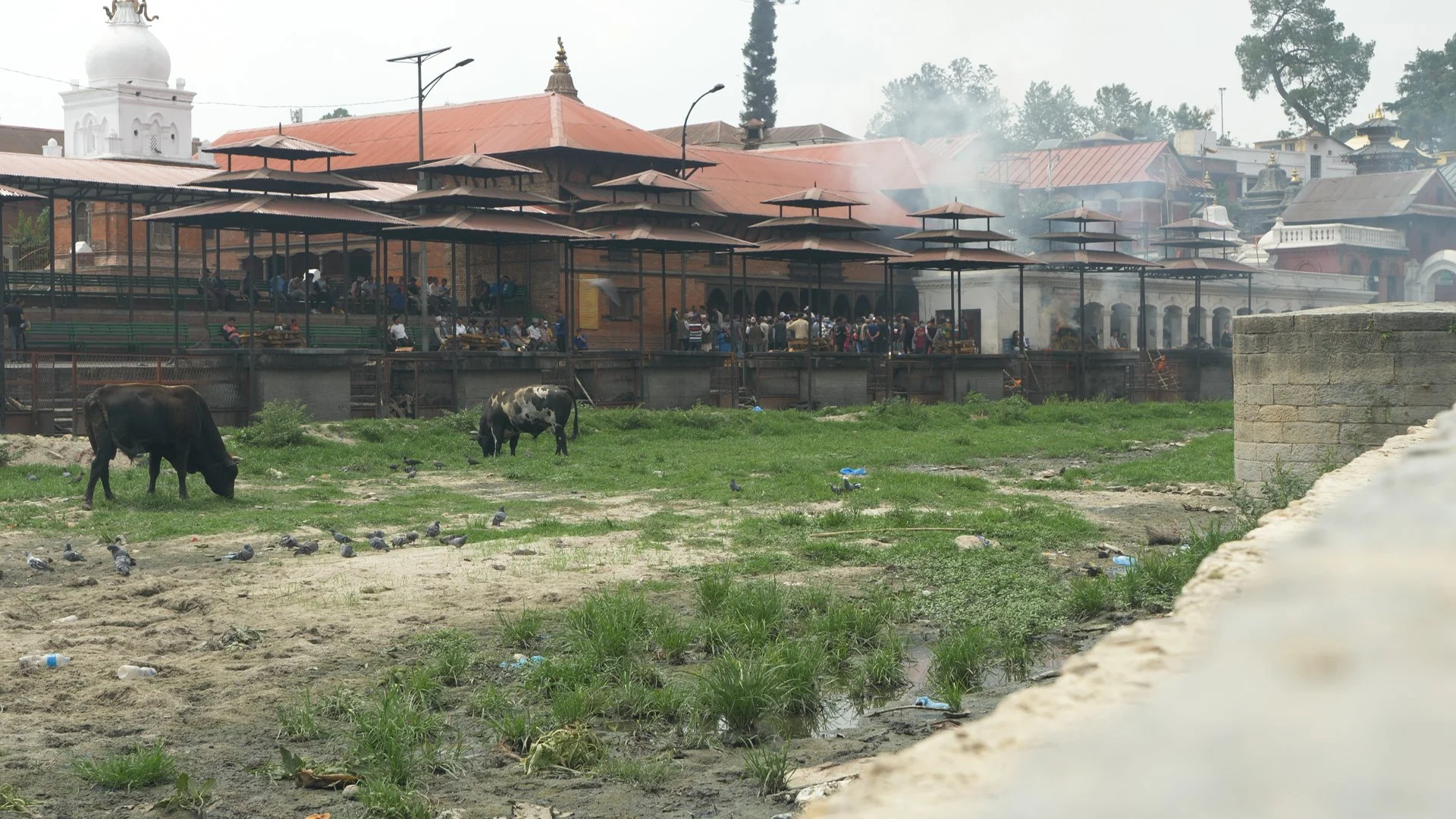
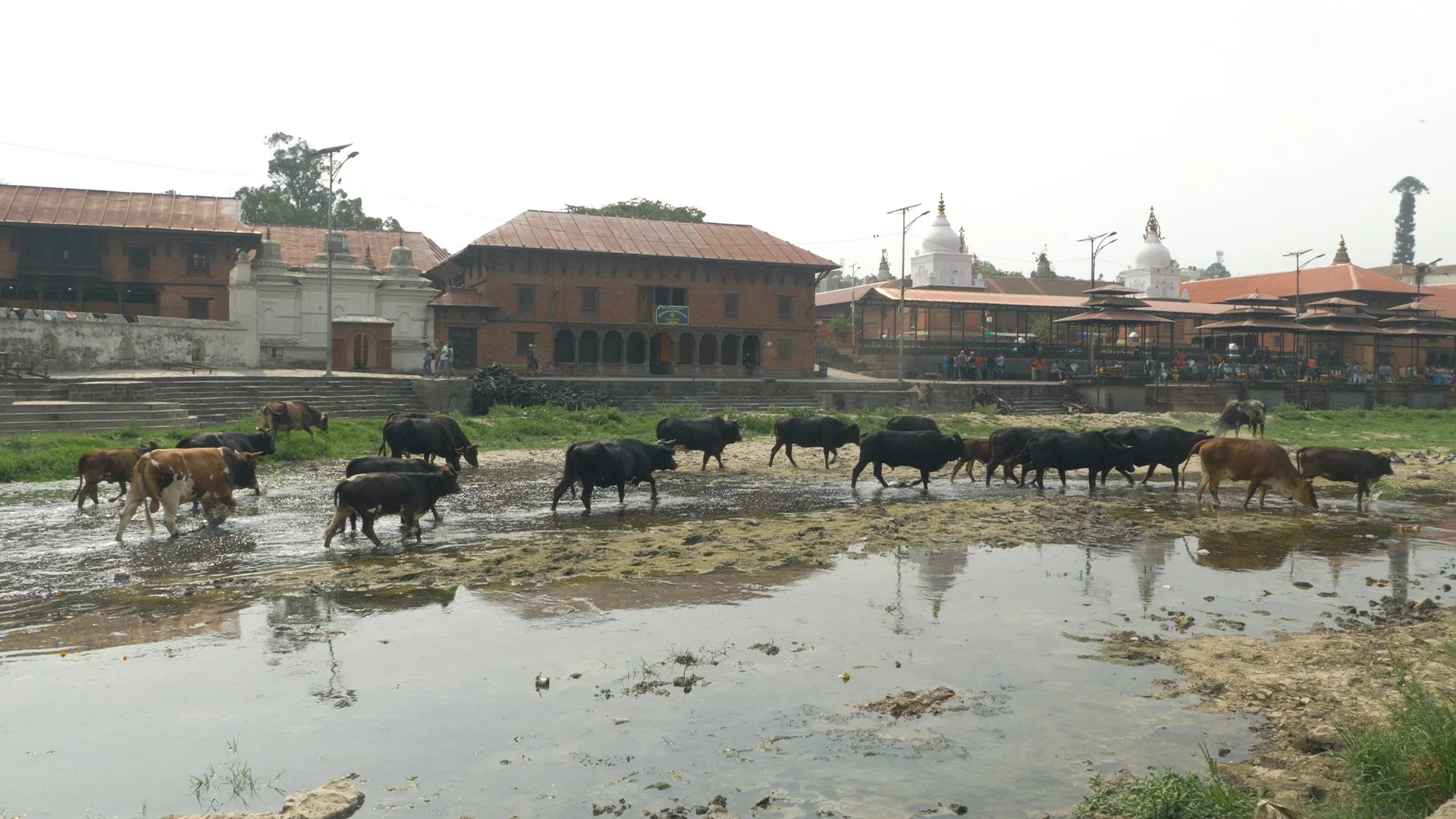
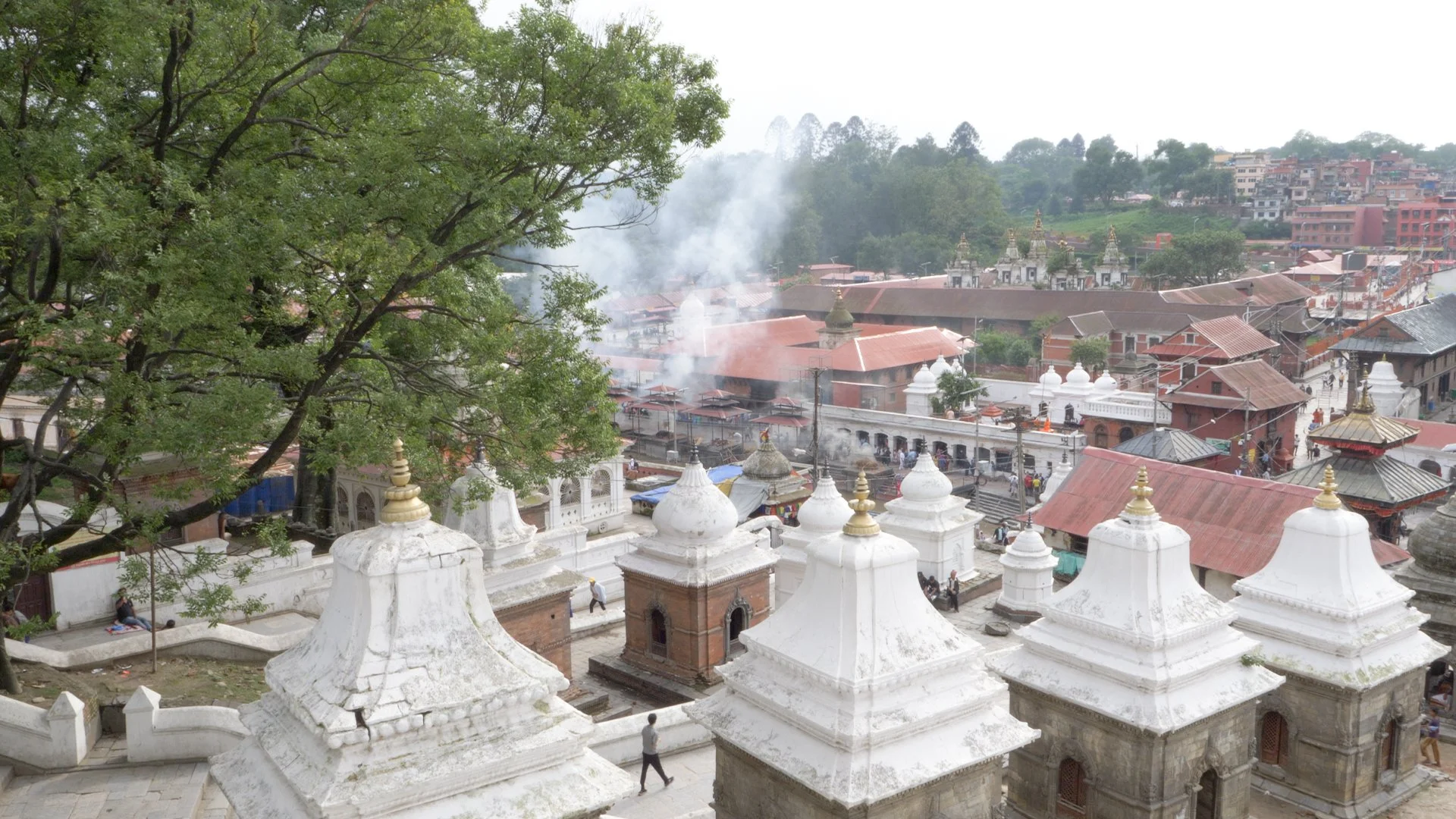
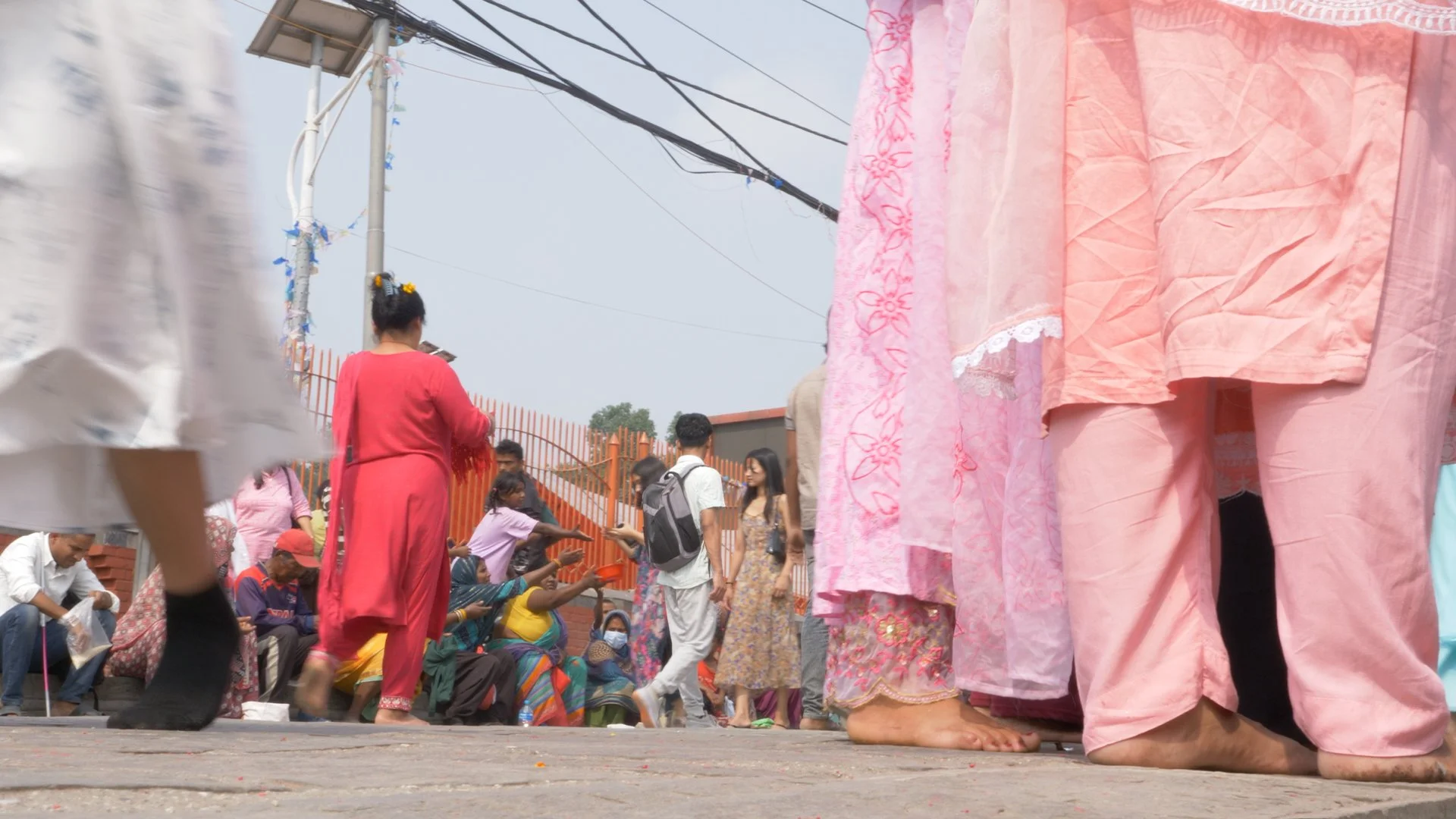
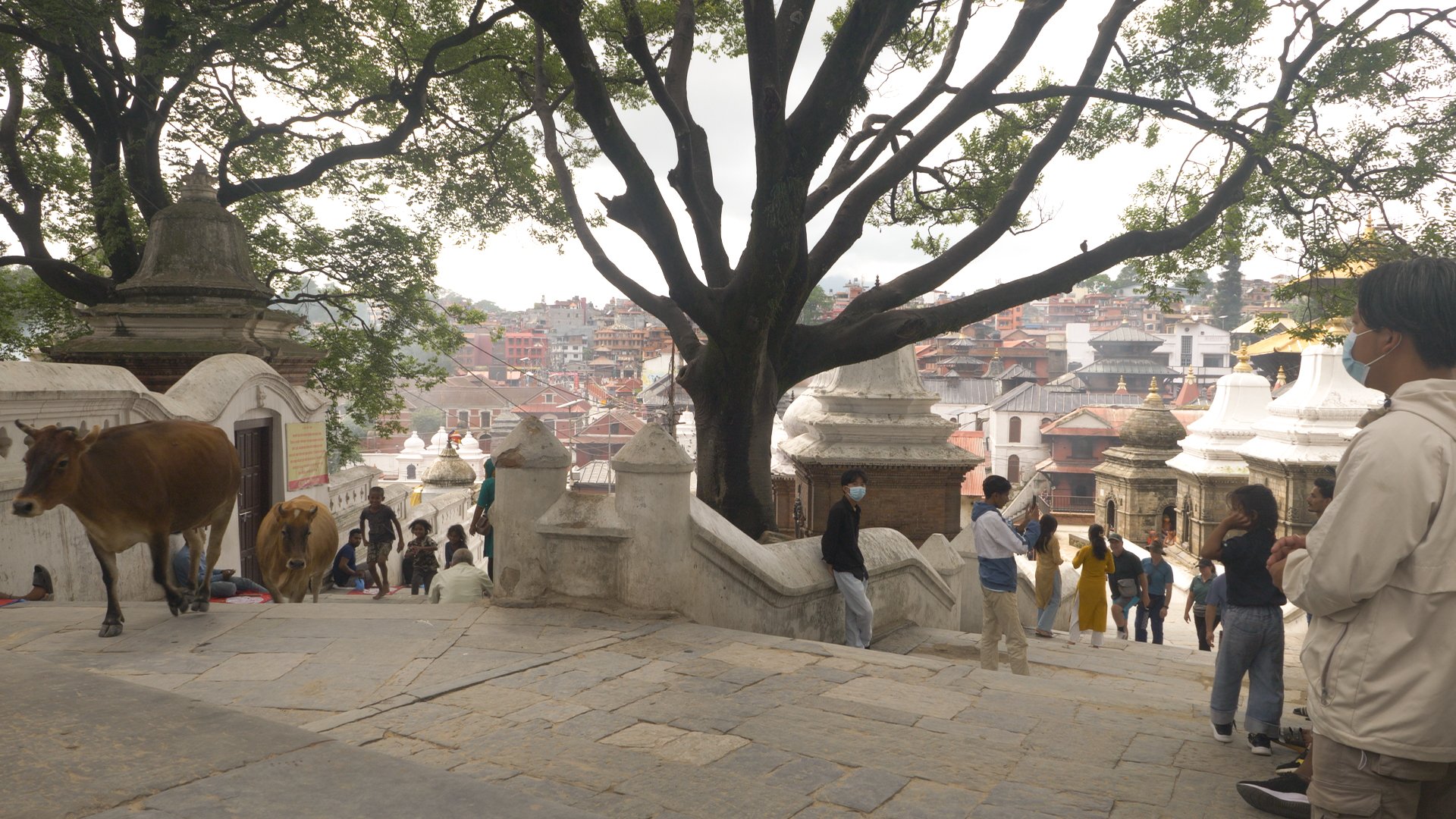
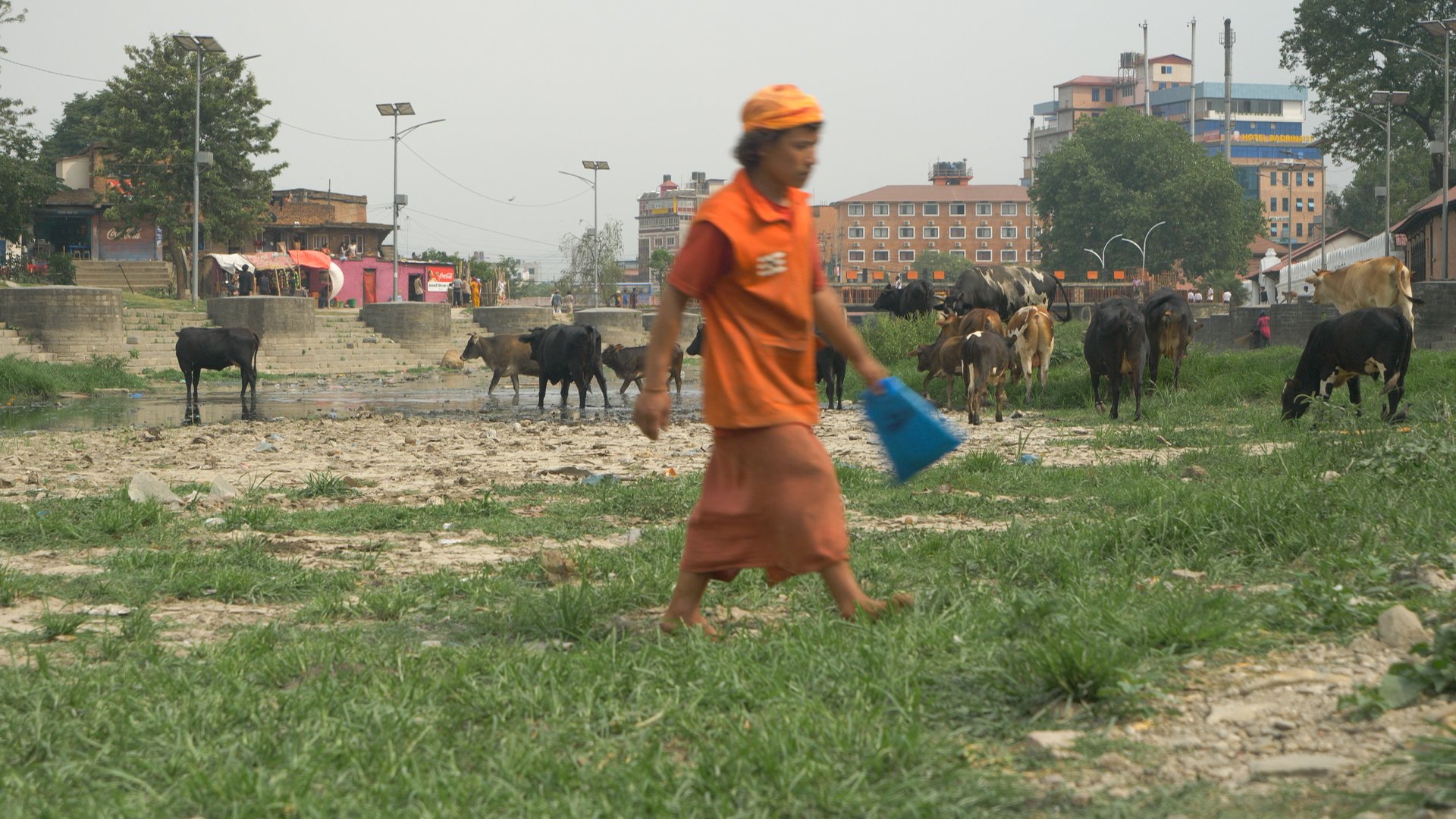
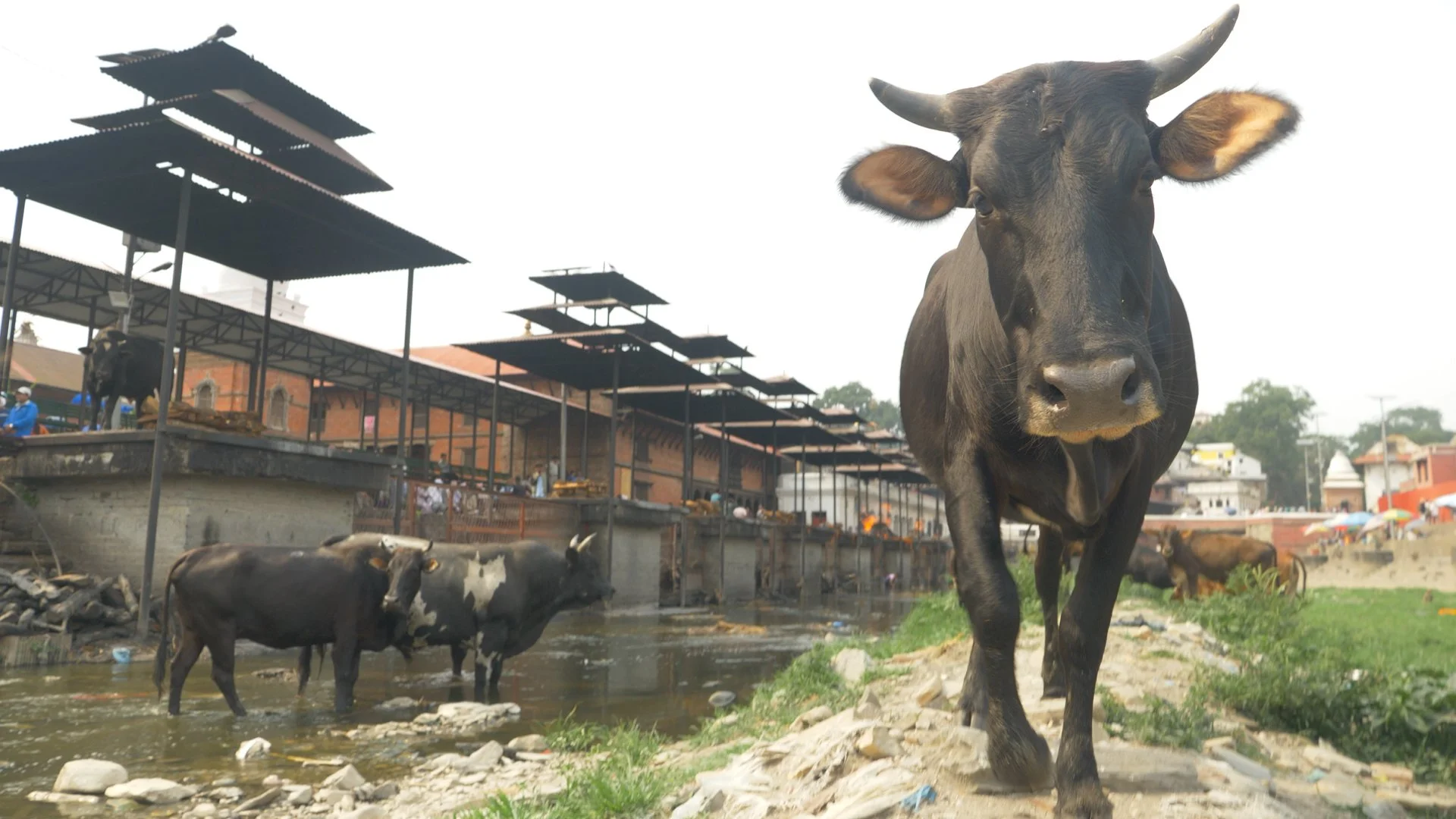
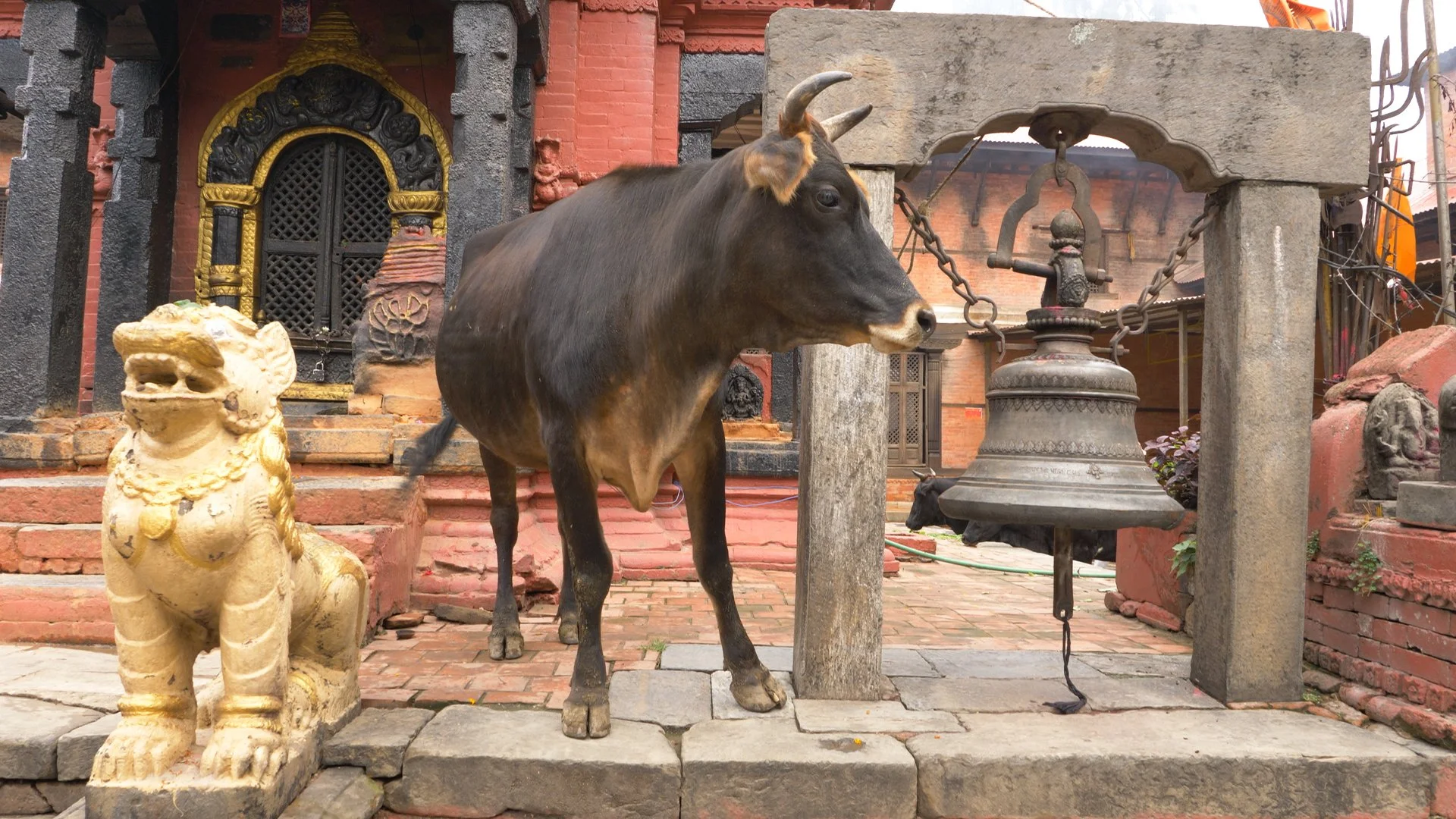
When I arrived in Kathmandu in June 2024, I began my ambition of following cattle through the city. At first, I could not find them. Newly arrived, unfamiliar with both terrain and species, I felt disoriented. I walked miles across the sprawling city, engulfed by the idling of engines at intersections; submerged into the layering of horns and construction drills punctuating the air. I followed leads from passersby, which led to narrow brick paved passages with dead-ends, sore feet and dismay at my preliminary research. My idealism of finding a participant crumbled into the unpredictable (I thought) will with which cattle roam - I was unable to schedule an appointment. Gradually however, if you persevere for long enough, what appears erratic resolves into a pattern. Word of two young calves led me to the Pashupatinath, where I encountered the highest concentration of bulls in the city. Near Pashupatinath, something shifted into a different arrangement of sound and space. Temple bells marked intervals of time or moments of ceremony where chanting rose and receded in cycles. The Bagmati opened a visual clearing in the urban density; movement slowed, pooled, redirected.
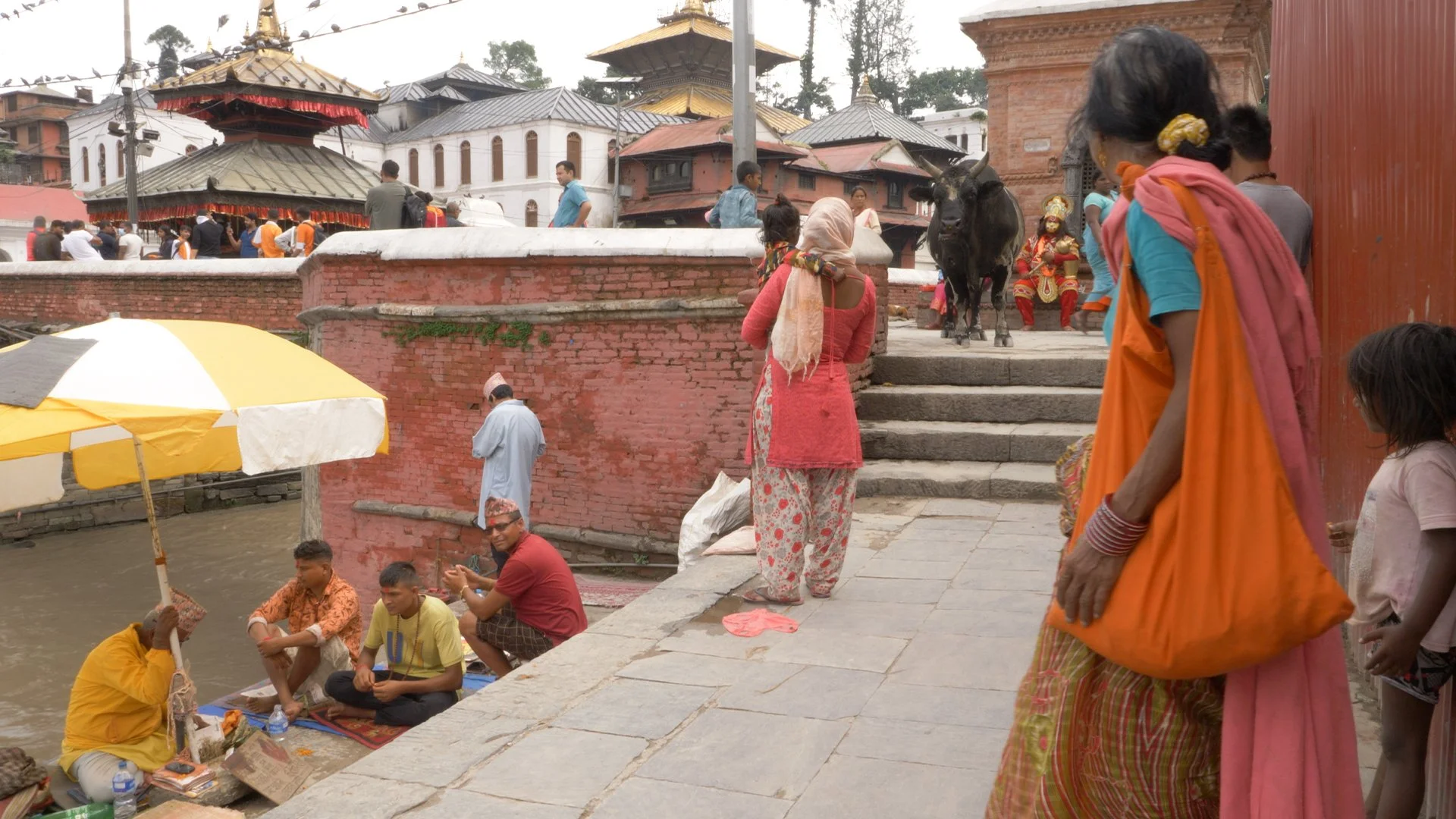
As Henningsen and Joffe note, the stranger in a new environment experiences the destabilisation of fixed boundaries of self.⁸ That destabilisation became a method. To follow cattle required relinquishing the stable stance of the observer. I had to understand my own adjustment to the changing sensory thresholds of space between Pashupatinath and the rest of the city. Following cattle through these zones revealed that they, too, responded to such shifts. Pashupatinath gathers those living at thresholds—ascetics, pilgrims, mourners, the elderly awaiting death. It functions as a sanctuary not only in symbolic terms but infrastructural ones: protected green space, access to the riverbed, steady flows of food offerings, and reproductive opportunity. Cows housed in nearby gaushalas⁹ are brought into proximity with resident bulls; farmers visit with their cows for impregnation knowing there are stray bulls within the precinct. If, as Eduardo Kohn argues, animals engage the world as selves—with points of view irreducible to human projection—then their sustained presence at Pashupatinath is not incidental.¹⁰ Attending to sound and pace became a way of perceiving why certain bodies—human and bovine alike—gravitated toward this site and how sacred geography also functioned as bovine infrastructural preferences.
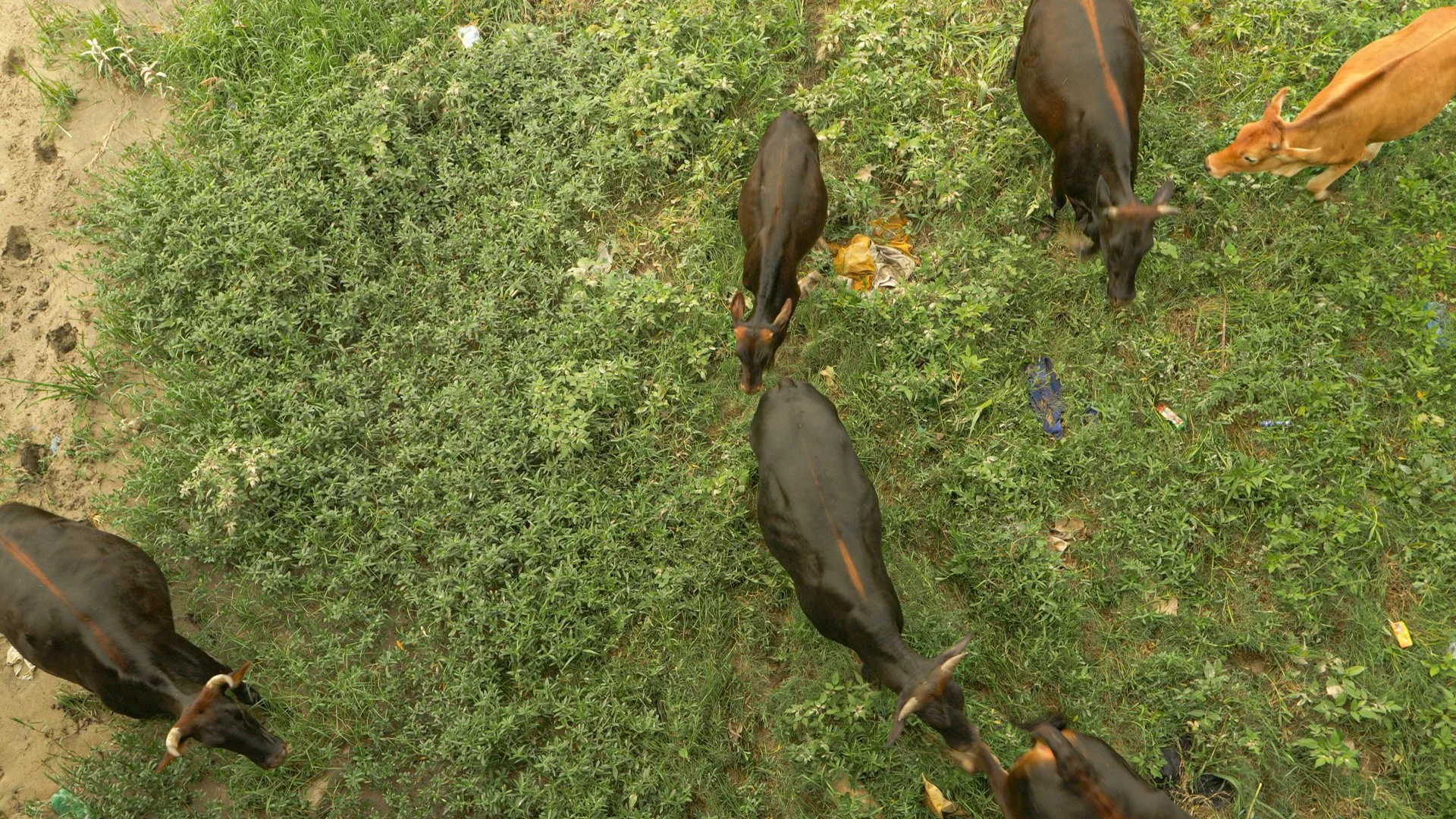
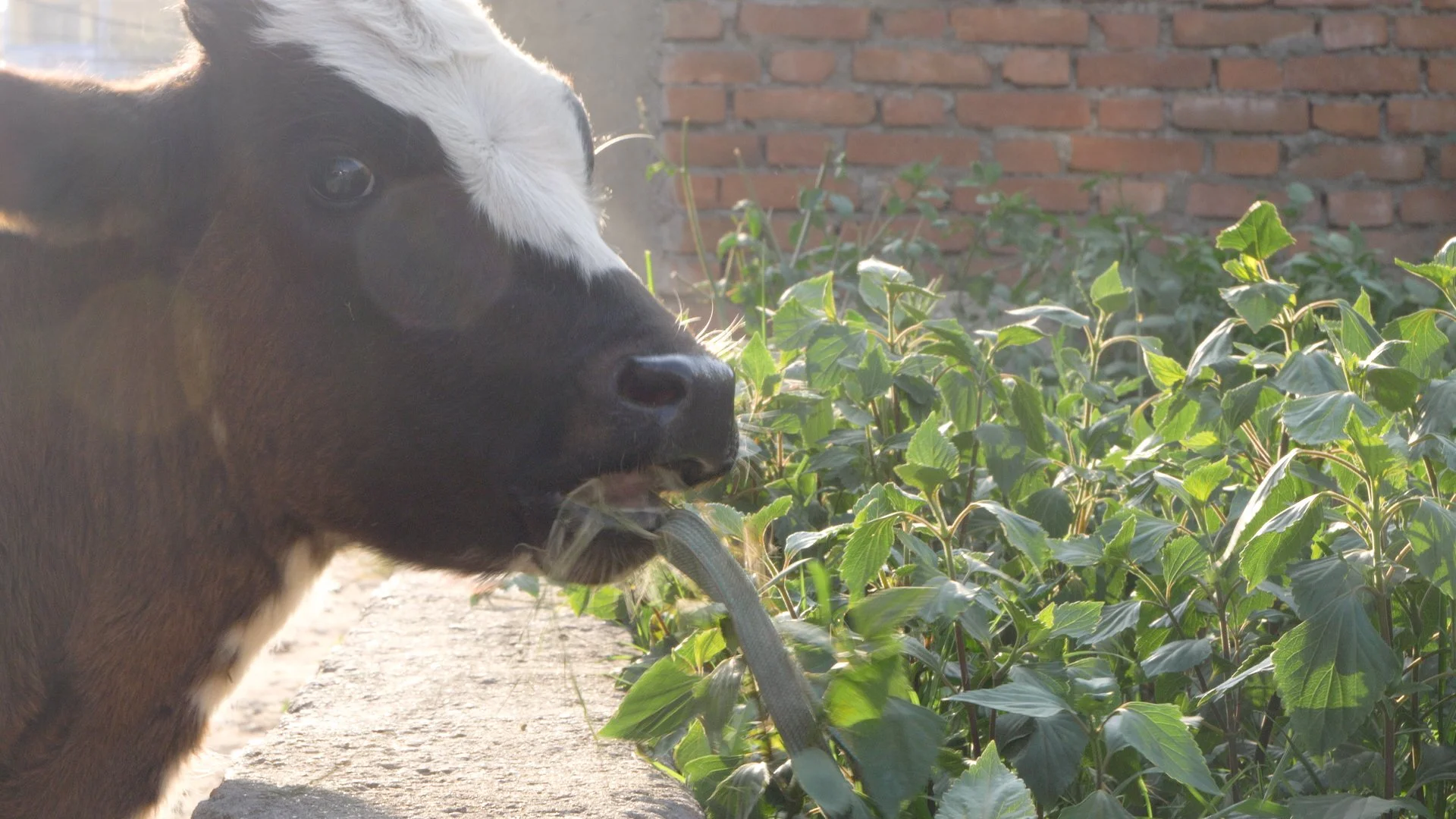
Arriving at the temple at the start of the day became a reliable way of finding cattle. As I began to follow them, I had to adjust my pace to theirs. I learnt to scan for shade the way they did, to notice which stalls tolerated proximity, which underpasses retained coolness, which patches of scrub persisted between concrete. Patterns became apparent and I ascertained the different territories of bulls and their (more or less) predictable routines for foraging.
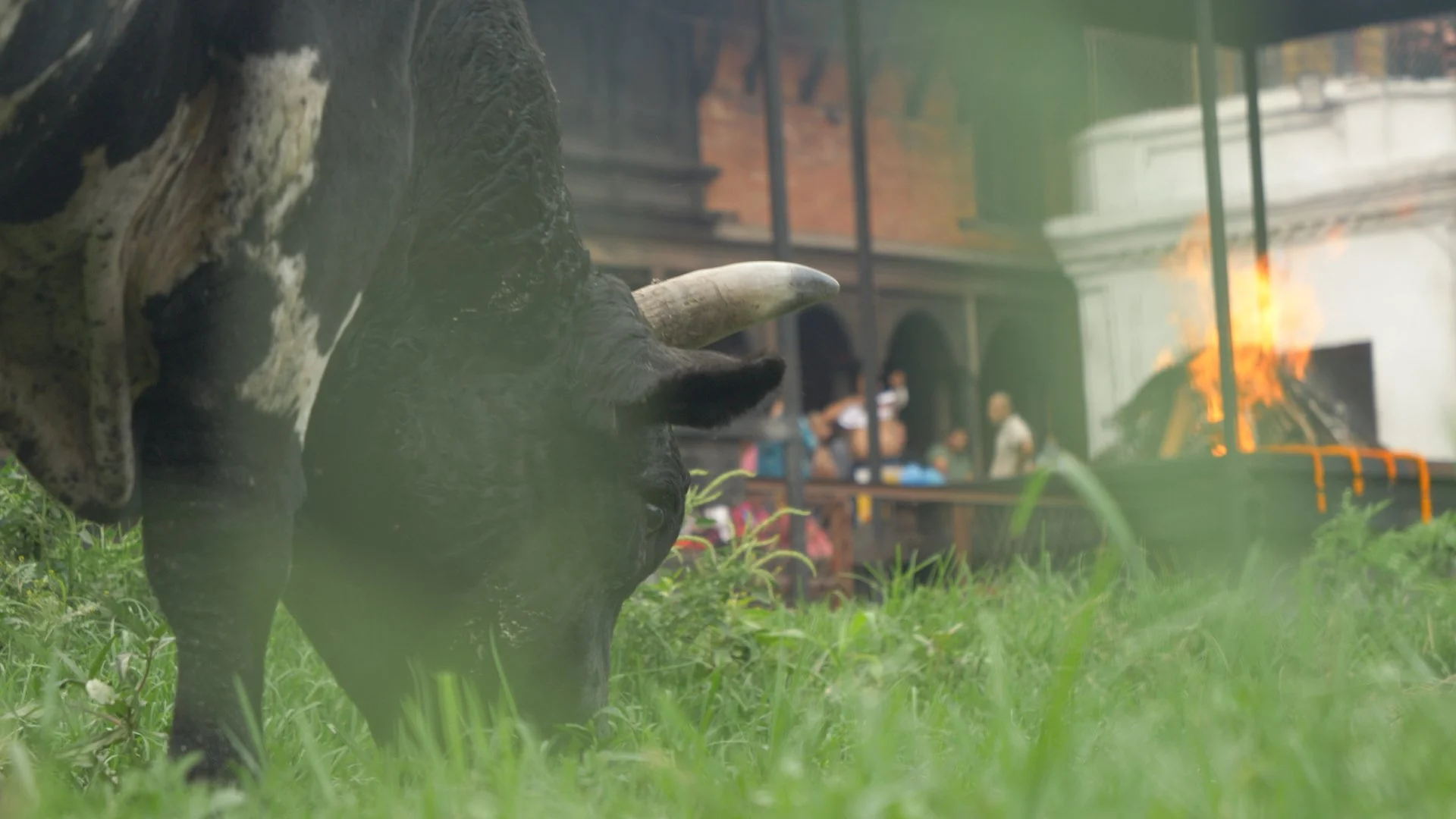
An elderly red bull slept beneath a noisy underpass near the temple gates—an apparently ill-suited refuge. A shopkeeper told me he had once dominated the ghats but was displaced by a younger rival.¹¹ He withdrew to the margins to die. In contrast, the most contested stretch near the river was controlled by Ghaumandi. The shopkeeper didn’t know who named him first, but those who knew him well referred to him as “the proud one.” Species tendencies mattered, but so did temperament, age, and history. As Kirksey and Helmreich argue, attending to biography shifts animals from “bare life” toward legible political presence.¹² Following, then, became a way of coming to know not cattle as a category but particular bulls with territories and trajectories.
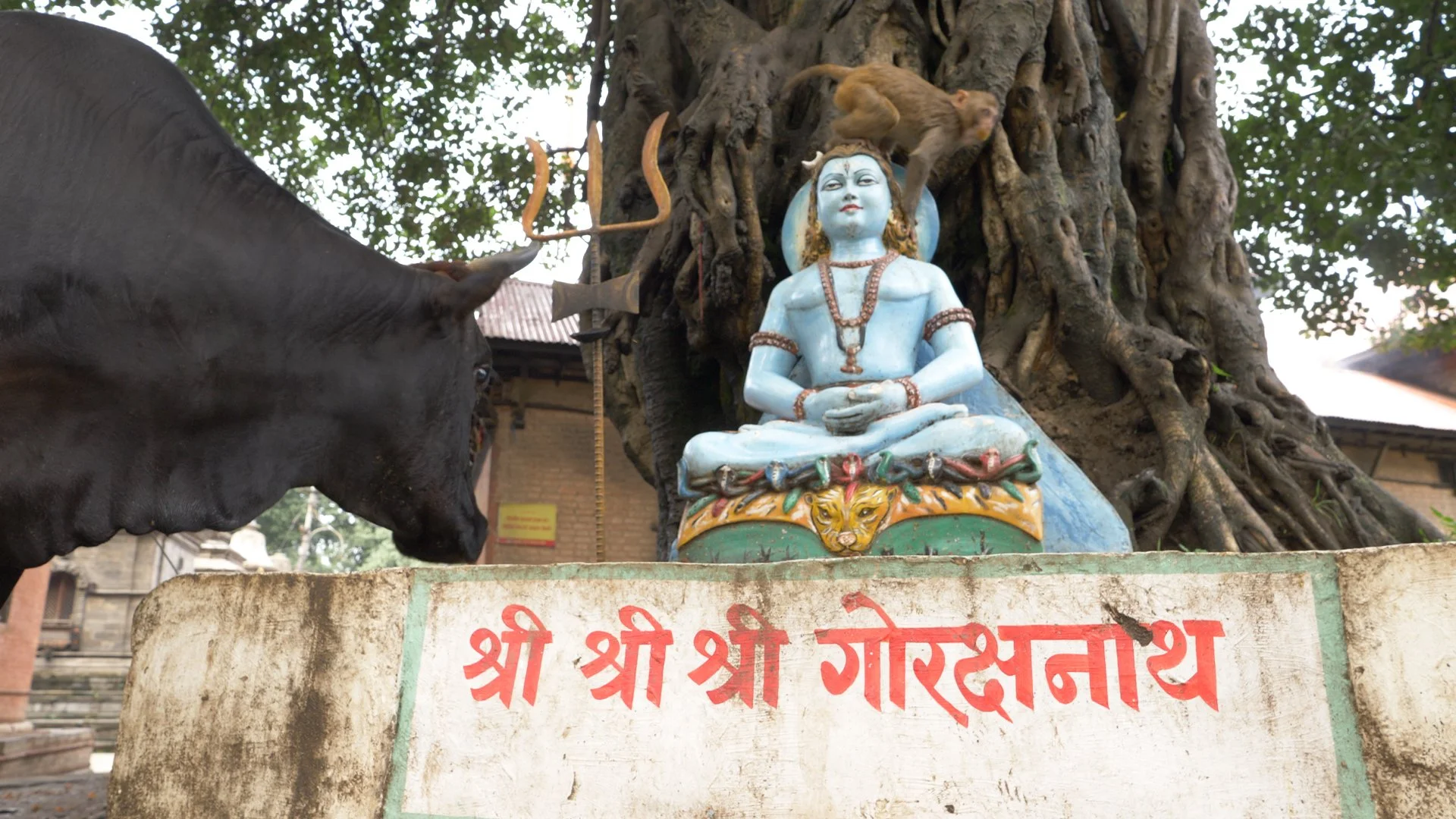
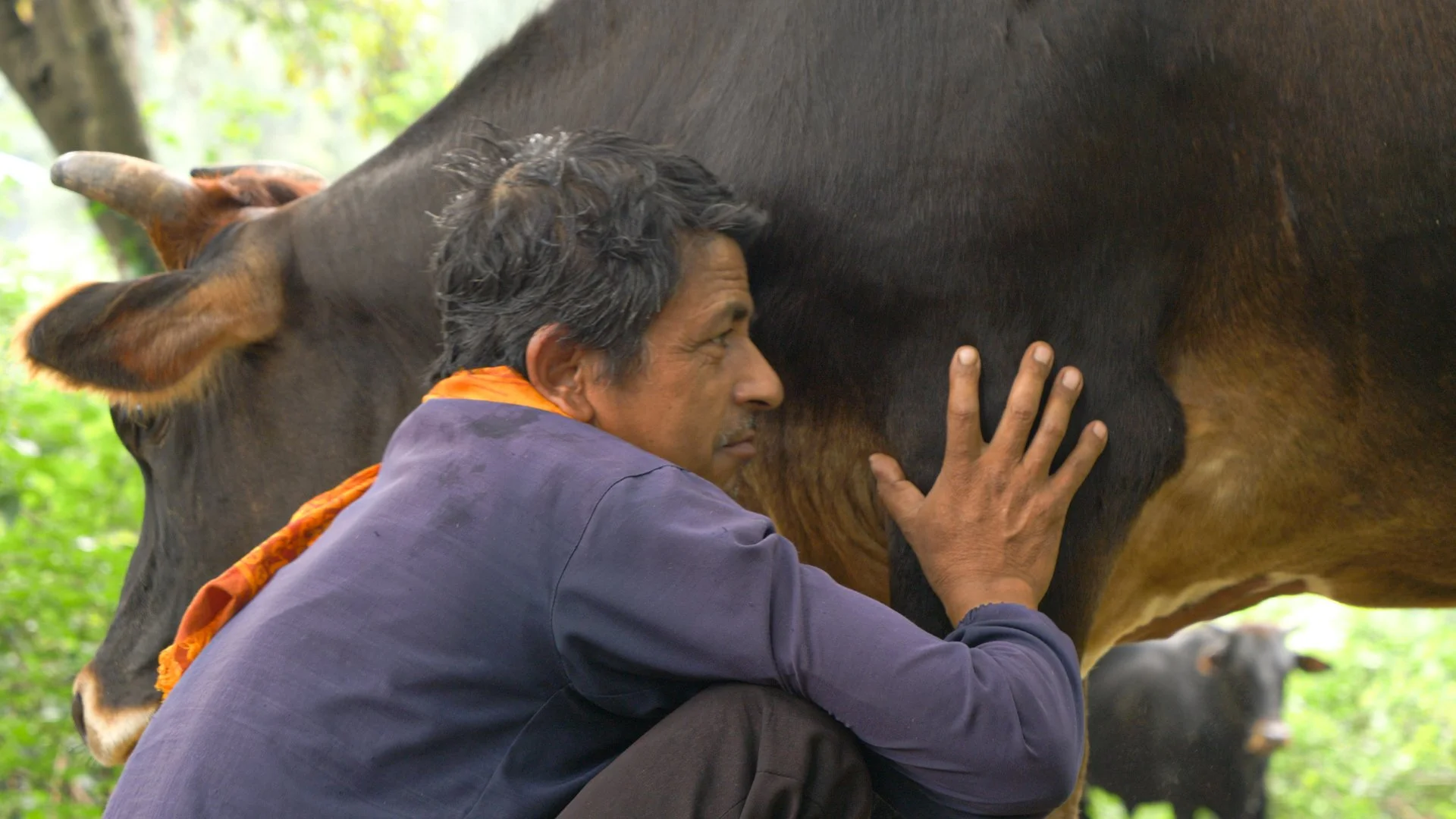
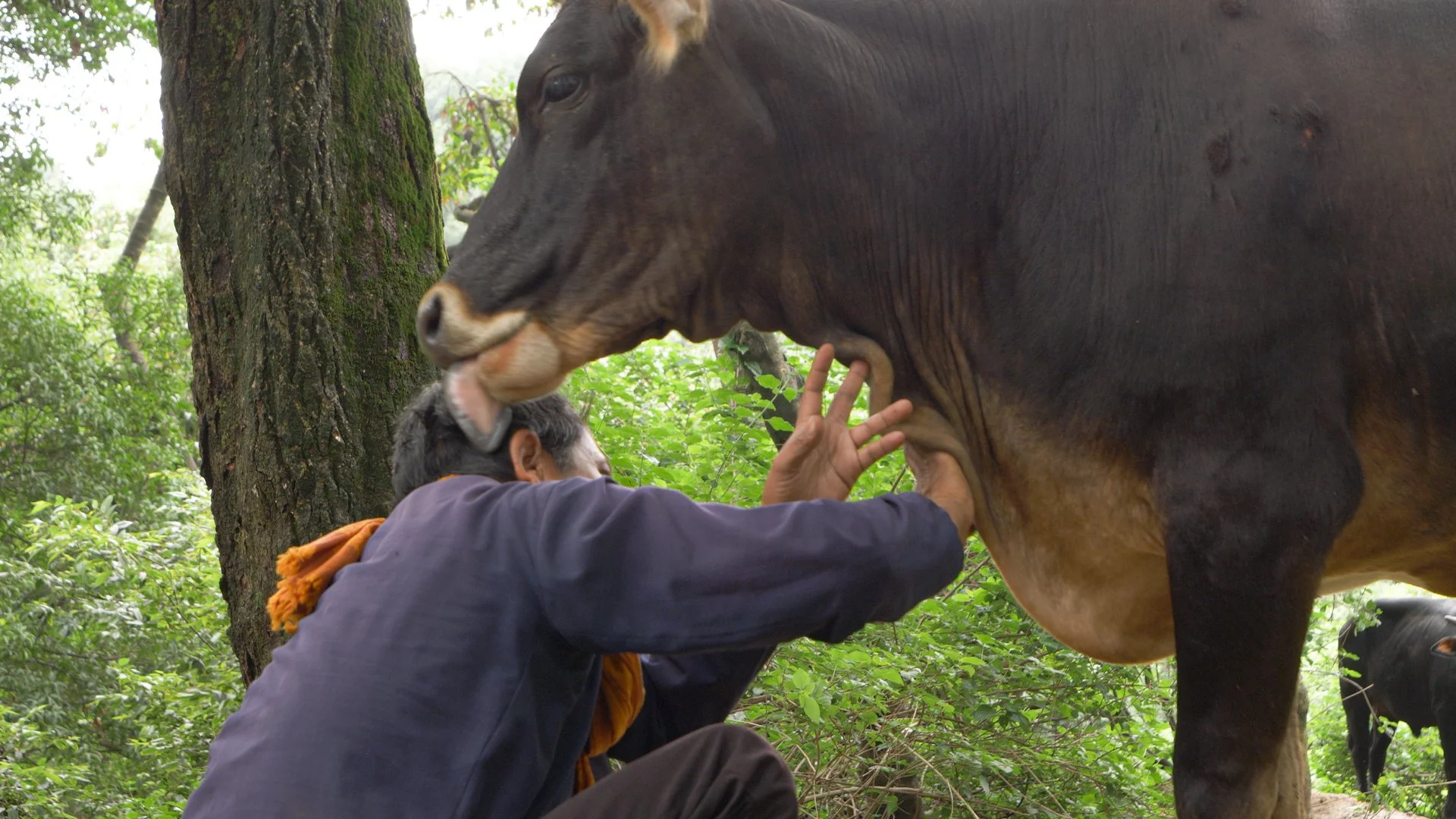
Ghaumandi would block the entrance to shops selling wooden deities and Rudraksha’s.¹³ Due to a change in the tone of his grunts, shopkeepers perceived he was hungry. Shopkeepers in response to this call, often answered with scraps, gestures, or shouts. While both had the intention of moving him along, the response that didn’t placate him meant that the stall a few meters away was more likely to get blocked next. Boundaries were communicated through breath rate, ear position, muscle tension and a new informal language of posture and sound, a form of “trans-species pidgin,” where elements of both human and cattle communication merge. Similar to pidgin development in colonial contexts.¹⁴ People used sounds like "ou ou" to call bulls or gain their attention, while other sounds prompted them to move. "Ou ou" became a functional semiotic tool, its repeated use helping bulls associate the sound with a specific action. These sounds humans would use resembled grunts found in cattle communication, which are not used in human conversation. The variety of sounds used to communicate depended on who was involved in the exchange. For example, Deepak who was a cattle herder at Gorakhnath ashram in Pahshupatinath had a broader range of sounds to guide his herd compared to shopkeepers, who primarily communicated two desires: "come" or "move." Bulls, too, vocalized to elicit specific human actions. One bull, unable to enter Pashupatinath’s jungle due to a closed gate, grunted persistently at a passerby until they opened it, demonstrating a potential awareness of his bodily limitations and his perceived potential of the human to fulfill his need.
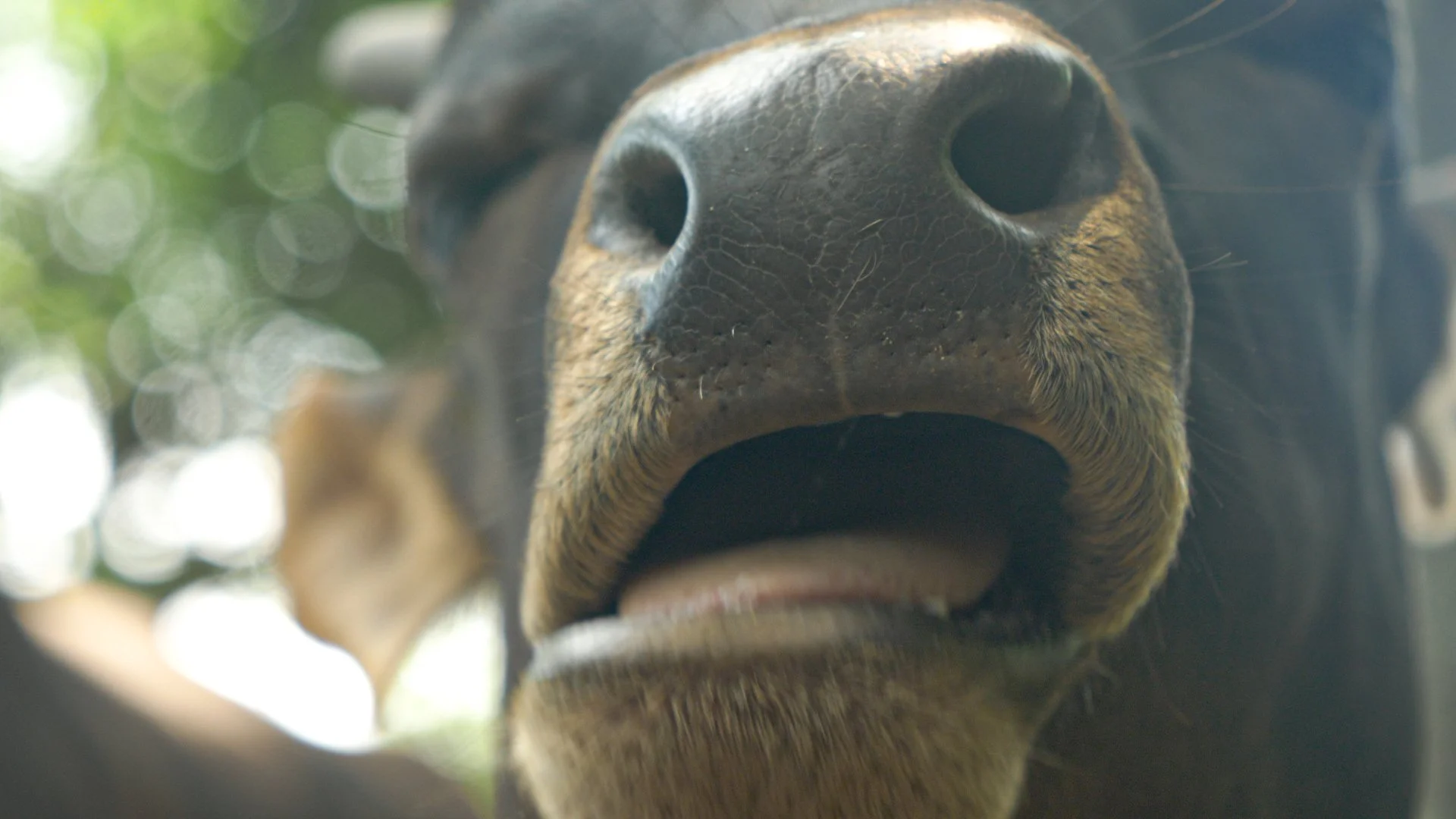
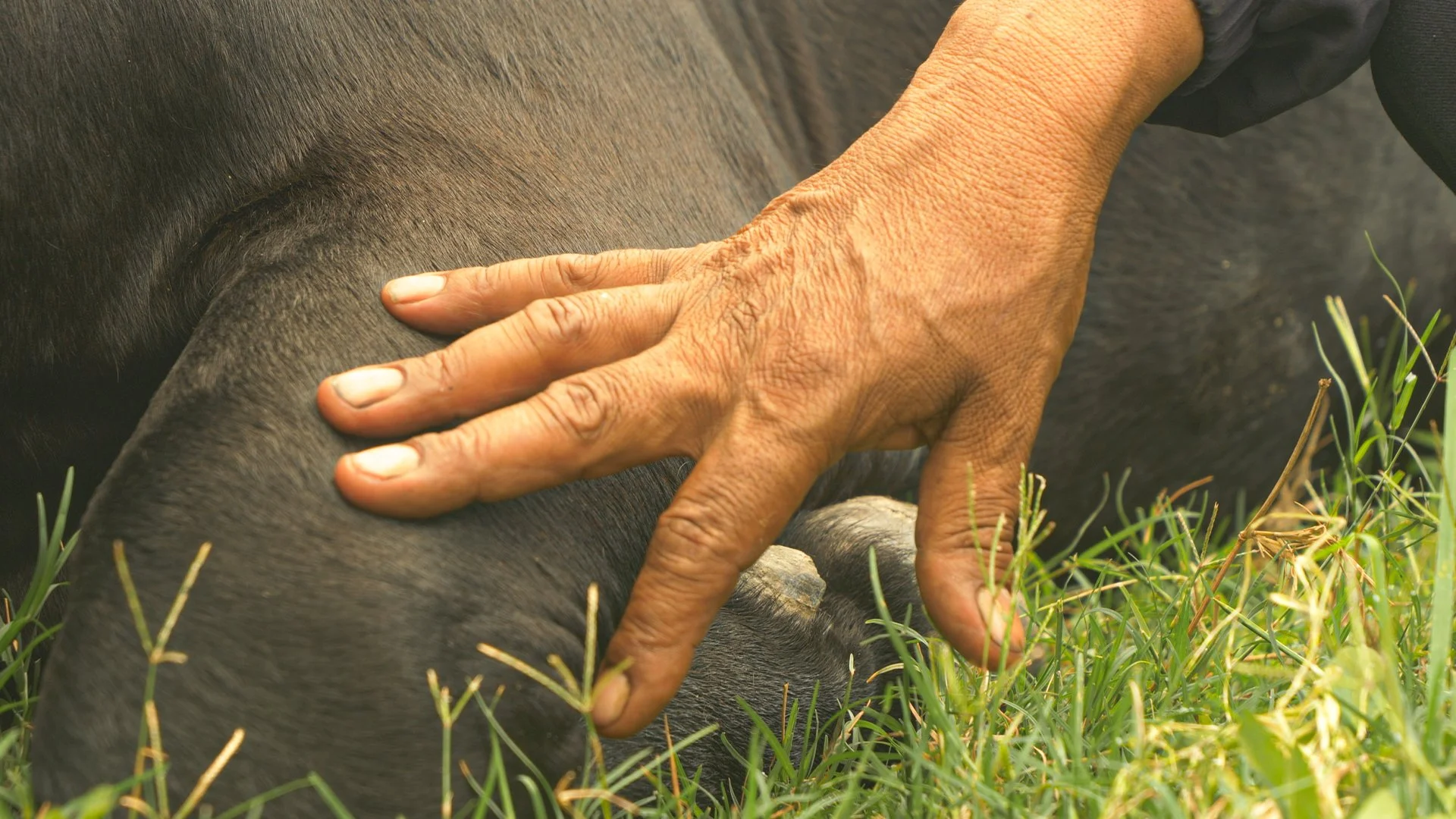
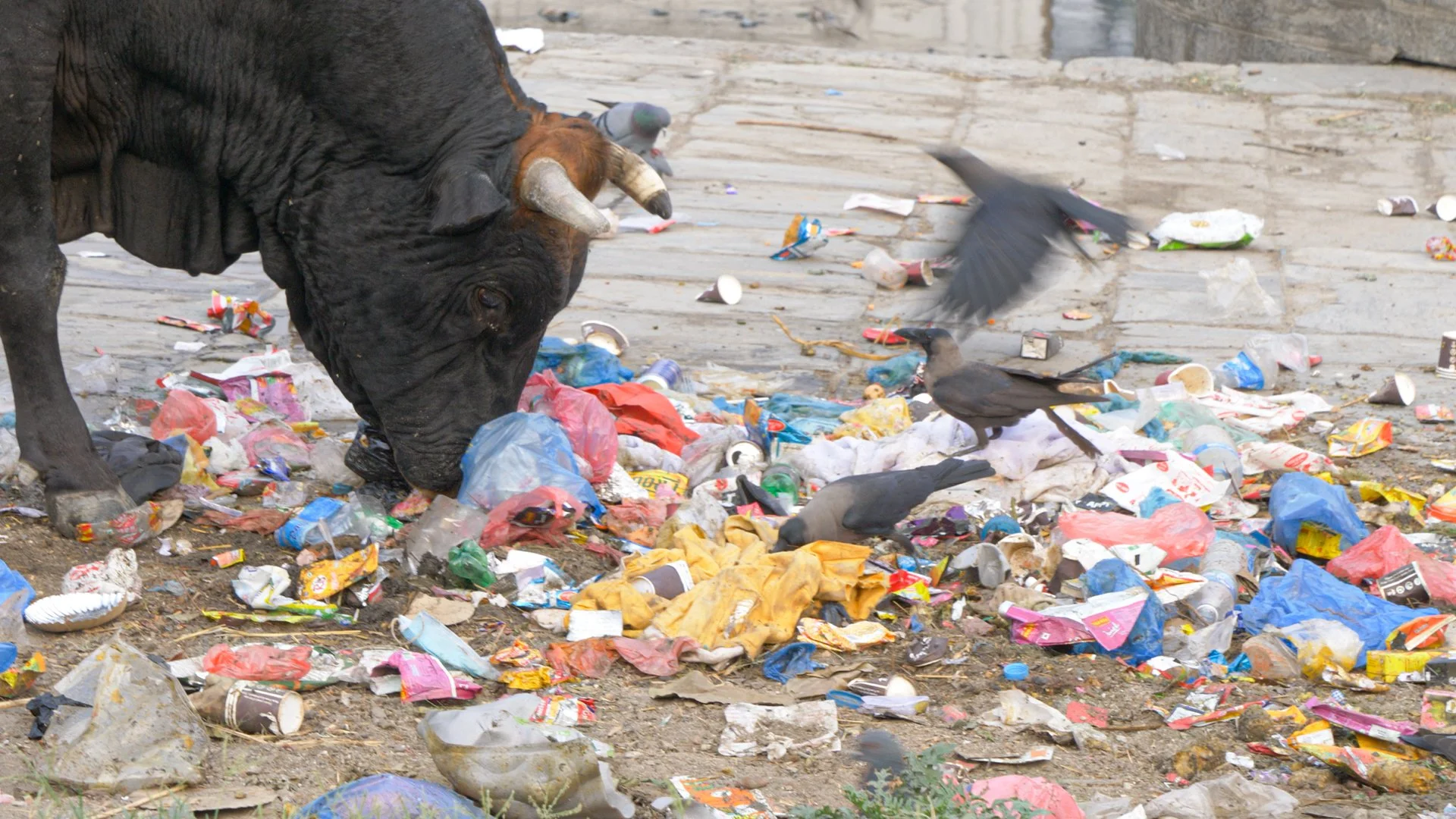
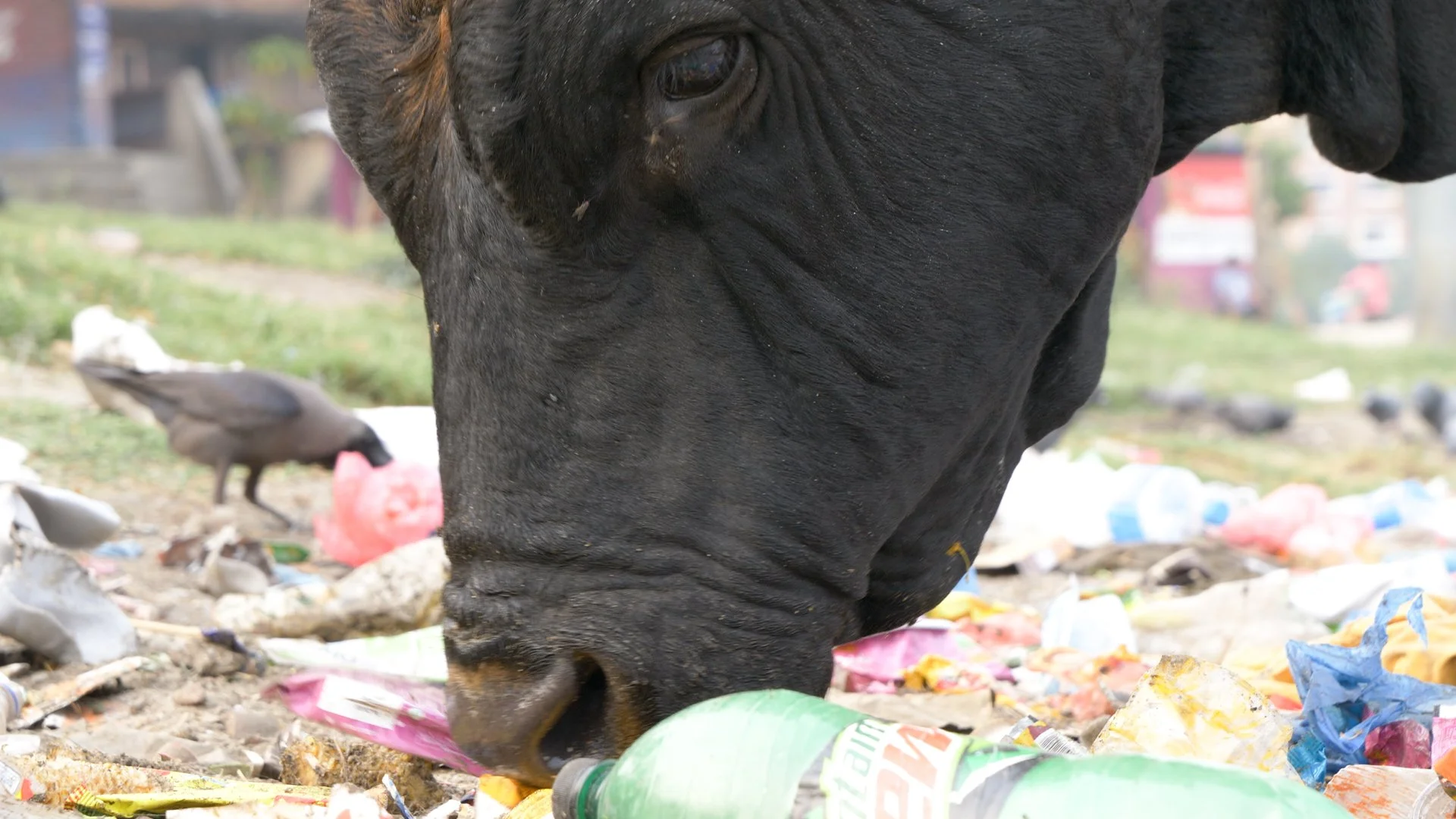
Entanglement can extend materially. As Lily Kelting observes, the contents of a cow’s rumen point to the human worlds around them.¹⁵ In Pashupatinath this includes ritual remnants—marigolds from cremation pyres, offerings left by the river—reabsorbed into bovine bodies. It also includes plastic: bags, wrappers, synthetic detritus accumulating until digestion fails. Milk, so often marketed as “local,”, becomes metabolised urban excess. The marketing often implies pastoral purity; the rumen records something else. Communication during my own encounters with cattle were often tactile: breath across my forearm, the rasp of a tongue gathering salt from skin, the movement of muscle beneath skin and hide and on one occasion, stomach cramps and diarrhea.
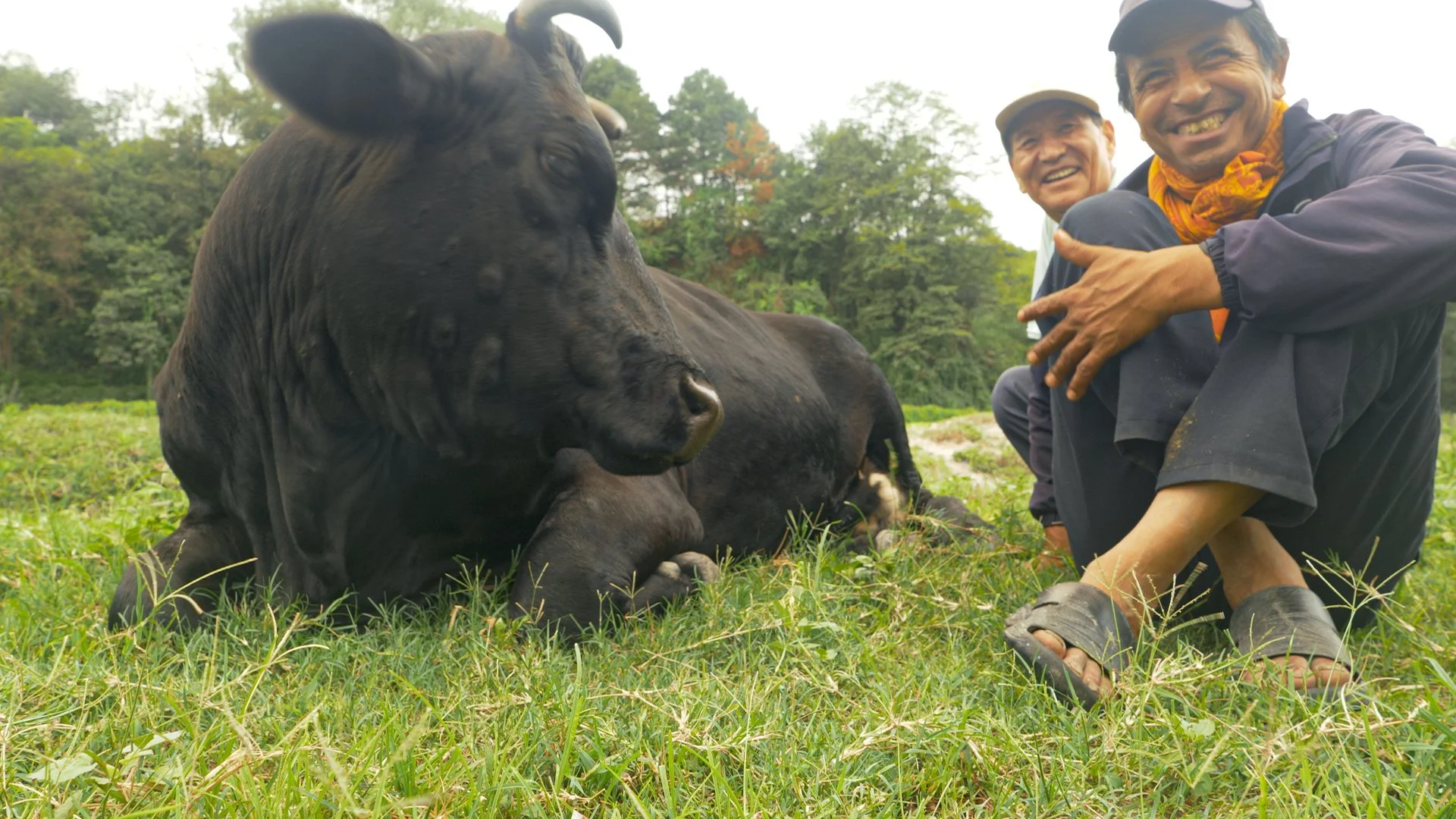
One day I was honoured by being invited into Gorakhnath ashram. The milk and urine from these sacred multi-generational cows raised at the ashram was used in temple rituals, such as in the bathing of the Shiva Linga. I was invited in by Deepak, whom I had spent many hours with over the last few days. I met Deepak when I had followed a stray bull which, interested in spending time with cows, had led me to his free-roaming herd. When he saw me filming with the stray, he invited me to walk with him and film the herd, assuming my interest as I couldn’t communicate with him in Nepali. The following day, after filming together some more, he brought me into the ashram and handed me a glass of freshly squeezed milk. As a vegan of 12 years, fieldwork had exposed the limits of maintaining purified ethical positions across radically different relational worlds. Veganism in this instance was relationally in-coherent. Unable to explain, I took the glass to my lips and drank. I don’t know why I was surprised by its corporeal warmth but I tasted it with specific cows in mind, namely those cows I had come to know through the lens (unlike shop bought milk, with a cold alienability). My decision to drink it was not purely ideological nor purely strategic but emerged in the moment. I had to digest my embodied history as a vegan, the moral obligation of hospitality, the affective desire to maintain rapport alongside the local sociality surrounding milk. Later that evening, cramps and diarrhea made me question what it means when an ethnographer can’t metabolize the relations they seek to understand. A week later, I met Deepak with my friend-translator Prajwal. Prajwal in a protective act told Deepak that I was vegan and he shouldn't give me milk. This collision of worlds was awkward yet informative. Deepak asserted that I must be mad, the justification being that milk was the most natural substance on earth, having come from the mother.¹⁶ I took the madness to mean I was being socially deviant to an ingrained cultural norm. Understanding that norm meant moving beyond my western notion of animals as either pets and subject to an ethic of care, or farming animals, like cows, being subject to an ethic of utility (of course with some blurred edges). Here, despite both me and Deepak caring for cows, and not eating them out of principles of harm, my notion of rights and bodily autonomy diverged from the sanctity of the cow as Cow Mother Gau Mutra. This is what Chirantana Mathkari calls the Mother-Milk paradox¹⁷ - that the demand for cow dairy growth arising from her mother-like sacred status, perpetuates the growth and sustenance of the industry compromising her wellbeing. A feminist critique is that the sacred gendering and role defining as the selfless ‘mother’ is used to rationalize the commodification of her reproductive system.
Encounters across differences, both species and cultural, can sometimes be tense and feel disruptive. Yet sitting with that tension is often generative to understanding and informs a better knowledge of the other - or perhaps moreso, oneself. I spoke almost as little Nepali as I did bull, which had both its benefits and drawbacks. That double incomprehension sharpened my attention. Deprived of fluent conversation, I attended to gesture, gaze, and timing. As Carta suggests, showing can insert us experientially into a way of acting.¹⁸ Filming became less about extracting narrative and more about sustaining attentiveness.
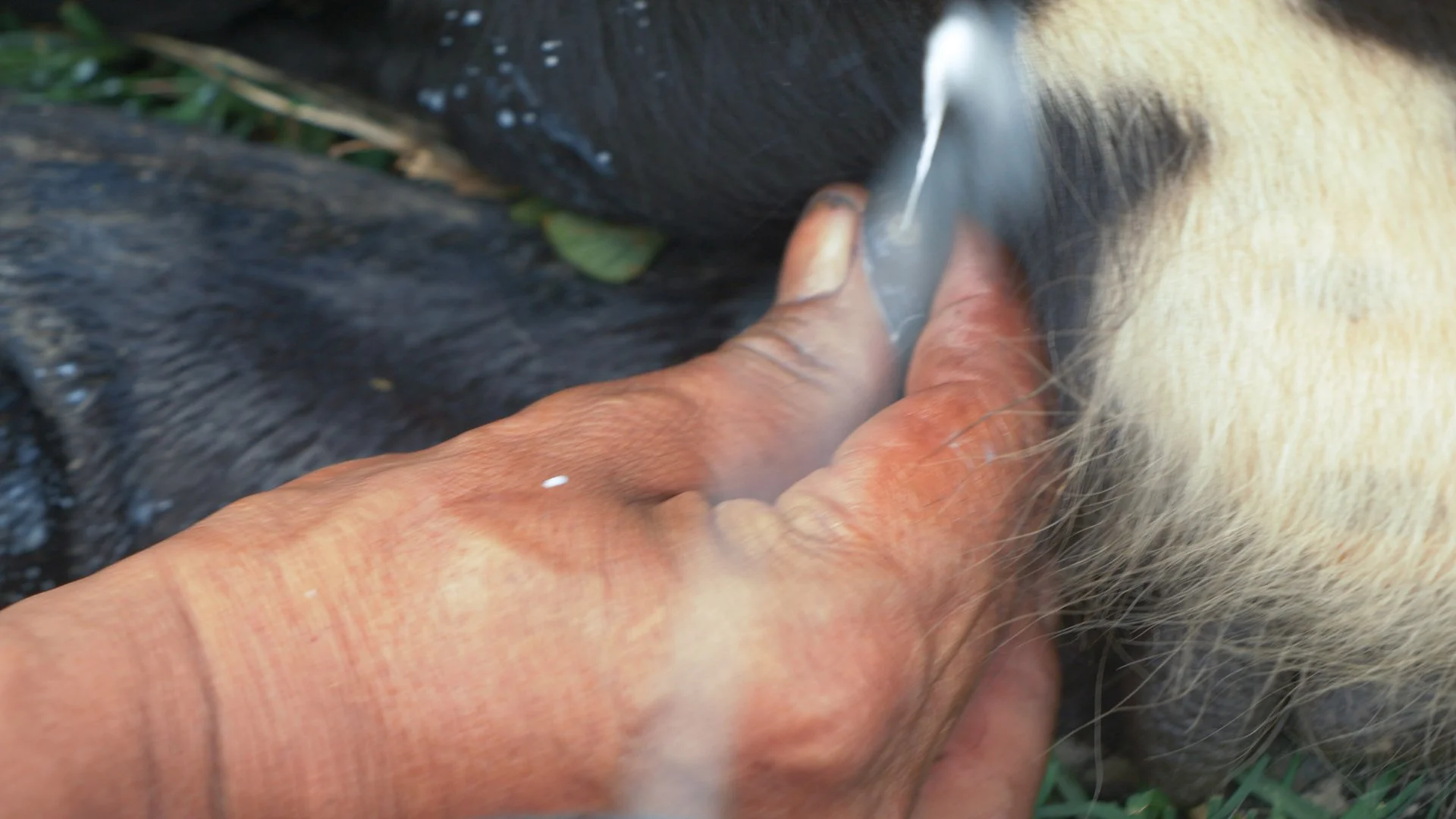
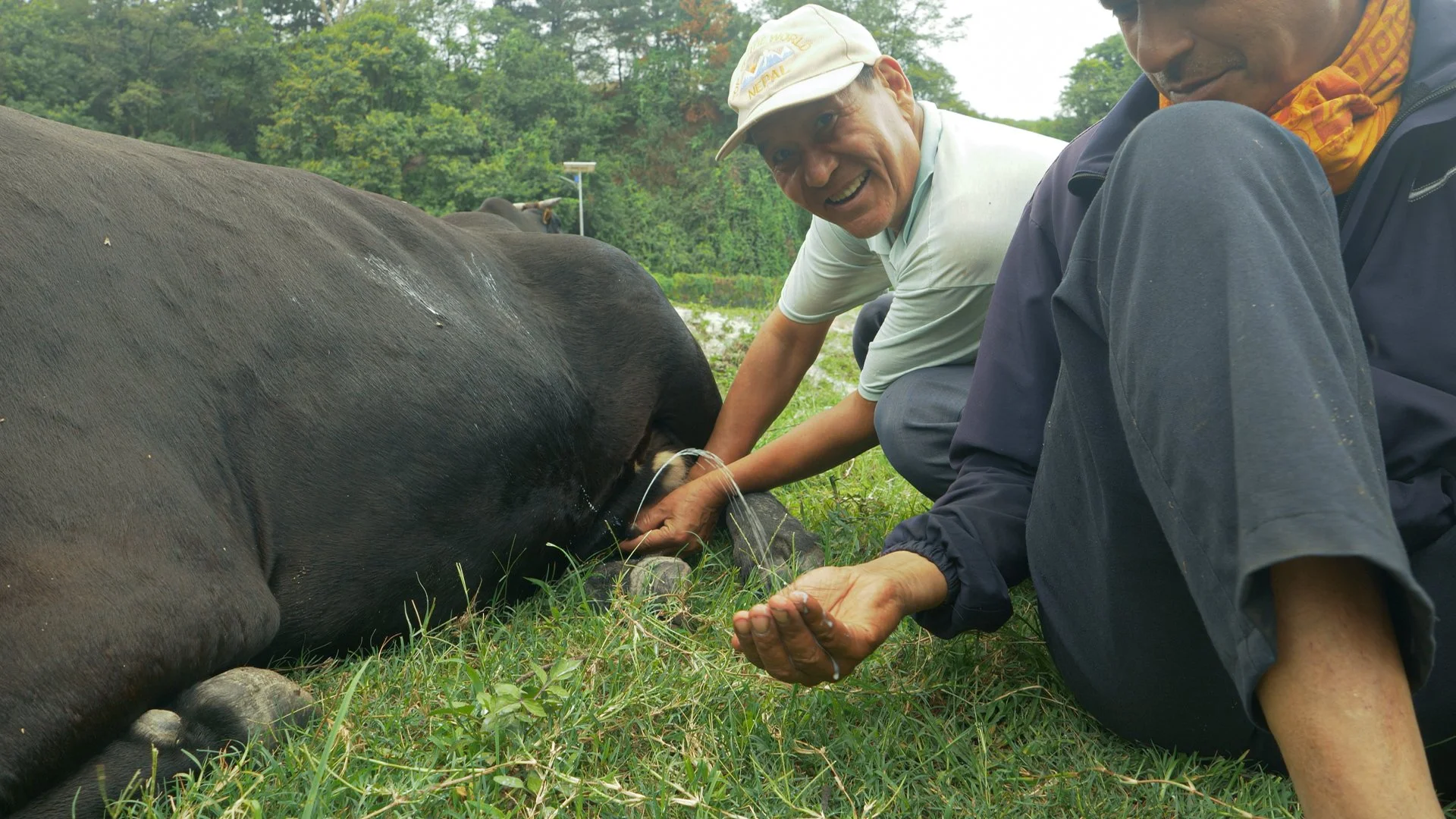
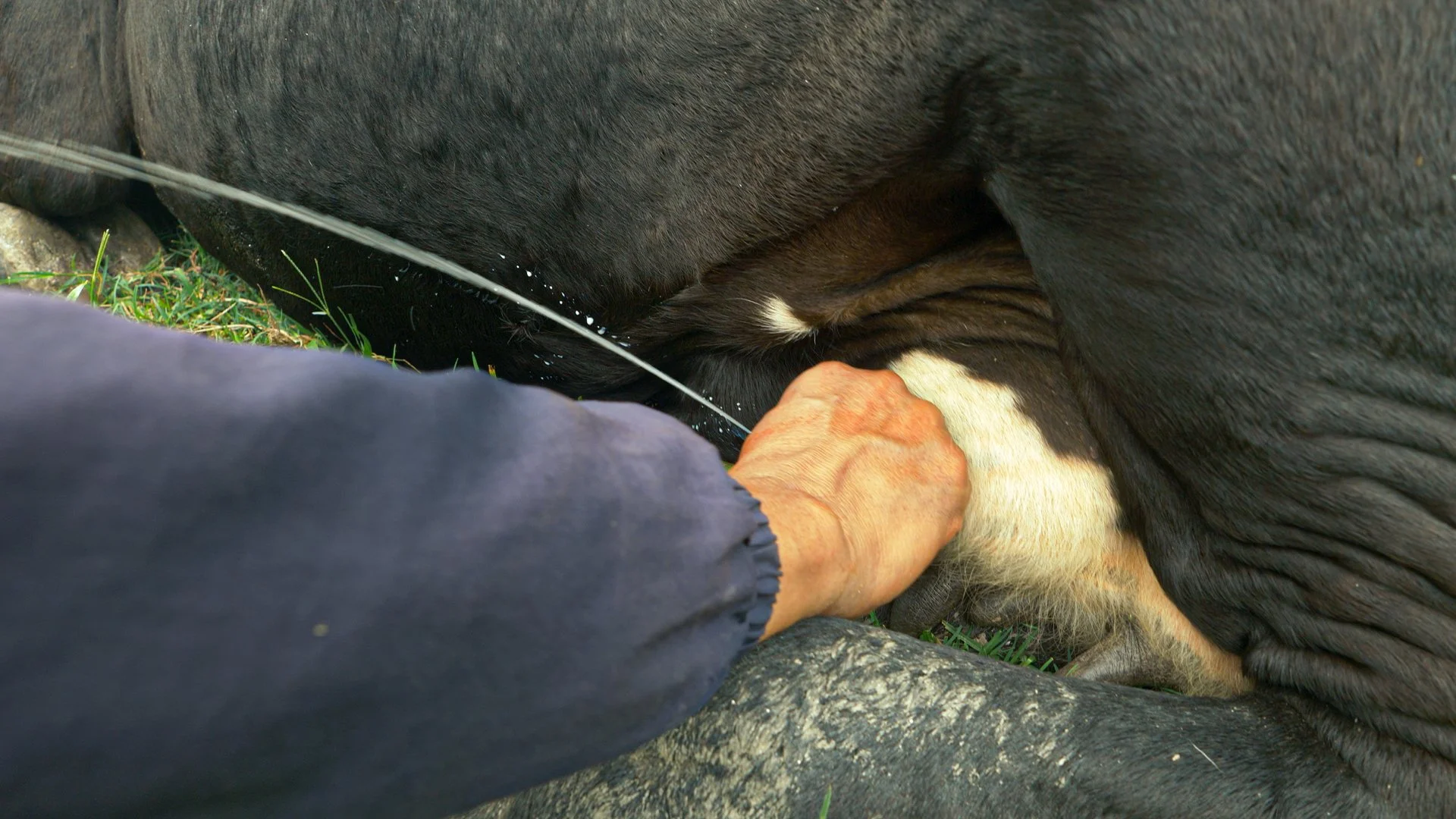
This approach revealed its limits one afternoon with Deepak. As I filmed, he began milking a cow who had recently lost her calf. The milk struck my lens and the skin behind it—hot, precisely body temperature. The warmth startled me. The men were laughing as they took it in turns to milk her. I felt suddenly exposed, unsure whether the act was practical necessity, humour, or a subtle assertion of authority within a gendered scene of labour and spectatorship. In that moment, I was triangulated between identifications: with the cow’s vulnerability, with my own as a young female researcher holding a camera among men, and with the desire to belong to the laughter rather than stand apart from it. I left feeling unsettled and uncertain what I had witnessed. Only later did I learn that milking was necessary to prevent mastitis.¹⁹ The encounter exposed how quickly affect fills gaps in knowledge. Partial understanding invites projection. Translation for the 'outsider’ anthropologist both linguistic and cultural, can arrive belatedly.
To film closely is not to claim interior access. My aim was not to access a hidden bovine consciousness—an anthropomorphic fantasy in which animals mirror human interiority—but to attend to the relational field in which we met by focusing on the encounter. This attempts to respect the different ontologies which meet in a humanized city designed with one way of being in mind. The risk in multispecies research is not only anthropomorphism but its opposite: reducing animals to instinct or symbol. My aim and challenge was to remain with the encounter without prematurely filling it with explanation. Observational cinema proved suited to these negotiations. Rather than explaining relations, it lingered with them. Grimshaw and Ravetz describe such filmmaking as remaining close to lived texture; long takes and diegetic sound allow ambiguity to persist.²⁰ The camera also becomes a key participant in the encounter. Contrary to advice that cameras should be introduced only after trust is secured,²¹ I decided to film from the outset so that it became part of the relational field. Cattle, being prey animals, are often nervous and suspicious around unfamiliar items. With this method bulls learn to trust its presence, and I learned their tolerances.
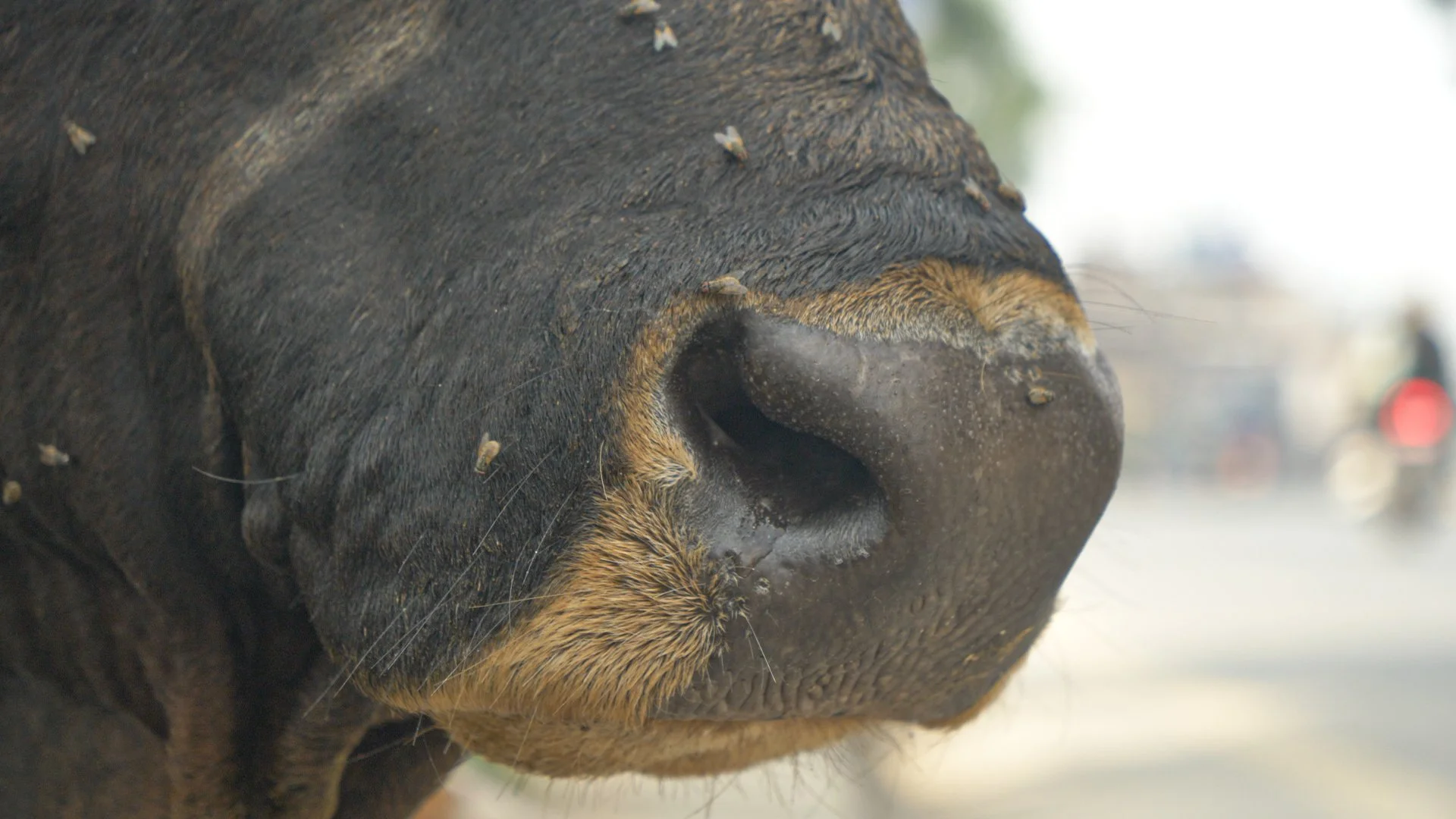
Drawing on Maisie Tomlinson’s notion of “felt-sense”,²² I approached filming as an embodied discipline—learning to register subtle shifts in atmosphere. Flies gathering on skin in rubbish heaps, the amplified rasp of breath through headphones, the tightening of muscle before movement. When I stepped too near a mother and calf, she charged. Later, during another intrusion, the herd reacted collectively; Deepak warned that if one attacked, all might follow. I decided to withdraw for some time. The ethics of distance applied in other fields must be considered in multispecies research - by developing a sensitivity to boundaries set by subjects we work with, ethics is always situational—a matter of recalibrating distance in real time.
¹ Meaning spiritual hermitages.
² With my mother, 2012.
³ Rabies in the Street by Nadal, 2020, p.157.
⁴ Constitution of Nepal, 2015; see also A case study of secularism in Nepal by Arjun, 2022.
⁵ Discussions with my host Kopila.
⁶ Imperial Eyes by Pratt, 1992, p. 4.
⁷ ibid. p. 364.
⁸ Strangers Within byHenningsen & Joffe, 2013, p. 10.
⁹ Meaning cow shelters.
¹⁰ How Forests Think by Eduardo Kohn, 2013, p.32.
¹¹ July 14th, 2024, outside the shops opposite the Slesmalak Jungle, Pashupatinath East Entrance.
¹² The Emergence of Multispecies Ethnography by Kirksey & Helmreich, 2010, p. 556.
¹³ Meaningprayer beads.
¹⁴ How Forests Think by Eduardo Kohn, 2013, p.145.
¹⁵ Lily Kelting, 2024 podcast on foraging cows in India.
¹⁶ 20th July 2024, outside cafe overlooking the Ram Ghat, Pashupatinath. Somewhere in the beginning of this section.
¹⁷ The Cultured Cow by Mathkarim 2026, p. 769.
¹⁸ Visual and Experiential Knowledge in Observational Cinema by Carta, 2015, p. 6.
¹⁹ Translating the footage with Prajwal.
²⁰ Observational Cinema Grimshaw and Ravetz, 2009, p.xiv.
²¹ Ethnographic Film and Video on Hybrid Television by Vannini, 2015, p. 400.
²² Clean Communication by M. Tomlinson, 2024, p. 166–167.
²³ Observable from the Aarya Ghat, Pashupatinath.
²⁴ with my host Kopila, Ascetics within the temple precinct and at Pashupatinath Gaushala alongside direct observation of severance after feeding.
²⁵ In Nepal typically referring to a hot, spiced milk tea simmered with ingredients like ginger, cardamom, and black tea.
SOURCES CITED
Published Sources:
Arjun, K. C. (2022). ‘A case study of secularism in Nepal.’ Voice of Teacher, 7(01), pp.9-23. doi: https://doi.org/10.3126/vot.v7i01.51017.
Carta, S. (2015). ‘Visual and Experiential Knowledge in Observational Cinema.’ Anthrovision, 3.1, pp.1-17, doi: https://doi.org/10.4000/anthrovision.1480.
Grimshaw, A. and Ravetz, A. (2009). Observational Cinema: Anthropology, Film, and the Exploration of Social Life. Bloomington, Ind: Indiana University Press.
Kelting, L. (2024) Holy terroir: Finding taste in an edge-place - by Lily Kelting, Emergence Magazine. Available at: https://emergencemagazine.org/essay/holy-terroir/ (Accessed: 10 October 2024).
Kirksey, S. E. and Helmreich, S. (2010). ‘The Emergence of Multispecies Ethnography.’ Cultural Anthropology, 25(4), pp.545–576.
Kohn, E. (2013). How Forests Think: Toward an Anthropology Beyond the Human. Berkeley: University of California Press.
Mathkari, C. (2026). ‘The Cultured Cow: Analyzing the Role of the Cow’s Acclaimed Holiness in India's Dairy Consumption Intentions.’ Animals. 16(5), 769.
Mandal, D. (2020). Rabies in the Street: Interspecies Camaraderie in Urban India. University Park, Pennsylvania: The Pennsylvanian State University Press.
Pink, S. (2021). Doing Visual Ethnography. Fourth edition. Los Angeles: SAGE.
Pratt, M. L. (1992). Imperial Eyes: Travel Writing and Transculturation. London: Routledge.
Tomlinson, M. (2024). ‘‘Clean communication’: Felt-sense methodologies and the reflexive researcher in equine-assisted personal development.’ The Sociological review (Keele), 72(1), pp.155–174.
Therese Henningsen & Juliette Joffe. (2022). Strangers Within: Documentary as Encounter. Prototype Publishing: London.
Vannini, P. (2015). ‘Ethnographic Film and Video on Hybrid Television: Learning from the Content, Style, and Distribution of Popular Ethnographic Documentaries.’ Journal of contemporary ethnography, 44(4), pp.391–416.
Direct Conversation:
July 14th, 2024, outside the shops opposite the Slesmalak Jungle, Pashupatinath East Entrance.
20th July 2024, outside cafe overlooking the Ram Ghat, Pashupatinath. Somewhere in the beginning of this section.
Translating the footage with Prajwal.
With my host Kopila, Ascetics within the temple precinct and at Pashupatinath Gaushala alongside direct observation of severance after feeding.
Common Knowledge:
Meaning spiritual hermitages.
Discussions with my host Kopila.
Meaning cow shelters.
Meaning prayer beads.
Observable from the Aarya Ghat, Pashupatinath.
In Nepal typically referring to a hot, spiced milk tea simmered with ingredients like ginger, cardamom, and black tea.