
Volatile Worlds: Image, Ecology, Extraction
NOTE!
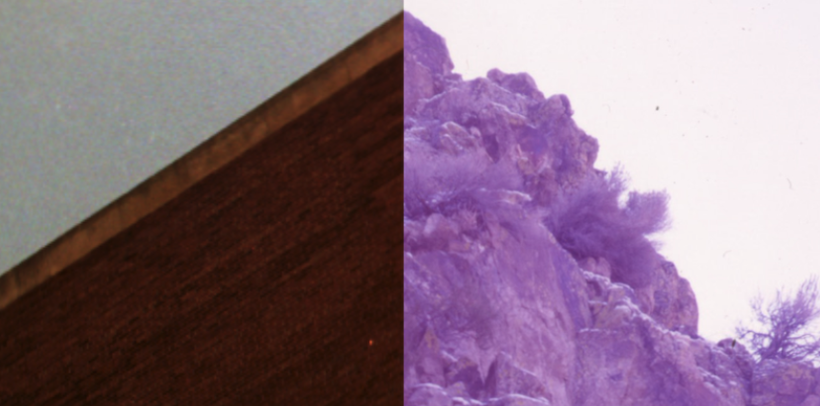
In solidarity with staff currently locked out of the Goldsmiths, KONTEKST Collective is taking over the CVA Public Programme, which will now be held off campus grounds. See below for updated venues. More updates to come!Volatile Worlds brings together artists, researchers, and practitioners whose work engages image-making as a materially embedded and environmentally entangled practice. Across film, photography, and experimental media, the programme foregrounds how images are produced through extractive infrastructures—petrochemical industries, mineral processes, agricultural transformations, and Settler-colonial land regimes. Rather than approaching images solely as visual representations, Volatile Worlds attends to their conditions of possibility: the substances, labour, and ecologies that sustain them, and the forms of violence they both register and reproduce. Here, media’s material residues point to the ethical and political challenges of studying forms of violence in the anthropocene.
The works presented explore image-making as a site of inquiry into ecological crisis and its histories, from the chemical toxicity of photographic processes to the reshaping of landscapes through mining, salinisation, and industrial agriculture. Many of the practices featured move beyond representational modes, engaging directly with materials and environments through experimental, process-based, and site-responsive methods.
Particular attention is given to how visual practices intervene in and reconfigure extractive relations—tracing their colonial genealogies, making perceptible their ongoing effects, and opening space for alternative ways of sensing and relating to damaged environments.
Bringing together perspectives from anthropology, environmental humanities, and artistic research, the programme creates a space for sustained engagement with image-making as both implicated in and responsive to the volatile worlds it inhabits.
The Centre of Visual Anthropology (CVA) is a Goldsmiths research and teaching platform that showcases our commitment to innovation and experimentation in visual and multimodal anthropology. At its core, the CVA supports the work of students, staff, alumni, and our growing network of researcher-practitioners who are contributing meaningfully to ethnographic theory and form beyond text. Working in collaboration with universities, cultural institutions, archives, and practitioners, CVA runs public programmes that showcase cutting-edge work that expands the reach and remit of anthropology.
This public programme Volatile Worlds: Image, Ecology, Extraction is co-sponsored by the Centre for Philosophy and Critical Theory and KONTEKST Collective, and acts as a pre-festival event series to our 2026 Film Festival Entanglements thataddresses similar themes.
Curated by Alice Cazenave & Lee Douglas. Delivered by members of KONTEKST.
Ecology & Image: Tracing Chemical & Colonial Histories
June 2, 2026; 5-7pm; Helm Studios, 3 Borwick St, Deptford SE8 3GH
With: Sustainable Darkroom’s Edd Carr and Hannah Fletcher and musical accompaniment by Jack Donnison
Discussant & Moderator: Dr Alice Cazenave
Captain James Cook was a British Royal Navy officer from North Yorkshire, with voyages stretching across New Zealand, Australia, Hawaii, and more. Following his death at the hands of Indigenous Hawaiians, his colonial legacy lives on in the exploitative and violent structures of today’s Pacific societies.
But this structure of land seizure did not arise from thin air: it was first developed with the legal and rhetorical framework of seizing common lands in England through the Enclosure Acts, including Captain Cook’s home of North Yorkshire - a privatisation which still lingers today.
As an artist from the same village where Cook worked, Edd Carr will discuss the development of a new moving image work on this subject. Through a practice of animating with oak materials foraged where Cook once lived, Edd will discuss how his work attempts to connect this legacy to the living landscape.
//
Hannah Fletcher will discuss her current research and work, Photo.Petro.Chemical.Capital, a project looking into the links between photography, the petroleum industry and capitalism.
The chemicals relied upon for both colour and black and white analogue photographs’ production and development are derived from fossil fuels - tracing these chemistries back always leads to petrochemical industry. For decades, we have known that these chemistries are toxic to life as carcinogens and through noxious fumes dispersal, causing ecosystem detriment. We continue to see their effects today.
Through this talk, Hannah considers how in the early 20th century, capitalism drove photography toward the use of petroleum-based chemicals. Following this, photography was intrinsic to capitalism’s global expansion as a world system - across marketing, media, and warfare.
Salt: A Crystal Image of Time — Spectral Attunement in Hypersaline Land-scape-times
June 3, 2026; 5-7pm; Helm Studios, 3 Borwick St, Deptford SE8 3GH
With: Dr. Sam Nightingale (RCA & Ruhr-Universität Bochum)
Discussant: Dr. James Burton
Moderator: Dr. Lee Douglas
Reserve your spot
Salt is often treated as residue or resource, but in hypersaline environments it also acts as a medium: it records, transports, and refracts entangled histories across soil, water, air, and infrastructure. This talk draws on my art-based research practice to introduce ‘spectral materialism’—a conceptual and critical-creative approach for attuning to coexisting, non-linear temporalities in environments shaped by settler‑colonial ecological violence and extractivist regimes. Focusing on the semi-arid Mallee in south-eastern Australia, I approach the region as a land–time–scape: a site where deep geological inheritances, settler‑colonial terraforming, and contemporary industrial agriculture converge and persist. This convergence becomes perceptible in the ecological, social, and economic challenges the region faces as salt accumulates in soils and across lake and river systems.
Through art-based fieldworking, I show how salt acts as both an elemental and a technical medium, shaping the image-making practices that emerge in response to hypersalinity. I will present three experimental practices: photographic salt prints made with site salt; soil chromatography that registers metabolic stress in saline soils; and camera-less “para-photo-mancy,” in which halophytes develop silver‑halide film and are stabilised in saline brine. Together, these works shift from representation toward situated encounters and process-oriented modes of working, offering innovative image-making practices as chemical encounters with extractive infrastructures and their afterlives.
Reflection by Dr. Sam Nightingale
Uncultivated lands, peoples, images: Extractive violence and moving image practices
June 11, 2026; 5-7pm; Location TBD
With: Dr. Salomé Lopes Coelho (Utrecht)
Discussant & Moderator: Lee Douglas
Baldio, a term said of land that has not been cultivated or used and is figuratively read as worthless or vain, names common lands and waters that have been managed and cared for collectively at least since the Middle Ages. In Covas do Barroso, northern Portugal, the baldios are governed through local assemblies and sustained by shared practices of animal grazing, forestry, and wood gathering. A prospective open-pit lithium mining project in the region, framed as strategic to European energy-transition agendas, would be situated largely on these lands. Local resistance, active since 2017, is discursively framed as an impediment to a “green future,” rendering the inhabitants themselves as backward and uncultivated. “Green extractivism” enacts a seizure logic that recodes communal ecologies and livelihoods as underused resources awaiting productive activation; uncultivated lands and uncultivated peoples are thus co-constituted as obstacles to be overcome. This logic reactivates longer genealogies of internal colonisation under the Estado Novo, imperial expansionist desires, and ecological violence. Taking baldios as a figure, I explore how moving image practices, from collaborative documentaries to video installation and investigative films, render extractivism as ecological violence and intersect with longer histories of dispossession and harm. I moreover introduce what I tentatively call imagens baldias, or baldio images: a mode of image-making embedded in fieldwork practices that produces visual traces as part of the research process without orienting them toward an expected and cultivated use – circulation and exhibition. Through the framework of ecologies of violence, I ask how moving images intervene in the violence they address, articulating possible post-extractivist world configurations.
Reflection by Dr. Salomé Lopes Coelho
The Causal River: Submerged Audio-Visual Practice for Devastated Ecologies
June 23, 2026; 5-7pm; Location TBD
With: Dr Ifor Duncan (EcoViolence, Utrecht)
Discussant: Professor Susan Schuppli
Moderator: Dr Lee Douglas
Drawing on an audio-visual research practice relating to cases of ecological violence including river borders, mega dams, and as infrastructures of genocide, “The Causal River” examines how the contestation of a river’s physical characteristics reveal it as simultaneously a technology of erasure and a processual archive of political violence. Problematising linear models of causality, Forensic Architecture use “field causality” as a relational and spatial concept that enables the investigation of violence through “arrangement[s] of simultaneous sites, actions, and causes”. In response to my questions regarding how a river acts as a site of evidence, underwater forensic experts in Colombia described rivers as unique spaces to sense the trans-temporal traces of human and multi-species violence. Sedimentary materials originating from multiple locations coalesce in sediment at certain points in a river’s course where water slows and eddies. In this presentation I ask what happens when we submerge the causal field? Thinking through the material processes of rivers, I read against their linear spatio-temporal conception to understand relations of causality as thickening and attenuated through material, social, cultural, and political interlappings.
Reflection by Dr Ifor Duncan